August 20th, 2026 | 07:15 CEST
From AI Data to Autonomous Launch Vehicles! SpaceX, Deutsche Telekom, Aspermont and Vodafone on the Rise
The convergence of artificial intelligence and massive data streams is rapidly revolutionizing global infrastructure, from the Earth's surface to orbit. At the forefront of this technological evolution is the space company SpaceX, which, with its "Direct to Cell" service through its telco division Starlink, is redefining global connectivity by linking ordinary smartphones directly to satellite networks. A crucial cog in the global mobile communications backbone in space is Deutsche Telekom, which bridges the gap between terrestrial networks and space through AI-powered network infrastructures and strong partnerships. The British telecommunications giant Vodafone is also demonstrating how it maximizes the efficiency of global data connections by intelligently analyzing massive amounts of data using big data analytics. The commodities-focused B2B platform Aspermont is also benefiting from this digital disruption in the network sector, operating at the intersection of mining and artificial intelligence. The media company monetizes its decades-old data sets in the mining and energy sectors through customized solutions. For investors, this represents a highly lucrative and innovative investment opportunity.
time to read: 5 minutes | Author: André Will-Laudien
ISIN: ASPERMONT LTD. | AU000000ASP3 | ASX: ASP , DEUTSCHE TELEKOM ADR 1 | US2515661054 , SPACE EXPLORATION TECHNOLOGIES CORP | US84615Q1031 | NASDAQ: SPCX , VODAFONE GROUP PLC | GB00BH4HKS39
Table of contents:
Author

André Will-Laudien
Born in Munich, he first studied economics and graduated in business administration at the Ludwig-Maximilians-University in 1995. As he was involved with the stock market at a very early stage, he now has more than 30 years of experience in the capital markets.
Tag cloud
Shares cloud
SpaceX: Elon Musk Enters the Telco Domain
After a series of sharp ups and downs, SpaceX's share price has returned to a level close to its initial public offering price of USD 135. Elon Musk can be satisfied with an initial valuation of USD 1.8 trillion, but his ego already compels him to announce his intention to reach the top of the NASDAQ by 2030. His approach in the telecom sector is equally aggressive. Through his subsidiary Starlink, he is elegantly bypassing traditional network operators with groundbreaking "Direct to Cell" technology by connecting unmodified smartphones directly to the orbital satellite network without expensive additional hardware. The latest figures for the second quarter of 2026 impressively underscore this aggressive expansion. The group's total revenue skyrocketed by 92% to USD 7.8 billion, with Starlink already contributing well over half of the revenue. But for the tech billionaire, the mobile revolution is merely a springboard, as he sees the true massive potential in orbital AI computing and gigantic data centers in space. Although the enormous surge in capital expenditures to USD 18.4 billion initially startled the markets, investors are now hoping for more—and for a new Tesla. Analysts at Raymond James have consequently backed the stock with a "Strong Buy" rating; on average, experts on the LSEG platform expect a 12-month price target of just under USD 235. The stock stood at USD 225 shortly after the announcement—yesterday it was back down to USD 141; what a roller-coaster ride!
Deutsche Telekom and Vodafone: Can the Local Giants Counter Starlink?
The orbital head-on assault by Elon Musk's space company is forcing the established European telecommunications giants to radically and agilely realign their market strategies. Instead of getting drawn into a futile price war on the ground, however, the seemingly old-fashioned local players are taking the smart route of technological cooperation and specialized AI upgrades. Deutsche Telekom recently demonstrated operational strength and is countering the spectre of Starlink simply through a strategic alliance that will close coverage gaps via the Starlink network starting in 2028. This evolution is bolstered by the booming US business of its subsidiary, T-Mobile US, as well as an upward revision to the annual forecast, which is expected to catapult adjusted EBITDA for the fiscal year to an impressive EUR 47.5 billion.
British competitor Vodafone is charting its own agile course in the space race and is relying on the competing AST SpaceMobile system for its direct satellite connections. Thanks to these promising hybrid infrastructures, traditional mobile operators need not shy away from technological change, especially since they continue to control an irreplaceable family ecosystem with lucrative all-in-one packages combining internet, TV, and landline services. In addition, artificial intelligence serves as a major performance lever for both companies. While Vodafone uses AI to optimize its network efficiency and energy balance, Telekom is investing heavily in European AI startups, igniting the next stage of growth. Investors seeking reliable dividends combined with defensive protection will find a first-class risk-reward ratio in this high-dividend duopoly.
Aspermont: 190 Years of Mining Expertise Turns into an AI Money Machine
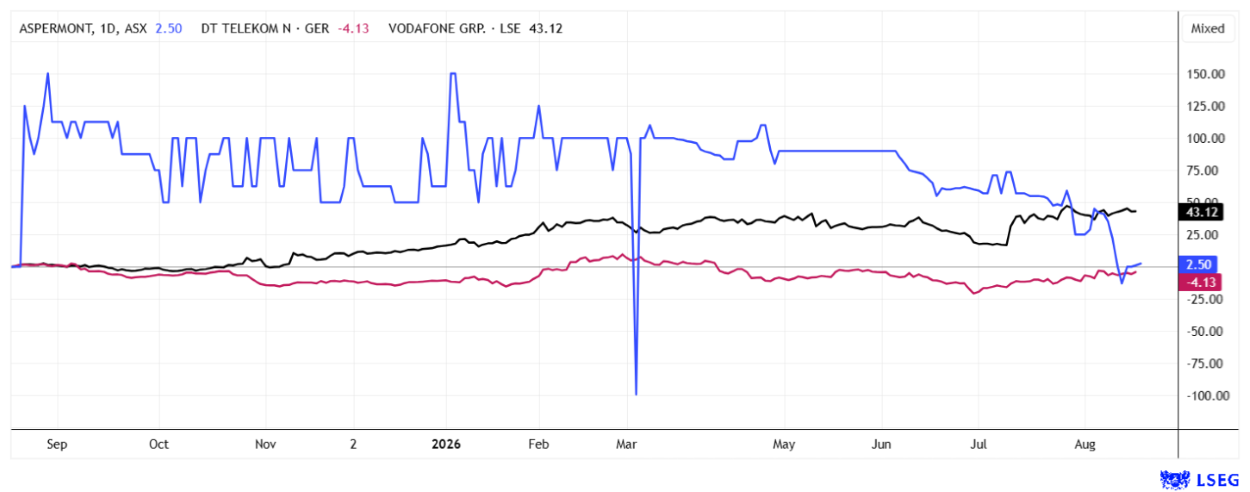
Away from telecoms and toward Big Data models, because data has long since become a strategic resource for the modern mining industry. This brings us to Australian company Aspermont. Its business model is based on an information and data base built up over decades, which has transformed the historic specialist publisher into a specialized B2B company. Today, this encompasses news, analyses, proprietary data, and, increasingly, AI-powered intelligence solutions for mining companies, investors, financiers, governments, and suppliers. The business model combines recurring subscriptions with data licensing, events, and marketing services, thereby offering comparatively high scalability with low capital intensity. In recent years, Aspermont has made great strides and repositioned itself for growth.
IIF moderator Lyndsay Malchuk interviewed the company's Managing Director, Alex Kent, about the company's future prospects.
The German research firm GBC now views this transformation as largely complete and highlights improved revenue quality, greater visibility, and increased pricing power for the subscription-driven platform. Aspermont's foundation is remarkably robust today. It serves more than 4,000 corporate customers across more than 150 countries and has increased its annual recurring revenue (ARR) to more than AUD 11 million. In Q3 2025/26, revenue rose to a new record of AUD 4.50 million, up 25% from the prior-year period, while normalized EBITDA reached the break-even point for the first time after a loss of AUD 0.60 million in the same quarter of the prior year. Of particular interest is the broader revenue base: in addition to subscription and data licensing revenues, which rose by 4% to AUD 2.60 million, advertising, Nexus, and events saw a substantial increase of 73% to AUD 1.90 million. After 9 months, total revenue thus amounts to an impressive AUD 11.90 million.
However, the key driver for the next phase is Mining IQ, as the approximately AUD 550,000 contract from Rio Tinto, according to GBC, provides an important proof of concept for monetizing its proprietary archives and could be converted into recurring enterprise revenue following the initial project phase. At the same time, GBC sees further potential in combining historical archives with daily data—including its own, as well as data from partners and third-party providers—which could turn individual data projects into significantly larger and recurring customer relationships. The actual investment case is driven less by a short-term jump in earnings than by the platform's expected operational leverage.
GBC projects an EBITDA margin of 13.7% starting in 2027/28, with a long-term target of 20%, while free cash flow is expected to rise from an initial negative AUD 1.95 million in fiscal year 2025/26 to AUD 1.45 million in 2027/28. It is also noteworthy that, despite having a cash balance of only AUD 0.90 million, Aspermont enjoys additional financial flexibility through its stake in Tāiko, which comprises approximately 15 million shares, or about 5% of the company. GBC therefore reaffirms its "Buy" recommendation and sets a price target of AUD 5.20—a fivefold increase, if the Augsburg-based analysts' calculations are correct.
Efficient language models are needed to feed autonomous industrial applications with essential market and geodata. Without these precise, data-driven insights from commodity markets and global supply chains, the construction and operation of highly complex facilities would be unthinkable today. While the mobile communications giants secure the physical data transmission routes across the globe and in orbit, Aspermont's B2B platform provides the digital fuel for business-critical decisions. A healthy mix of all these elements could also help the share take off.
Conflict of interest
Pursuant to §85 of the German Securities Trading Act (WpHG), we point out that Apaton Finance GmbH as well as partners, authors or employees of Apaton Finance GmbH (hereinafter referred to as "Relevant Persons") currently hold or hold shares or other financial instruments of the aforementioned companies and speculate on their price developments. In this respect, they intend to sell or acquire shares or other financial instruments of the companies (hereinafter each referred to as a "Transaction"). Transactions may thereby influence the respective price of the shares or other financial instruments of the Company.
In this respect, there is a concrete conflict of interest in the reporting on the companies.
In addition, Apaton Finance GmbH is active in the context of the preparation and publication of the reporting in paid contractual relationships.
For this reason, there is also a concrete conflict of interest.
The above information on existing conflicts of interest applies to all types and forms of publication used by Apaton Finance GmbH for publications on companies.
Risk notice
Apaton Finance GmbH offers editors, agencies and companies the opportunity to publish commentaries, interviews, summaries, news and the like on news.financial. These contents are exclusively for the information of the readers and do not represent any call to action or recommendations, neither explicitly nor implicitly they are to be understood as an assurance of possible price developments. The contents do not replace individual expert investment advice and do not constitute an offer to sell the discussed share(s) or other financial instruments, nor an invitation to buy or sell such.
The content is expressly not a financial analysis, but a journalistic or advertising text. Readers or users who make investment decisions or carry out transactions on the basis of the information provided here do so entirely at their own risk. No contractual relationship is established between Apaton Finance GmbH and its readers or the users of its offers, as our information only refers to the company and not to the investment decision of the reader or user.
The acquisition of financial instruments involves high risks, which can lead to the total loss of the invested capital. The information published by Apaton Finance GmbH and its authors is based on careful research. Nevertheless, no liability is assumed for financial losses or a content-related guarantee for the topicality, correctness, appropriateness and completeness of the content provided here. Please also note our Terms of use.