February 24th, 2026 | 08:05 CET
Frequentis, Parrot, and Volatus Aerospace under the microscope: A hidden gem from Canada is reshuffling the deck
Drones have long been more than just a technological trend - they have become a geopolitical factor, and the stock market is reacting accordingly. While Austrian security specialist Frequentis, valued at billions, is already firmly in the sights of institutional investors, French micro-drone pioneer Parrot and Canadian full-service provider Volatus Aerospace are engaged in an exciting race for investor favor. Volatus, previously little known in Germany, has transformed itself from a restructuring case to a growth star in a remarkably short time with government backing, a promising NATO contract, and inclusion in the prestigious "TSX Venture 50" list. Parrot has apparently reached the break-even point, but is leaving investors in the dark until the end of March. Those who make the right choice now could benefit from one of the most exciting investment themes of the decade – but the differences between the three candidates are greater than they appear at first glance.
time to read: 6 minutes | Author: Mario Hose
ISIN: FREQUENTIS AG | ATFREQUENT09 , PARROT S.A. INH. EO-_1524 | FR0004038263 , VOLATUS AEROSPACE INC | CA92865M1023
Table of contents:
Author

Mario Hose
Born and raised in Hannover, Lower Saxony follows social and economic developments around the globe. As a passionate entrepreneur and columnist he explains and compares the most diverse business models as well as markets for interested stock traders.
Tag cloud
Shares cloud
Politics: The controversial term "drone"
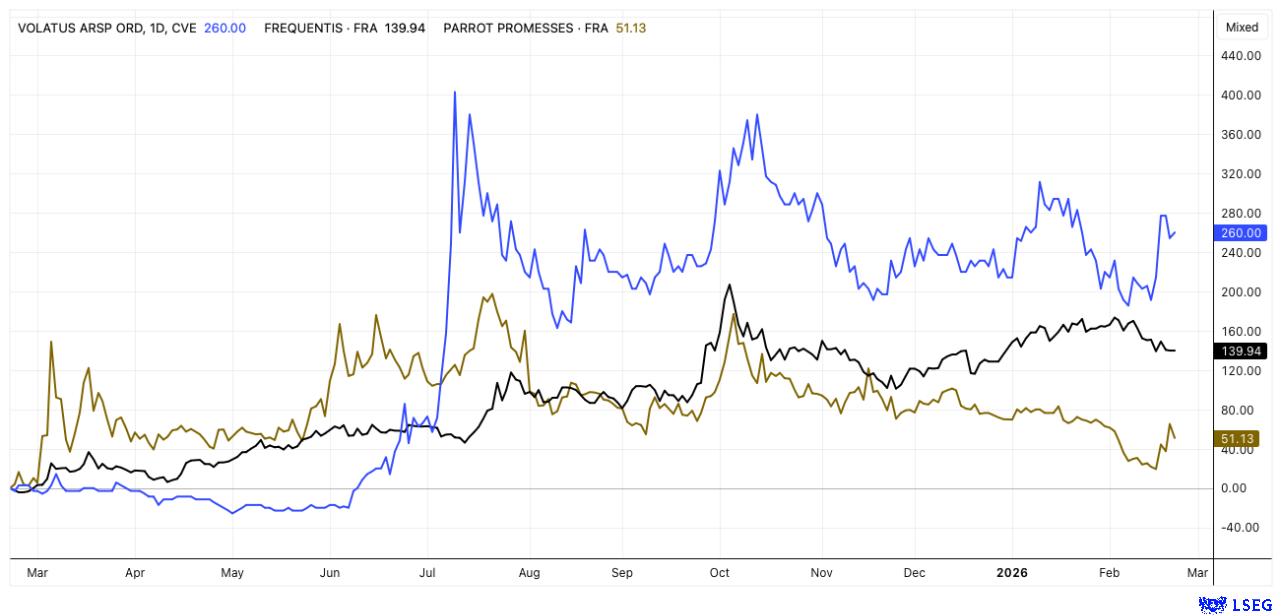
"Drone" has long been a controversial term in politics, not only because of the massive use of unmanned aerial vehicles in the Ukraine conflict, but also because of numerous incidents at German airports and infrastructure facilities, some of which are attributed to Russian intelligence services. For stock market traders, on the other hand, the word has a magical appeal. For Frequentis shares, for example, there was no stopping them in the fall when a series of threatening drone sightings in Western Europe caused uncertainty. Within just three days, the share price rose from EUR 55 to EUR 100.
The Austrian provider of security and communications solutions announced a series of groundbreaking contracts last year, including the development of a drone-based reconnaissance system for the European Defense Agency (EDA). Stefan Martin, who is responsible for investor relations at Frequentis, was one of the most sought-after discussion partners at the ODDO BHF Small & Mid Cap Conference in Frankfurt at the end of January. Even though the euphoria has since subsided, the revaluation has been a fact ever since.
French drone manufacturer Parrot experienced its first surge in popularity a good ten years ago. The subsequent crash of the share price to EUR 2.00 was followed by a sixfold increase in the price between the fourth quarter of 2024 and mid-2025. But here, too, the fantasy has partly evaporated again. In 2025, revenues rose by only 2% to EUR 79.8 million, partly due to negative exchange rate effects. The company apparently reached break-even by the skin of its teeth, but management has yet to provide more detailed information.
New challenger in the drone sky
It is becoming increasingly clear that a small-cap company from Canada, still largely unknown in Germany, is overtaking the former investor favorite Parrot: Volatus Aerospace, a full-service provider for manned and unmanned aviation. Since it is even more difficult for companies in the lower stock market segments in Canada than it is here in Germany to raise money for ambitious growth plans, the company was facing a serious financing problem just one year ago. Since this was resolved in mid-2025 with the help of, among others, the Canadian government investment company Investissement Québec, the company has not only seen a sharp upturn in its operations, but also on the stock market. The share price has climbed from CAD 0.13 in June to CAD 0.62 most recently. In Germany, the share is trading at around EUR 0.40 in Stuttgart, but is reasonably liquid on the private investor exchanges Tradegate and Gettex in particular. This is a clear indication that institutional investors in this country have not yet taken the stock into account. That could soon change, because tomorrow, Wednesday, February 25, CEO Glen Lynch will present the company live at 12:30 p.m. at the 18th International Investment Forum (IIF) -

The IIF is a highly regarded virtual investor conference organized by Apaton Finance and GBC Research.
There is no doubt that CEO Lynch will have good news to share at the IIF. Thanks to its strong share price performance, Volatus was recently added to the Canadian stock exchange's prestigious "TSX Venture 50" list for 2026. Financing problems and a lack of interest from institutional investors are likely to be a thing of the past in Canada, especially since the company is now classified as a systemically important player in the field of critical infrastructure and defense. In line with this, Lynch already announced details yesterday, Monday, at a virtual investor briefing on the opportunities to benefit from Canada's defense strategy. Volatus sees itself as well-positioned in terms of the independent development and operation of remote-controlled aircraft systems with a decentralized command structure. Its national presence in the provinces of Québec, Ontario, and Alberta and its geographical proximity to the Arctic Circle could prove to be trump cards. Canada is also increasing its defense spending and giving priority to domestic companies when awarding contracts.
Wide range of products and services
It is no surprise that Volatus' business model is increasingly shifting toward military applications. In December, the company announced a CAD 9 million defense contract from a NATO member state, followed by another training contract in early February. Volatus benefits from covering the entire value chain: from engineering to equipment sales and maintenance to training programs for drone pilots. In addition to military applications, the focus is on public safety and agriculture, but also on the monitoring of critical infrastructure, such as power lines and gas pipelines. Freight transport by drone, especially in areas that are difficult to access, is also part of the service portfolio, as are data evaluation and AI-supported analyses.
Measured against this, sales are still relatively modest. They amounted to around CAD 27 million (just under EUR 17 million) in 2024. But revenues are rising rapidly – one reason for its inclusion in the "TSX Venture 50" list of the fastest-growing and best-performing Canadian small caps. In 2025, Volatus had already almost reached the previous year's revenue of CAD 26.9 million after just nine months, and according to analyst estimates, at least another CAD 8 million is likely to have been added in the last quarter. Analysts may even be underestimating the figures, as revenue rose by more than 60% to CAD 10.6 million in the third quarter alone. Positive surprises are therefore not unlikely.
Analysts are becoming more optimistic
The nine-month result was slightly negative at CAD -0.01 per share, and according to earlier forecasts by experts, this was not expected to change until 2028. However, more recent estimates now predict earnings of CAD 0.04 per share. With the tailwind of increasing military orders, Volatus could potentially reach the break-even point in the near future, similar to its competitor Parrot. The US investment bank Maxim Group recently issued a price target of CAD 1.25 (approximately EUR 0.78). This would correspond to an upside potential of almost 100%.
In a direct comparison with Parrot, Volatus has the advantage of stronger share momentum and the fact that it also offers heavy aircraft for civil and military purposes, while the French company has so far focused on micro drones (especially compact quadcopters). Before investing in Parrot, investors should wait for the outlook from CEO and majority shareholder Henri Seydoux, which is expected to be presented on March 27, along with the detailed 2025 annual report. Volatus, on the other hand, could benefit from the upcoming news flow in the short term.
Strong preliminary figures
Investors will have to wait until April 9 for Frequentis. That is when CEO Norbert Haslacher plans to present the detailed figures for 2025. There are unlikely to be any big surprises, as the preliminary results for 2025 have already been known for almost two weeks. Revenue climbed by around 20% to approximately EUR 580 million, while operating profit (EBIT) rose disproportionately from EUR 32.1 million to around EUR 47 million.
Since significantly more analysts are focusing on the Vienna-based company than on the much smaller drone specialists from France and Canada, Frequentis has already achieved a market capitalization of around EUR 1 billion, while the two small caps only account for around a quarter of this value on the stock market. Furthermore, the Austrians are not purely a drone player, but primarily a software manufacturer: their business model focuses on communication and information solutions for control centers for air traffic control, police, fire departments, rescue services, shipping, and railways.
The broader diversification of the business model and the significantly higher sales level – analysts expect revenues of more than EUR 600 million for 2026 due to the strong order intake – suggest lower price fluctuations, but also more moderate growth and correspondingly lower upside potential.
Conflict of interest
Pursuant to §85 of the German Securities Trading Act (WpHG), we point out that Apaton Finance GmbH as well as partners, authors or employees of Apaton Finance GmbH (hereinafter referred to as "Relevant Persons") currently hold or hold shares or other financial instruments of the aforementioned companies and speculate on their price developments. In this respect, they intend to sell or acquire shares or other financial instruments of the companies (hereinafter each referred to as a "Transaction"). Transactions may thereby influence the respective price of the shares or other financial instruments of the Company.
In this respect, there is a concrete conflict of interest in the reporting on the companies.
In addition, Apaton Finance GmbH is active in the context of the preparation and publication of the reporting in paid contractual relationships.
For this reason, there is also a concrete conflict of interest.
The above information on existing conflicts of interest applies to all types and forms of publication used by Apaton Finance GmbH for publications on companies.
Risk notice
Apaton Finance GmbH offers editors, agencies and companies the opportunity to publish commentaries, interviews, summaries, news and the like on news.financial. These contents are exclusively for the information of the readers and do not represent any call to action or recommendations, neither explicitly nor implicitly they are to be understood as an assurance of possible price developments. The contents do not replace individual expert investment advice and do not constitute an offer to sell the discussed share(s) or other financial instruments, nor an invitation to buy or sell such.
The content is expressly not a financial analysis, but a journalistic or advertising text. Readers or users who make investment decisions or carry out transactions on the basis of the information provided here do so entirely at their own risk. No contractual relationship is established between Apaton Finance GmbH and its readers or the users of its offers, as our information only refers to the company and not to the investment decision of the reader or user.
The acquisition of financial instruments involves high risks, which can lead to the total loss of the invested capital. The information published by Apaton Finance GmbH and its authors is based on careful research. Nevertheless, no liability is assumed for financial losses or a content-related guarantee for the topicality, correctness, appropriateness and completeness of the content provided here. Please also note our Terms of use.