January 14th, 2026 | 07:35 CET
Fraunhofer Sounds the Alarm! Will Batteries Soon Be Scarce from China? NEO Battery Materials Offers an Alternative – Launching in 2026!
Fraunhofer is sounding the alarm with unusual clarity. Europe's largest research and innovation organization warns that China's new trade policy measures on battery technology pose a strategic risk. In extreme cases, an export ban could become a reality "in a very short time." What is particularly explosive is that Beijing is not only targeting batteries and preliminary products, but also the machines without which no cell factory can start up. This could not only slow down German car manufacturers' race to catch up in electromobility but also create bottlenecks in drones, robotics, and other emerging technologies. Battery suppliers from "Western" production, such as NEO Battery Materials, could benefit from this development. The Company's revolutionary technology is market-ready, with mass production set to begin in South Korea. NEO shares currently appear undervalued.
time to read: 4 minutes | Author: Fabian Lorenz
ISIN: NEO BATTERY MATERIALS LTD | CA62908A1003
Table of contents:
Author

Fabian Lorenz
For more than twenty years, the Cologne native has been intensively involved with the stock market, both professionally and privately. He is particularly passionate about national and international small and micro caps.
Tag cloud
Shares cloud
China versus Europe? Fraunhofer sounds the alarm
When the usually level-headed researchers at Fraunhofer sound the alarm, it is not scaremongering, but a strategic problem. This is precisely what happened with battery technology at the end of 2025. "We are observing China's latest trade policy developments, which also affect lithium-ion battery cells and their production chain, with great concern. It must be assumed that if the regulations are further tightened, a complete export ban could be imposed in a very short time. To secure Europe's technological sovereignty, it is essential to establish a complete supply and value chain in Europe," says Prof. Dr. Simon Lux, director of the Fraunhofer FFB.
China is now flexing its trade policy muscles not only in the area of rare earths and other critical raw materials, but increasingly in battery technology as well. New export rules have been in force since November 8, 2025. And these are tough. They cover not only certain high-performance lithium-ion batteries and key precursors such as cathode precursors and graphite anode materials, but also the machines without which no cell factory can start up. What Beijing justifies as "national security" appears, from a European perspective, to be a lever that can slow down or increase the cost of building up its own capacities at any time – and quickly. The West's dependence on China for batteries has been known for years, but now it is taking on a new dimension. It is no longer just a question of supply volumes, but of access to technology and production equipment. The message is unmistakable: anyone who wants to industrialize the energy transition and e-mobility must control the supply chain - or remain vulnerable to coercion.
Battery industry set for growth spurt in 2026
Unlike the US under President Trump, China is proceeding in a planned manner with its chess moves. This is likely to be the case with the latest export rules as well. The battery market appears to be on the verge of a growth spurt in 2026. Batteries have long been more than just the "fuel tank" of electric mobility – they are a key technology for the electrification of the entire economy. They make energy mobile, storable, and accessible in milliseconds. From grid storage and stationary storage in industry and buildings to robotics, autonomous systems, and drones. Without powerful cell chemistry and scalable manufacturing, none of these would be marketable. This is precisely why the market could receive an additional boost in 2026. The industry has long since ceased to be dependent on demand for electric vehicles. Analysts expect that installed storage capacity could exceed the 100 GW per year mark for the first time in 2026. And the next surge in demand will come not only "from the road," but also from automation. Robots and autonomous technologies continue their triumphant advance and require powerful batteries. This is precisely what NEO Battery Materials delivers with its production in South Korea.
Revolutionary technology in mass production from 2026
NEO Battery Materials offers manufacturers of drones, robots, and electric vehicles exactly what they need: customizable high-performance batteries produced in the West. The technology is based on silicon anodes developed and patented in-house, giving NEO batteries up to ten times the capacity of graphite anodes. The technology company also considers itself to be over 40% more powerful than its direct competitors. At the same time, the batteries can be charged faster and are also up to 60% cheaper.
All this is not just a pipe dream, but should already be reflected in strong sales growth this year. Instead of a costly new building, the Company has acquired an already operational factory with a production capacity in the megawatt range. Based on existing orders and promising prospects, production capacity is expected to roughly double in the coming months through longer shift times and additional automation.
Drones, robots, and defense should drive revenue
Last year, NEO Battery Materials already attracted attention with strong partners and its first paying customers. This includes a million-dollar order from an Asian drone maker for cargo drones. NEO will supply lithium-silicon cells and packs to a South Korean provider of industrial robotics solutions as part of a development agreement. Among other things, the partner manufactures logistics and production applications as well as humanoid robotics. A manufacturer of performance-intensive batteries - including for drones, UAS, and defense mobile systems - plans to buy 50 tons of NEO silicon anode material over four years. Initial references have also been gained in the automotive sector: in mid-December, a North American Fortune 500 automotive manufacturer placed an order for a pilot project, shortly after a South Korean Fortune 500 supplier.
Shortly before Christmas, a strategically important step was taken. NEO entered into a cooperation agreement with the Korea Institute for Defense Industry (KOIDI), an organization authorized by the South Korean Ministry of Defense to strengthen the national defense sector. This moves NEO into the country's defense industry ecosystem – an environment comprising the military, industry, research, and government agencies. This formal connection is a decisive door opener, especially for smaller suppliers, because access to the defense market often fails due to approvals and certifications. To kick things off, NEO and KOIDI plan to set up a joint task force to technically evaluate the use of silicon-reinforced batteries in defense drones and unmanned systems and to promote their integration into UAS applications.
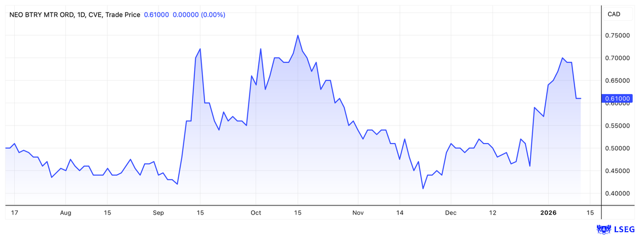
NEO shares struggled surprisingly for a long time last year. Around the turn of the year, however, there was a small breakthrough and a jump from EUR 0.28 to EUR 0.43. The stock is currently consolidating at EUR 0.35. Given its potential and market capitalization of around EUR 50 million, the Company appears to be anything but expensive. The expected positive news flow should give the stock further momentum and argues in favor of a Buy.
Conflict of interest
Pursuant to §85 of the German Securities Trading Act (WpHG), we point out that Apaton Finance GmbH as well as partners, authors or employees of Apaton Finance GmbH (hereinafter referred to as "Relevant Persons") may hold shares or other financial instruments of the aforementioned companies in the future or may bet on rising or falling prices and thus a conflict of interest may arise in the future. The Relevant Persons reserve the right to buy or sell shares or other financial instruments of the Company at any time (hereinafter each a "Transaction"). Transactions may, under certain circumstances, influence the respective price of the shares or other financial instruments of the Company.
In addition, Apaton Finance GmbH is active in the context of the preparation and publication of the reporting in paid contractual relationships.
For this reason, there is a concrete conflict of interest.
The above information on existing conflicts of interest applies to all types and forms of publication used by Apaton Finance GmbH for publications on companies.
Risk notice
Apaton Finance GmbH offers editors, agencies and companies the opportunity to publish commentaries, interviews, summaries, news and the like on news.financial. These contents are exclusively for the information of the readers and do not represent any call to action or recommendations, neither explicitly nor implicitly they are to be understood as an assurance of possible price developments. The contents do not replace individual expert investment advice and do not constitute an offer to sell the discussed share(s) or other financial instruments, nor an invitation to buy or sell such.
The content is expressly not a financial analysis, but a journalistic or advertising text. Readers or users who make investment decisions or carry out transactions on the basis of the information provided here do so entirely at their own risk. No contractual relationship is established between Apaton Finance GmbH and its readers or the users of its offers, as our information only refers to the company and not to the investment decision of the reader or user.
The acquisition of financial instruments involves high risks, which can lead to the total loss of the invested capital. The information published by Apaton Finance GmbH and its authors is based on careful research. Nevertheless, no liability is assumed for financial losses or a content-related guarantee for the topicality, correctness, appropriateness and completeness of the content provided here. Please also note our Terms of use.