March 27th, 2025 | 07:10 CET
First Hydrogen, BYD, Amazon - How hydrogen, e-mobility, and quality control are transforming the economy
The global economy is changing, opening new doors for investors. Three companies are in the spotlight. First Hydrogen is attracting attention with hydrogen and small reactors as an energy source. The founding of the new subsidiary First Nuclear makes it clear: The energy future is being built here. Electric automaker BYD is pushing forward with all its might, aiming to produce 5.5 million vehicles in 2025 - the ambitious goal: To double sales outside of China. With production sites in the EU and other countries, the Company is cleverly avoiding possible tariffs and conquering new markets. Amazon remains a pioneer in its field and relies on green energy and quality: Wind and solar projects are being developed in Spain and Portugal. In addition, it is taking a tough line against brand counterfeiting – the fight against plagiarism in the marketplace has begun. Hydrogen, electric mobility, and quantum technology – these future drivers could fundamentally change existing industries. How exactly are these companies influencing tomorrow's world?
time to read: 5 minutes
|
Author:
Juliane Zielonka
ISIN:
First Hydrogen Corp. | CA32057N1042 , BYD CO. LTD H YC 1 | CNE100000296 , AMAZON.COM INC. DL-_01 | US0231351067
Table of contents:
Author

Juliane Zielonka
Born in Bielefeld, she studied German, English and psychology. The emergence of the Internet in the early '90s led her from university to training in graphic design and marketing communications. After years of agency work in corporate branding, she switched to publishing and learned her editorial craft at Hubert Burda Media.
Tag cloud
Shares cloud
First Hydrogen relies on nuclear technology: Energy transition with potential for returns
First Hydrogen Corporation is laying the foundation for a clean energy future. With its new subsidiary First Nuclear, the Company aims to take the production of green hydrogen to a new level. Small Modular Reactors, better known as SMRs, are at the center of this. They provide reliable energy, regardless of the weather. Their design is modular, meaning they can be prefabricated in factories and transported to the site. The strength of SMRs lies in their flexibility. They are compact, scalable, and significantly cheaper to build than conventional reactors.
They are also suitable for locations that would otherwise be difficult to develop. The first research projects on this type of reactor are already underway worldwide, including in Argentina, Canada, China, and Russia.
Market analyses speak a clear language. IDTechEx predicts that the SMR market could grow to USD 295 billion by 2043 – at an annual growth rate of 30%. With such growth rates, infrastructure should be carefully evaluated. First Hydrogen is ideally positioned with this focus.
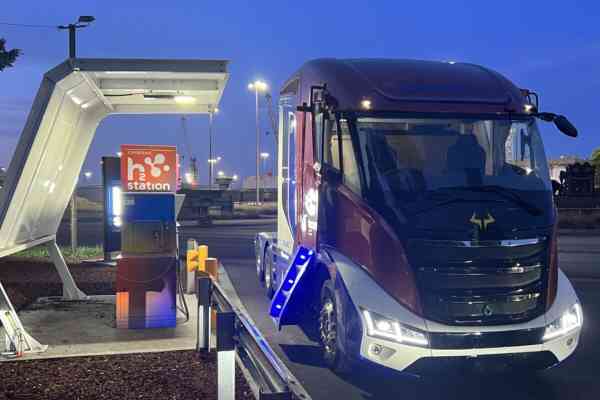
In addition, intelligent networking exists within the First Hydrogen group of companies. First Nuclear complements the "Hydrogen-as-a-Service" model, which helps companies transition to hydrogen. With already proven fuel cell vehicles for logistics transport like Amazon or Hermes, which can achieve a range of over 630 km with just one hydrogen refueling, and the new nuclear technology, a strong overall package is emerging. For investors, this looks like a company that embodies innovation and sustainability – with an eye on long-term returns in a booming sector.
BYD sets its sights on global markets: Doubling foreign sales in focus
The Chinese electric automaker BYD is driving forward its international growth. Group CEO Wang Chuanfu has announced plans to double vehicle sales outside China to over 800,000 units. He wants to circumvent tariffs by producing locally and conquering new markets. Great Britain, Latin America, and Southeast Asia are at the top of the priority list, as these regions are open to Chinese brands. For private investors, this could be a sign of rising profits from overseas markets – an area that, according to Wang, will soon play a greater role in the global economy.
From Australia to Germany, BYD is opening new showrooms. However, plans for Canada and the US are on hold for the time being due to high tariffs imposed by the Trump administration (100% on Chinese e-vehicles). BYD remains optimistic nonetheless. With a sales target of 5.5 million vehicles this year, the Company aims to outperform its Tesla rival. This is supported by affordable models such as the Seagull (under USD 10,000), smart features at no extra charge, and the anti-Tesla sentiment due to Elon Musk's involvement in the US government's DOGE program.
Wang also plans to expand his team for intelligent software and semiconductors from 5,000 to 8,000 employees. His vision sounds ambitious: BYD aims to become more profitable per vehicle than Toyota as soon as the production size is right. Thanks to strict cost control, he sees the Japanese giant (10.8 million vehicles last year) within reach. BYD already sold 4.27 million vehicles in 2024, Tesla 1.79 million. For investors, a clear picture is emerging: BYD combines scale with efficiency – a recipe for powerful success.
Amazon is driving sustainability and authenticity: New energy vision and protection against counterfeiting
Amazon is intensifying its efforts to achieve a sustainable future. In Spain, 17 new solar and wind projects are starting, expanding the portfolio to 94 initiatives with over 3.7 GW of clean energy. That is enough energy to supply more than 2.3 million households with clean energy annually. At the same time, Amazon is launching the Tâmega wind complex in Portugal, the country's largest wind project. With 219 MW of power and smart storage from hydropower, it supports the region and creates over 700 new jobs.
Amazon marketplaces are also becoming cleaner as a result of the Company's global efforts against counterfeiting. "Our goal is to be the most trusted online retailer worldwide," emphasizes Kebharu Smith, head of anti-fraud. In 2024, his team identified and removed 15 million counterfeit products from circulation. That is an increase of over 100% compared to the previous year.** Hundreds of organized crime figures have been arrested as a result of more than 60 international raids supported by authorities in countries such as China and Vietnam.
For customers and investors, this is a clear signal of reliability. The Comany is showing foresight by investing in AI and over USD 1 billion in the fight against fraud. For investors, it is a strong profile: a company that combines environmental responsibility and authenticity with economic strength.
First Hydrogen is demonstrating a strong commitment to the energy transition, focusing on hydrogen and the establishment of the new subsidiary, First Nuclear. The combination of SMR technology and a "Hydrogen-as-a-Service" model positions the Company in a high-growth future market. First Hydrogen could take off as hydrogen subsidies increase. This is an exciting signal for investors: an opportunity to enter a future market at an early stage. BYD is impressing with its aggressive international expansion and a clear strategy to conquer the global electric vehicle market. With a target of 5.5 million vehicles by 2025 and a doubling of foreign sales, the Company is demonstrating stamina and inventiveness, for example by setting up local production sites to avoid customs duties. Strong cost control and technology investments make BYD a serious rival to Tesla and Toyota. BYD combines scale with efficiency. With its dual strategy, Amazon is demonstrating foresight and responsibility with its commitment to clean energy and clean brand quality. Investments in 3.7 GW of clean energy and the fight against counterfeiting show innovative strength and customer focus, inspiring confidence. This could make the Company even more robust and future-proof. For investors, sustainability and innovation could secure Amazon's competitive advantage over its rivals.
Conflict of interest
Pursuant to §85 of the German Securities Trading Act (WpHG), we point out that Apaton Finance GmbH as well as partners, authors or employees of Apaton Finance GmbH (hereinafter referred to as "Relevant Persons") may hold shares or other financial instruments of the aforementioned companies in the future or may bet on rising or falling prices and thus a conflict of interest may arise in the future. The Relevant Persons reserve the right to buy or sell shares or other financial instruments of the Company at any time (hereinafter each a "Transaction"). Transactions may, under certain circumstances, influence the respective price of the shares or other financial instruments of the Company.
In addition, Apaton Finance GmbH is active in the context of the preparation and publication of the reporting in paid contractual relationships.
For this reason, there is a concrete conflict of interest.
The above information on existing conflicts of interest applies to all types and forms of publication used by Apaton Finance GmbH for publications on companies.
Risk notice
Apaton Finance GmbH offers editors, agencies and companies the opportunity to publish commentaries, interviews, summaries, news and the like on news.financial. These contents are exclusively for the information of the readers and do not represent any call to action or recommendations, neither explicitly nor implicitly they are to be understood as an assurance of possible price developments. The contents do not replace individual expert investment advice and do not constitute an offer to sell the discussed share(s) or other financial instruments, nor an invitation to buy or sell such.
The content is expressly not a financial analysis, but a journalistic or advertising text. Readers or users who make investment decisions or carry out transactions on the basis of the information provided here do so entirely at their own risk. No contractual relationship is established between Apaton Finance GmbH and its readers or the users of its offers, as our information only refers to the company and not to the investment decision of the reader or user.
The acquisition of financial instruments involves high risks, which can lead to the total loss of the invested capital. The information published by Apaton Finance GmbH and its authors is based on careful research. Nevertheless, no liability is assumed for financial losses or a content-related guarantee for the topicality, correctness, appropriateness and completeness of the content provided here. Please also note our Terms of use.