December 18th, 2025 | 07:15 CET
Financial revolution: How BlackRock, Bank of America, and Finexity are leveraging the USD 16 trillion potential of tokenization
When one of the key figures at the world's most powerful financial regulatory authority talks about a historic turning point, Wall Street sits up and takes notice. SEC Chairman Paul Atkins recently described the tokenization of assets as the key market driver for the coming years. This is no longer about speculative cryptocurrencies, but about the digital, legally secure representation of real assets – from real estate and art to government bonds. While US giants such as BlackRock and Bank of America are already pumping billions into this new infrastructure and seeking to divide the market among themselves, a specialized player is positioning itself in Germany that has long since mastered this technology and is making it available to investors: Finexity.
time to read: 3 minutes | Author: Nico Popp
ISIN: BLACKROCK INC | US09290D1019 , BANK AMERICA DL 0_01 | US0605051046 , FINEXITY AG | DE000A40ET88
Table of contents:
Author

Nico Popp
At home in Southern Germany, the passionate stock exchange expert has been accompanying the capital markets for about twenty years. With a soft spot for smaller companies, he is constantly on the lookout for exciting investment stories.
Tag cloud
Shares cloud
The accolade from Wall Street
For a long time, blockchain technology was considered a playground for adventurers in the boardrooms of major banks. But this assessment has changed radically. Larry Fink, CEO of BlackRock, the world's largest asset manager, has publicly proclaimed tokenization to be the "next generation of markets." This statement is much more than just PR, because BlackRock is following through with action: with the launch of the tokenized fund "BUIDL" on the Ethereum blockchain around a year ago, the group has proven that institutional capital is ready to leave the well-trodden paths of the previous financial system. The logic of the big banks is impressively simple: tokenization suddenly makes illiquid assets tradable, transaction costs drop dramatically, and transactions are settled in real time instead of over several days. Bank of America strategists also predict that the tokenization of real-world assets (RWA) will make the financial infrastructure fundamentally more efficient. When Bank of America and BlackRock march in the same direction, it creates a pull that the rest of the market can hardly resist.
The end of illiquidity: What real-world assets mean
The core of this revolution lies in the democratization of exclusive asset classes. Until now, investments in art, fine wines, or commercial real estate were often reserved for the wealthy, as the barriers to entry were extremely high and the markets were illiquid. Tokenization divides such assets into digital shares, known as tokens, making them tradable even in the smallest amounts. A Picasso or a property in a prime location in Hamburg no longer belongs to a single investor, but to thousands of investors who can trade their shares digitally at any time. Experts at the Boston Consulting Group estimate that the market for tokenized illiquid assets could reach a volume of up to USD 16 trillion by 2030. It is precisely this gigantic volume that the SEC and US banks are targeting, because whoever provides the infrastructure for this trade will control the stock exchanges of the future.
Finexity: The German response to the US trend
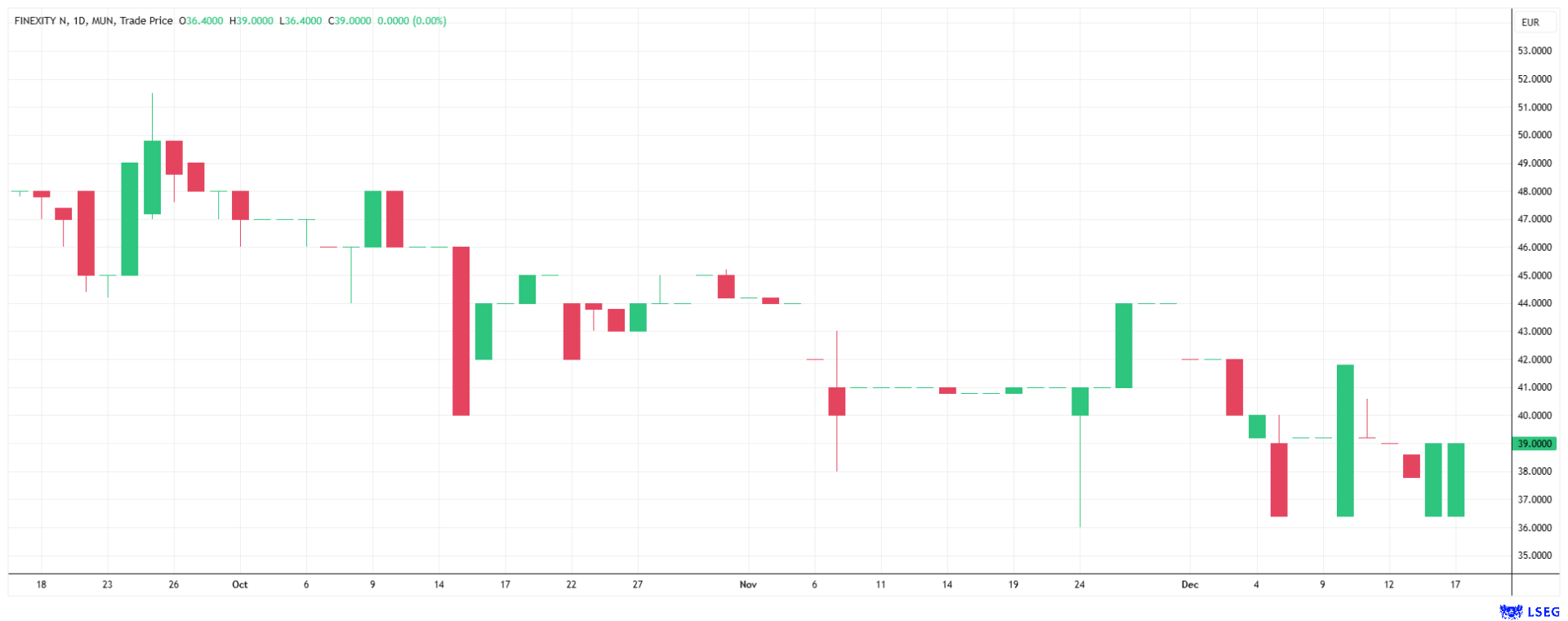
While Wall Street is turning the big institutional wheels, a company has established itself in Europe that is already putting this vision of the future into practice today. Hamburg-based fintech Finexity is considered a pioneer in the field of tokenized real assets. Unlike many startups that merely produce white papers, Finexity has a market-ready platform and, more importantly, in the conservative German market, the necessary regulatory legal certainty. The Company uses blockchain technology to divide tangible assets such as real estate, art, classic cars, and even diamonds into smaller units and make them tradable independently of banks.
Finexity is thus perfectly positioned to benefit within the regulatory framework in Germany and the EU. While US players are often still struggling with the vagueness of the SEC, Finexity operates in a clearly defined regulatory environment. The business model is highly scalable: Finexity not only acts as a marketplace for its own products, but increasingly as an infrastructure provider for banks and asset managers who want to tokenize their own holdings but shy away from the technical complexity. In a gold rush, the best thing to sell is shovels – and Finexity provides the digital shovel for the European RWA market.
Conclusion: Infrastructure beats speculation
The message from the SEC and BlackRock's entry are definitive proof that tokenization has come of age. For investors, this means that the focus should shift away from volatile coins and toward companies that are building bridges between the old and new financial worlds. Finexity embodies precisely this interface: a German technology company that makes real assets digitally available, delivering precisely what Larry Fink has identified as the future of the financial markets. Anyone who believes that in ten years, stocks, bonds, and real estate will be traded predominantly on the blockchain will find Finexity to be one of the most tangible beneficiaries of this development, apart from the already highly valued US giants.
Watch YouTube videoConflict of interest
Pursuant to §85 of the German Securities Trading Act (WpHG), we point out that Apaton Finance GmbH as well as partners, authors or employees of Apaton Finance GmbH (hereinafter referred to as "Relevant Persons") may hold shares or other financial instruments of the aforementioned companies in the future or may bet on rising or falling prices and thus a conflict of interest may arise in the future. The Relevant Persons reserve the right to buy or sell shares or other financial instruments of the Company at any time (hereinafter each a "Transaction"). Transactions may, under certain circumstances, influence the respective price of the shares or other financial instruments of the Company.
In addition, Apaton Finance GmbH is active in the context of the preparation and publication of the reporting in paid contractual relationships.
For this reason, there is a concrete conflict of interest.
The above information on existing conflicts of interest applies to all types and forms of publication used by Apaton Finance GmbH for publications on companies.
Risk notice
Apaton Finance GmbH offers editors, agencies and companies the opportunity to publish commentaries, interviews, summaries, news and the like on news.financial. These contents are exclusively for the information of the readers and do not represent any call to action or recommendations, neither explicitly nor implicitly they are to be understood as an assurance of possible price developments. The contents do not replace individual expert investment advice and do not constitute an offer to sell the discussed share(s) or other financial instruments, nor an invitation to buy or sell such.
The content is expressly not a financial analysis, but a journalistic or advertising text. Readers or users who make investment decisions or carry out transactions on the basis of the information provided here do so entirely at their own risk. No contractual relationship is established between Apaton Finance GmbH and its readers or the users of its offers, as our information only refers to the company and not to the investment decision of the reader or user.
The acquisition of financial instruments involves high risks, which can lead to the total loss of the invested capital. The information published by Apaton Finance GmbH and its authors is based on careful research. Nevertheless, no liability is assumed for financial losses or a content-related guarantee for the topicality, correctness, appropriateness and completeness of the content provided here. Please also note our Terms of use.