August 6th, 2026 | 07:00 CEST
Europe Facing a Tungsten Shock? Airbus and Siemens Under Pressure—Could Almonty Double?
Walking through the production facilities of European industrial giants such as Airbus or Siemens, it is easy to overlook just how fragile many of their supply chains have become. On Tuesday, Switzerland's Neue Zürcher Zeitung (NZZ) assessed the situation with regard to the EU: Western industry is caught in a dangerous cycle of dependency from which it can hardly free itself on its own. Since China significantly tightened export controls on tungsten in February 2025, tungsten prices have surged, in some cases rising seven to ninefold. Meanwhile, European initiatives such as the Critical Raw Materials Act (CRMA) have struggled to gain traction due to limited funding and lengthy permitting processes. Without reliable alternative suppliers, manufacturing operations across Europe could face serious disruptions. In this article, we examine the current market dynamics and take a closer look at Almonty, one of the West's leading tungsten producers, which is widely viewed as a potential beneficiary of the tightening global supply situation.
time to read: 4 minutes | Author: Nico Popp
ISIN: ALMONTY INDUSTRIES INC. | CA0203987072 | TSX: AII , NASDAQ: ALM , ASX: AII , AIRBUS | NL0000235190 , SIEMENS AG NA O.N. | DE0007236101
Table of contents:
Author

Nico Popp
At home in Southern Germany, the passionate stock exchange expert has been accompanying the capital markets for about twenty years. With a soft spot for smaller companies, he is constantly on the lookout for exciting investment stories.
Tag cloud
Shares cloud
When Even Aircraft Manufacturing Grinds to a Halt Without Tungsten
For the European aviation giant Airbus, the metal with the chemical symbol W is simply irreplaceable. In the wings and tail sections of the A330neo and A350 commercial aircraft, precisely fitted counterweights ensure the balance of the flight control system. Given a material density of 19.25 g/cm³, no other material can replicate the required mass in such a confined space. But the threat scenario extends much further. For the precision milling and drilling of extremely hard titanium alloys and plastics, Airbus requires cutting tools made of tungsten carbide with a Mohs hardness of up to 9.0. Without the hardest of all industrial materials, production of commercial aircraft comes to a halt. In the military sector, Airbus Defence and Space uses the raw material for hardened armour, kinetic penetrators, and satellite protection.
Siemens: Electric Arcs and High-Performance Chips Require Heat Resistance
The technology conglomerate Siemens also demonstrates a heavy reliance on tungsten. In power engineering and medium-voltage switchgear, melt-resistant switching contacts made of tungsten-copper and tungsten-silver prevent components from welding together under extreme electric arcs, as the material withstands temperatures of up to 3,420 °C. In diagnostic imaging at Siemens Healthineers, rotating anodes made of tungsten alloys in X-ray tubes withstand enormous thermal shocks. In addition, the Munich-based company uses a special tungsten hexafluoride gas in the design of modern semiconductor factories to deposit nanometer-thin metal layers on high-performance chips. Even the heat sinks for these chips require excellent thermal conductivity. This shows that if the supply of tungsten were to be cut off, many divisions of the Siemens Group would likely face serious difficulties.
Tungsten Producer Almonty Breaks China's Monopoly
The mining company Almonty is determined to prevent precisely this supply crisis. CEO Lewis Black pursued a countercyclical acquisition strategy early on and secured the Panasqueira mine in Portugal in the mid-2010s. It continues to produce tungsten to this day, and its workforce possesses a wealth of knowledge that benefits the company as it expands. At the heart of this growth initiative is the Sangdong Mine in South Korea, which is located in a legally secure OECD jurisdiction and boasts unique key metrics. The deposit holds proven and probable reserves of 7.89 million metric tons with a tungsten trioxide (WO₃) grade of 0.45%, while the measured and indicated resources comprise an additional 8.0 million metric tons with a grade of 0.51% WO₃. In early July, the processing plant in South Korea began operations with an initial inventory of 139,700 metric tons of ore. In Phase I, the plant is set to process 640,000 metric tons of ore annually and produce approximately 2,300 metric tons of tungsten concentrate. With this production volume, Almonty covers about 5% of the Western world's total annual demand of approximately 50,000 metric tons. The second expansion phase of the Sangdong Mine, which the NZZ article does not mention, is expected to double the mine's capacity by 2027. Almonty's financial foundation is rock-solid. The German KfW IPEX-Bank supported the project with a senior credit line of USD 75.1 million. At the same time, the US subsidiary of the Plansee Group extended its offtake agreement to 21 years in July. Under the agreement, Almonty will supply 4.41 million MTU of tungsten concentrate, securing potential annual revenue of up to USD 490 million at current market prices.
Almonty: Creating Value on Every Continent
In addition to its massive mine in South Korea, Almonty is also focusing on Europe. At the Panasqueira Mine in Beira Baixa, Portugal, high-quality concentrate has been mined continuously for around 130 years, thereby maintaining the mining operation within the EU. Almonty is currently deepening the mine by approximately 120 m to expand production to up to 124,000 MTU of concentrate per year. At the same time, management is moving forward with a refining project in Sangdong that is expected to supply 3,000 to 4,000 metric tons of high-purity nano-tungsten oxide annually for semiconductor gases and batteries, supported by a letter of intent from KfW IPEX-Bank for USD 50 million. In addition, the South Korean license holds a molybdenum deposit of 21.48 million metric tons of inferred resources with 0.26% MoS2. SeAH M&S secured full rights to this byproduct in January 2025 for a period of 60 years at a minimum price of USD 19.00 per pound. The Gentung Browns Lake Tungsten Project is also located in the US state of Montana; it is scheduled to be brought into production step by step over the coming quarters and will then be the only operating tungsten mine in the US.
Almonty: A Unique Opportunity
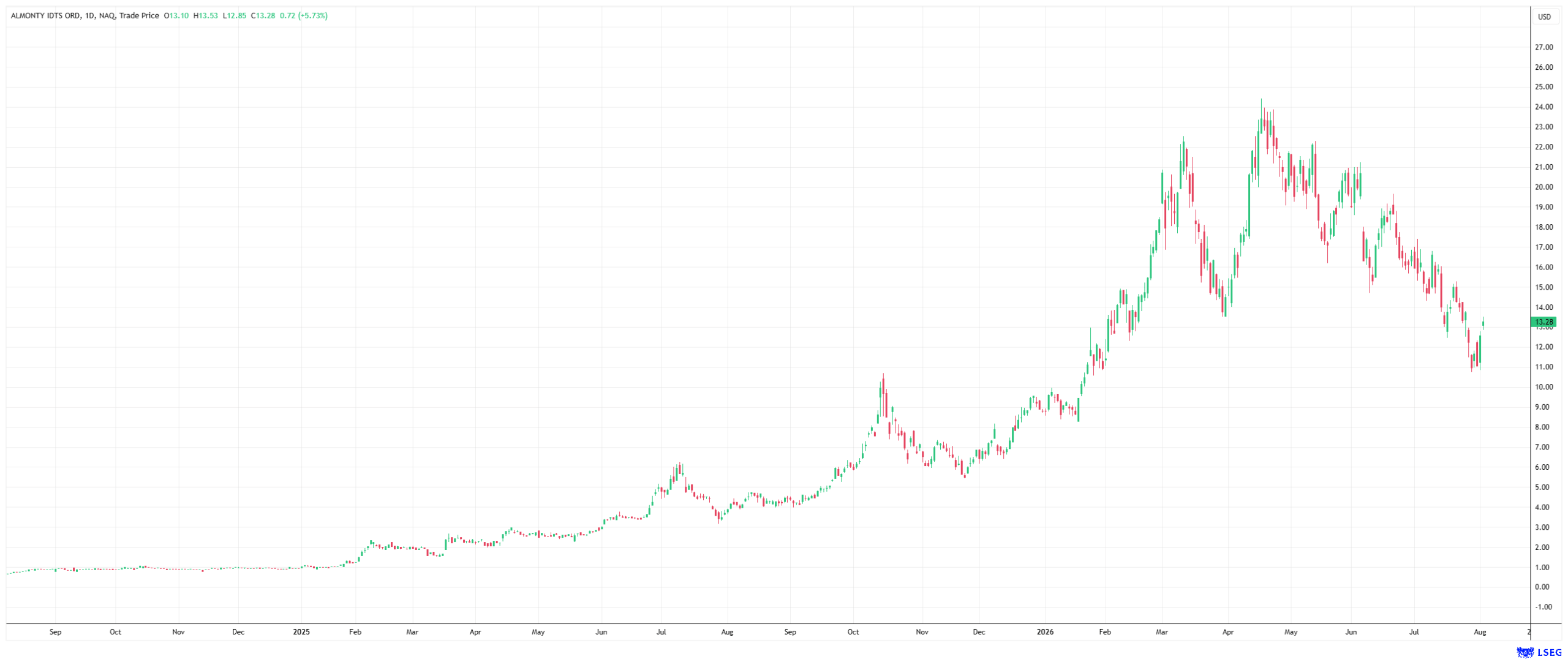
With its unique market position, the ongoing ramp-up at Sangdong, the expansion of the Panasqueira mine, and the approaching start of production in the US, Almonty shares also offer plenty of upside potential. After the stock was among the top performers of the 2025 trading year, when its price increased tenfold, months of consolidation followed. Now, the stock could once again be a promising investment—at least that is how analysts see it. Experts at Diamond Equity Research valued Almonty shares at CAD 31.80 in mid-July. The stock is currently trading on the NASDAQ at just USD 13.28. With research firms such as Bank of America and Cantor Fitzgerald maintaining bullish views and issuing price targets well above USD 20, now may be an opportune time for investors to take a closer look at Almonty. The situation in industry shows that without tungsten, production lines come to a standstill. Almonty controls significant tungsten resources and possesses specialized expertise that is difficult to replicate. Wall Street has already begun to recognize the company's strategic value.
Watch YouTube videoConflict of interest
Pursuant to §85 of the German Securities Trading Act (WpHG), we point out that Apaton Finance GmbH as well as partners, authors or employees of Apaton Finance GmbH (hereinafter referred to as "Relevant Persons") currently hold or hold shares or other financial instruments of the aforementioned companies and speculate on their price developments. In this respect, they intend to sell or acquire shares or other financial instruments of the companies (hereinafter each referred to as a "Transaction"). Transactions may thereby influence the respective price of the shares or other financial instruments of the Company.
In this respect, there is a concrete conflict of interest in the reporting on the companies.
In addition, Apaton Finance GmbH is active in the context of the preparation and publication of the reporting in paid contractual relationships.
For this reason, there is also a concrete conflict of interest.
The above information on existing conflicts of interest applies to all types and forms of publication used by Apaton Finance GmbH for publications on companies.
Risk notice
Apaton Finance GmbH offers editors, agencies and companies the opportunity to publish commentaries, interviews, summaries, news and the like on news.financial. These contents are exclusively for the information of the readers and do not represent any call to action or recommendations, neither explicitly nor implicitly they are to be understood as an assurance of possible price developments. The contents do not replace individual expert investment advice and do not constitute an offer to sell the discussed share(s) or other financial instruments, nor an invitation to buy or sell such.
The content is expressly not a financial analysis, but a journalistic or advertising text. Readers or users who make investment decisions or carry out transactions on the basis of the information provided here do so entirely at their own risk. No contractual relationship is established between Apaton Finance GmbH and its readers or the users of its offers, as our information only refers to the company and not to the investment decision of the reader or user.
The acquisition of financial instruments involves high risks, which can lead to the total loss of the invested capital. The information published by Apaton Finance GmbH and its authors is based on careful research. Nevertheless, no liability is assumed for financial losses or a content-related guarantee for the topicality, correctness, appropriateness and completeness of the content provided here. Please also note our Terms of use.