November 20th, 2025 | 07:30 CET
EU gets serious about hydrogen: Pure Hydrogen, NEL, Air Liquide
The European hydrogen transition could get a boost thanks to the EU's new Hydrogen Mechanism. This matchmaking portal aims to bring together suppliers and buyers of hydrogen in the EU, thereby making the market more transparent. The idea behind it is that if potential buyers are visible and purchase agreements for hydrogen are concluded, the market will get going. Until now, the hydrogen transition has struggled with a classic chicken-and-egg problem: without investment, there is no supply, and without supply, there is no demand. We examine what this new initiative could mean for companies and why smaller suppliers such as Pure Hydrogen could benefit in particular.
time to read: 4 minutes | Author: Nico Popp
ISIN: PURE HYDROGEN CORPORATION LIMITED | AU0000138190 , NEL ASA NK-_20 | NO0010081235 , AIR LIQUIDE INH. EO 5_50 | FR0000120073
Table of contents:
Author

Nico Popp
At home in Southern Germany, the passionate stock exchange expert has been accompanying the capital markets for about twenty years. With a soft spot for smaller companies, he is constantly on the lookout for exciting investment stories.
Tag cloud
Shares cloud
Matchmaking portal to boost hydrogen market
On November 12, 2025, the EU launched the first call for tenders under the new Hydrogen Mechanism. In the future, companies will be able to use the platform to post their planned hydrogen offers and find interested buyers. The portal covers green and low-emission hydrogen as well as derived products such as ammonia, methanol, e-kerosene, and e-methane. The EU Commission and companies in the hydrogen industry expect this to bring several advantages: First and foremost, the platform is intended to make the market more transparent and ensure planning security. As a result, the financing of new projects is expected to gain momentum, and the hydrogen infrastructure is expected to be expanded. Finally, EU legislators hope to see more equal opportunities. Smaller players in particular, who may not yet be so well known, should be able to find buyers. One of these companies could be Pure Hydrogen in the medium term.
Pure Hydrogen: Complete solutions for commercial vehicles
Pure Hydrogen is based in Australia and covers a broad spectrum of the hydrogen ecosystem. Its business model is aimed at an integrated clean energy platform: Pure Hydrogen develops zero-emission vehicles, such as battery and fuel cell-powered trucks, buses, and commercial vehicles, while also promoting corresponding energy projects related to hydrogen. The goal: integrated complete solutions for companies from a single source. In the commercial vehicle sector, Pure Hydrogen has already announced several orders in recent months. Among other things, it equipped Heidelberg Materials in Western Australia with trucks. At the same time, it offers electrolysers and storage systems. In addition to Australia, the Company also has its sights set on other markets. In addition to emerging markets, Europe is of particular interest to Pure Hydrogen.
For a small company like Pure Hydrogen, the EU matchmaking portal could open the door to the European market. Since the platform is explicitly open worldwide, Pure Hydrogen can, for example, post offers for the supply of hydrogen or the sale of its vehicle and filling station solutions there. Ideally, the Company will find European customers, such as municipalities, public transport operators, or hydrogen projects looking for supply partners, in a similar way to its already successful Australian business. Until now, such contacts would have been difficult for an Australian SME to establish. The portal gives Pure Hydrogen visibility among potential major customers and investors in Europe. European SMEs that do not want to be small players among the industry's major suppliers, such as NEL or Air Liquide, could also become aware of smaller suppliers such as Pure Hydrogen.
Hydrogen giants such as NEL and Air Liquide are hoping for a tailwind
The situation at Norwegian hydrogen pioneer NEL shows how important the new Hydrogen Mechanism could be for industry. Orders there have slumped in 2025. The new matchmaking platform could motivate potential interested parties to indicate their needs in order to get in touch with potential business partners. NEL has been particularly successful with its wide range of products, and is the only supplier that can deliver both alkaline and PEM electrolysers on a large scale, which the new shareholder, Samsung, explicitly cited as the reason for its investment in March. NEL also remains a leader in automation - its production facility in Herøya, Norway, is considered state-of-the-art and is expected to significantly reduce the unit costs for electrolysers when operating at full capacity. Another advantage is its extensive network of partnerships. In addition to Samsung, these include Shell, Yara, Iberdrola, and General Motors.
However, NEL also faces intense competition: large corporations such as thyssenkrupp nucera, Plug Power, and Air Liquide are entering the market with their own offerings. The latter company decided this year to install an electrolyser at the port of Rotterdam, which is expected to produce 23,000 tons of green hydrogen annually starting in 2027. Air Liquide was able to make the EUR 500 million investment thanks in part to subsidies from the Netherlands. Since the new matchmaking portal is to be closely linked to existing subsidies, smaller companies in particular, which find it challenging to negotiate grants for such mega-projects themselves, could benefit.
Small company, big leverage: Pure Hydrogen
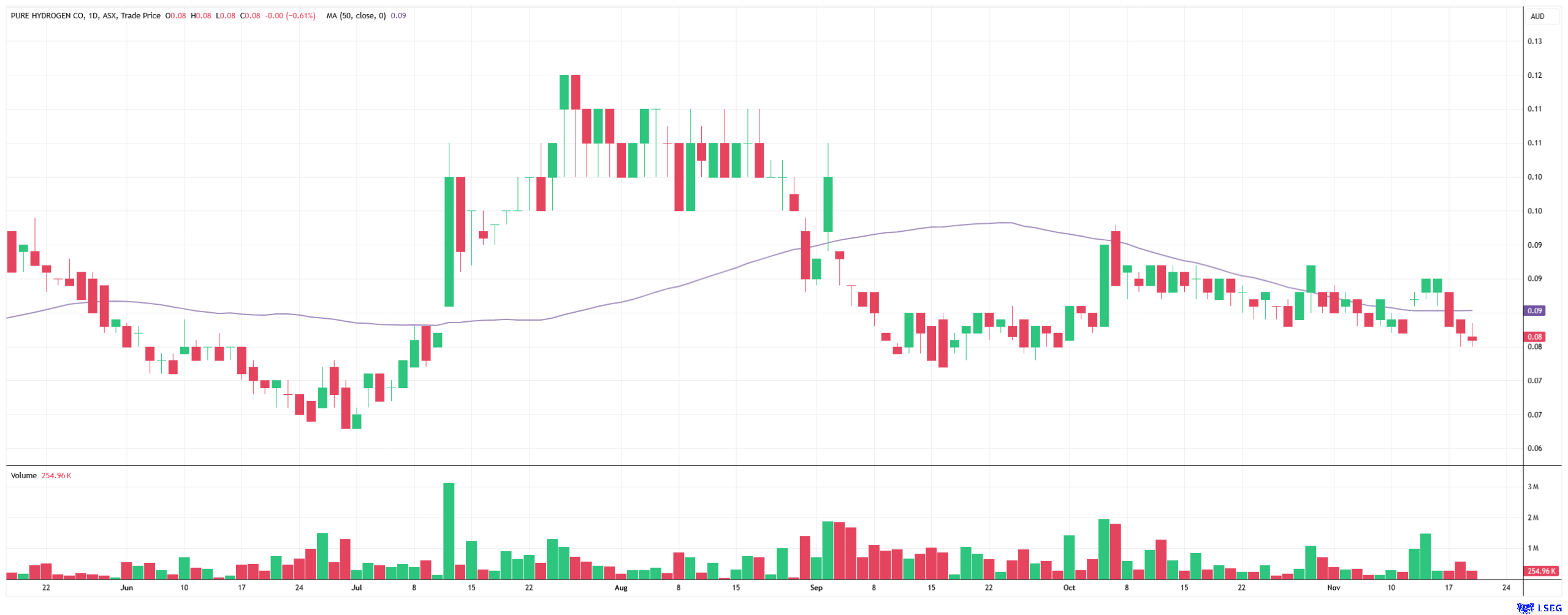
The EU's new Hydrogen Mechanism has not yet triggered a surge in share prices among large hydrogen suppliers. However, industry observers consider the solution to be practical and promising. Opportunities could arise, especially for smaller companies such as Pure Hydrogen. Although the Australians have not focused on Europe so far, they are closely monitoring the market due to the large number of small and mid-sized enterprises, especially in Germany. The share price has been fluctuating between EUR 0.05 and EUR 0.06 on the German stock market for weeks. New sales successes or market entry in Europe in the form of a branch office could give Pure Hydrogen's share price additional momentum.
Conflict of interest
Pursuant to §85 of the German Securities Trading Act (WpHG), we point out that Apaton Finance GmbH as well as partners, authors or employees of Apaton Finance GmbH (hereinafter referred to as "Relevant Persons") may hold shares or other financial instruments of the aforementioned companies in the future or may bet on rising or falling prices and thus a conflict of interest may arise in the future. The Relevant Persons reserve the right to buy or sell shares or other financial instruments of the Company at any time (hereinafter each a "Transaction"). Transactions may, under certain circumstances, influence the respective price of the shares or other financial instruments of the Company.
In addition, Apaton Finance GmbH is active in the context of the preparation and publication of the reporting in paid contractual relationships.
For this reason, there is a concrete conflict of interest.
The above information on existing conflicts of interest applies to all types and forms of publication used by Apaton Finance GmbH for publications on companies.
Risk notice
Apaton Finance GmbH offers editors, agencies and companies the opportunity to publish commentaries, interviews, summaries, news and the like on news.financial. These contents are exclusively for the information of the readers and do not represent any call to action or recommendations, neither explicitly nor implicitly they are to be understood as an assurance of possible price developments. The contents do not replace individual expert investment advice and do not constitute an offer to sell the discussed share(s) or other financial instruments, nor an invitation to buy or sell such.
The content is expressly not a financial analysis, but a journalistic or advertising text. Readers or users who make investment decisions or carry out transactions on the basis of the information provided here do so entirely at their own risk. No contractual relationship is established between Apaton Finance GmbH and its readers or the users of its offers, as our information only refers to the company and not to the investment decision of the reader or user.
The acquisition of financial instruments involves high risks, which can lead to the total loss of the invested capital. The information published by Apaton Finance GmbH and its authors is based on careful research. Nevertheless, no liability is assumed for financial losses or a content-related guarantee for the topicality, correctness, appropriateness and completeness of the content provided here. Please also note our Terms of use.