September 14th, 2026 | 08:20 CEST
Empty Ammunition Stockpiles, Tight Tungsten Supply: Almonty Industries, Rheinmetall and Lockheed Martin Set to Benefit
As geopolitical conflicts intensify once again and NATO countries ramp up defence spending, ammunition supplies are increasingly running low. This is making tungsten ever more important. Without this critical raw material, armour-piercing ammunition, precision missiles and high-performance tools cannot be produced. Starting in 2027, US procurement rules will also require supply chains independent of China, Russia, Iran, and North Korea. This is redirecting billions of dollars and intensifying the race for secure sources. Against this backdrop, Almonty Industries, Rheinmetall, and Lockheed Martin are moving into focus. All three companies stand to benefit from the realignment of the Western defence industry.
time to read: 5 minutes | Author: Armin Schulz
ISIN: ALMONTY INDUSTRIES INC. | CA0203987072 | TSX: AII , NASDAQ: ALM , ASX: AII , RHEINMETALL AG | DE0007030009 , LOCKHEED MARTIN DL 1 | US5398301094
Table of contents:
Author

Armin Schulz
Born in Mönchengladbach, he studied business administration in the Netherlands. In the course of his studies he came into contact with the stock exchange for the first time. He has more than 25 years of experience in stock market business.
Tag cloud
Shares cloud
Almonty Industries: Sangdong Delivers, the US Comes Later
Almonty mines tungsten in Portugal and South Korea; since April, the company has been headquartered in Dillon, Montana. On August 11, the company reported its quarterly results. Revenue rose to CAD 43.0 million. By comparison, it was CAD 7.2 million in the same quarter last year. Earnings from the mining business turned from a loss of CAD 0.9 million to a profit of CAD 26.1 million, driven almost entirely by Panasqueira, as Sangdong was still in the ramp-up phase. Of the CAD 181.8 million net profit, however, CAD 173.1 million came from valuation effects. Nevertheless, there is no need to raise additional funds, as the company has around CAD 1.2 billion in cash reserves to finance its business expansion.
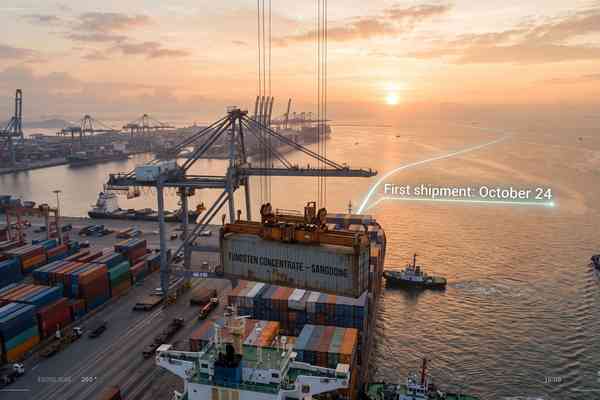
At the heart of the strategy is the Sangdong mine in South Korea. Phase 1 is designed for an ore throughput of 640,000 metric tons and is expected to produce approximately 230,000 MTU of WO₃ concentrate annually. In June 2026, the plant began processing raw ore, initially drawing from approximately 139,700 metric tons of stockpiled development ore. In mid-July, the offtake agreement with Global Tungsten & Powders was extended from 15 to 21 years at more favourable prices. This covers approximately 90% of Phase 1 production and improves the company's planning certainty. The planned Phase 2 is expected to double the processing throughput. If the ramp-up is successful, Almonty could account for approximately 40% of global tungsten supply outside of China.
The Gentung Browns Lake project in Montana provides the company's US footprint. It is expected to be ready for production in the second half of 2026, but an exact production start date has not yet been announced. The new procurement rules for defence materials could boost the project, but it will only be able to contribute operationally if the schedule is met. In addition, there are plans for oxide production in South Korea, which is intended to transform the company from a concentrate seller to a processor. The molybdenum deposit on the Sangdong property is also set to be developed. In Europe, the Panasqueira mine is to be expanded to Level 4. The company has big plans for the coming years.
Rheinmetall: Record Figures and US Orders
Rheinmetall's portfolio includes vehicles, ammunition, and air defence systems, and as of February 2026 also encompasses the marine business. On August 6, the Düsseldorf-based company presented its half-year results. Revenue rose by 39% to just over EUR 5.2 billion. By comparison, the figure for the previous year was EUR 3.75 billion. Operating profit climbed from EUR 453 million to EUR 786 million, with the margin rising to 15%. The order backlog surged to EUR 80.5 billion. However, operating free cash flow was minus EUR 1.6 billion due to delayed advance payments and higher inventory.
Growth in the US is driven by the subsidiary American Rheinmetall. On September 1, the first of eight prototypes of the Lynx XM30 Mechanized Infantry Combat Vehicle was delivered to the US Army; the development contract is worth approximately USD 764 million. One day later, Kongsberg placed an order worth around USD 710,000 for turret components from Michigan. On September 4, the US Navy ordered spare parts for ground-based launch systems in the single-digit million euro range; on September 10, the Marine Corps ordered 12 autonomous Mission Master SPs for USD 7.28 million. Winning the contract to replace the Bradley would be the big breakthrough.
However, Germany currently provides the greatest leverage. The Boxer program involves a firm vehicle contract worth EUR 12.4 billion, on which the Bundestag is set to decide on December 9. Negotiations are underway regarding a 30% down payment, amounting to more than EUR 3 billion. That would give the company's cash flow a much-needed boost. The expansion in Kassel, costing over EUR 260 million, depends on this. The cancellation of the F126 frigate, which cost EUR 300 million in revenue, showed that such projects can fall through. If the contract is signed, the financing situation will ease. If it is delayed, the cash outflow will remain high.
Lockheed Martin: Tailwind from Missiles and Contracts
Lockheed Martin builds fighter jets, helicopters, missiles, and satellites. These products require large quantities of tungsten. In 2025, the US government accounted for 72% of revenue. In the second quarter of 2026, revenue rose 11% to USD 20.1 billion, with all four divisions posting gains. The order backlog climbed to USD 230.4 billion. By comparison, it stood at USD 193.6 billion at the end of 2025. For 2026, the company is targeting revenue of USD 79.75 to USD 81.75 billion and free cash flow of USD 7.0 to USD 7.2 billion. This represents nearly three years' worth of revenue on the books.
The missile business is setting the pace, with revenue rising 19% in the second quarter to USD 4.1 billion and earnings up 24% to USD 594 million. The division's order backlog surged from USD 46.65 billion to USD 87.88 billion. In June, a seven-year framework contract worth over USD 35 billion was added for the THAAD mobile, ground-based missile defence system, followed on July 29 by the PAC-3 MSE missile package worth USD 58.62 billion. On September 9, USD 826 million was awarded for the JASSM cruise missile and the LRASM missile, as well as USD 257.3 million for US Navy torpedoes. Sweden ordered the HIMARS wheeled rocket system for approximately USD 729 million.
The weak point lies in production. According to the Government Accountability Office (GAO), the Block 4 modernization program for the F-35 will cost at least USD 6 billion more and be completed at least 5 years later than planned. In the first half of the year, new program costs totaling USD 395 million were added. The ramp-up ties up capital; contract assets grew by USD 3.037 billion to USD 16.038 billion. By 2030, USD 8 to USD 9 billion is expected to flow into more than 20 plants. Funding for the framework contracts is provided only through annual budget resolutions. If the expansion succeeds without new write-downs, the financial cushion will generate returns. Until then, it is premature to celebrate.
The tailwind for tungsten and Western defence is strong, but the valuation hinges on operational execution. Almonty Industries impresses with the start of production in Sangdong and the planned expansions. Despite record orders, Rheinmetall must reverse its negative cash flow, fill the F-126 gap, and scale its US expansion profitably. Lockheed Martin is benefiting from the missile cycle but needs to improve production of the F-35 and expand production.
Conflict of interest
Pursuant to §85 of the German Securities Trading Act (WpHG), we point out that Apaton Finance GmbH as well as partners, authors or employees of Apaton Finance GmbH (hereinafter referred to as "Relevant Persons") currently hold or hold shares or other financial instruments of the aforementioned companies and speculate on their price developments. In this respect, they intend to sell or acquire shares or other financial instruments of the companies (hereinafter each referred to as a "Transaction"). Transactions may thereby influence the respective price of the shares or other financial instruments of the Company.
In this respect, there is a concrete conflict of interest in the reporting on the companies.
In addition, Apaton Finance GmbH is active in the context of the preparation and publication of the reporting in paid contractual relationships.
For this reason, there is also a concrete conflict of interest.
The above information on existing conflicts of interest applies to all types and forms of publication used by Apaton Finance GmbH for publications on companies.
Risk notice
Apaton Finance GmbH offers editors, agencies and companies the opportunity to publish commentaries, interviews, summaries, news and the like on news.financial. These contents are exclusively for the information of the readers and do not represent any call to action or recommendations, neither explicitly nor implicitly they are to be understood as an assurance of possible price developments. The contents do not replace individual expert investment advice and do not constitute an offer to sell the discussed share(s) or other financial instruments, nor an invitation to buy or sell such.
The content is expressly not a financial analysis, but a journalistic or advertising text. Readers or users who make investment decisions or carry out transactions on the basis of the information provided here do so entirely at their own risk. No contractual relationship is established between Apaton Finance GmbH and its readers or the users of its offers, as our information only refers to the company and not to the investment decision of the reader or user.
The acquisition of financial instruments involves high risks, which can lead to the total loss of the invested capital. The information published by Apaton Finance GmbH and its authors is based on careful research. Nevertheless, no liability is assumed for financial losses or a content-related guarantee for the topicality, correctness, appropriateness and completeness of the content provided here. Please also note our Terms of use.