In a market environment marked by structural upheaval, portfolio stability is increasingly coming into focus. Analysts at JPMorgan emphasize that preserving accumulated gains requires a renewed focus on resilience and diversification. Research by S&P Global also shows that dividends have contributed over 50% to the total return of global equities over the past 25 years. Choosing the right stocks is crucial to securing steady cash flows even during volatile market phases. Pharmaceutical giant Sanofi, investment firm BB Biotech, and the virtually unknown Canadian company RE Royalties offer fundamentally different but extremely promising approaches for investors.
time to read: 3 minutes | Author: Nico Popp
ISIN: SANOFI SA INHABER EO 2 | FR0000120578 , BB BIOTECH NAM. SF 0_20 | CH0038389992 , RE ROYALTIES LTD | CA75527Q1081 | TSXV: RE , OTCQX: RROYF
Table of contents:
Author

Nico Popp
At home in Southern Germany, the passionate stock exchange expert has been accompanying the capital markets for about twenty years. With a soft spot for smaller companies, he is constantly on the lookout for exciting investment stories.
Tag cloud
Shares cloud
Sanofi: Stability Through Operational Transformation
The French pharmaceutical group Sanofi presents itself as a classic defensive anchor of stability. In fiscal year 2025, revenue rose by 9.9% to EUR 43.6 billion, driven primarily by the continued success of the blockbuster drug Dupixent. The company recently proposed a dividend of EUR 4.12, marking the 31st consecutive increase. This makes it clear: Sanofi stands for absolute reliability. In February of this year, the group announced a strategic leadership change: Belén Garijo, who previously led Merck KGaA, will take over the CEO position from Paul Hudson in the coming weeks to boost research productivity. Analysts at Bank of America subsequently downgraded the stock to "Neutral" due to concerns about a transition phase. Future upside potential stems primarily from the successful integration of acquisitions such as the takeover of Dynavax, while the dividend is optimally secured thanks to strong free cash flow of EUR 8.1 billion.
BB Biotech: Returns Thanks to Expertise and Innovation
The Swiss investment firm BB Biotech provides access to a specialized biotech portfolio. The company closed 2025 with a record profit of CHF 578 million. The strict dividend policy provides for an annual payout of 5% of the average December share price, which corresponds to CHF 2.25 per share for 2025. To enhance fundamental stability, management has recently focused the portfolio heavily on clinically mature and market-leading companies such as Ionis Pharmaceuticals and Argenx. Although BB Biotech provided a somewhat more cautious outlook for 2026, a new share buyback program covering up to 10% of the capital provides downside protection. The dividend is directly linked to investment performance but offers an excellent risk-reward profile with significant upside potential driven by upcoming clinical trial data.
RE Royalties: The Undiscovered Anchor of Stability
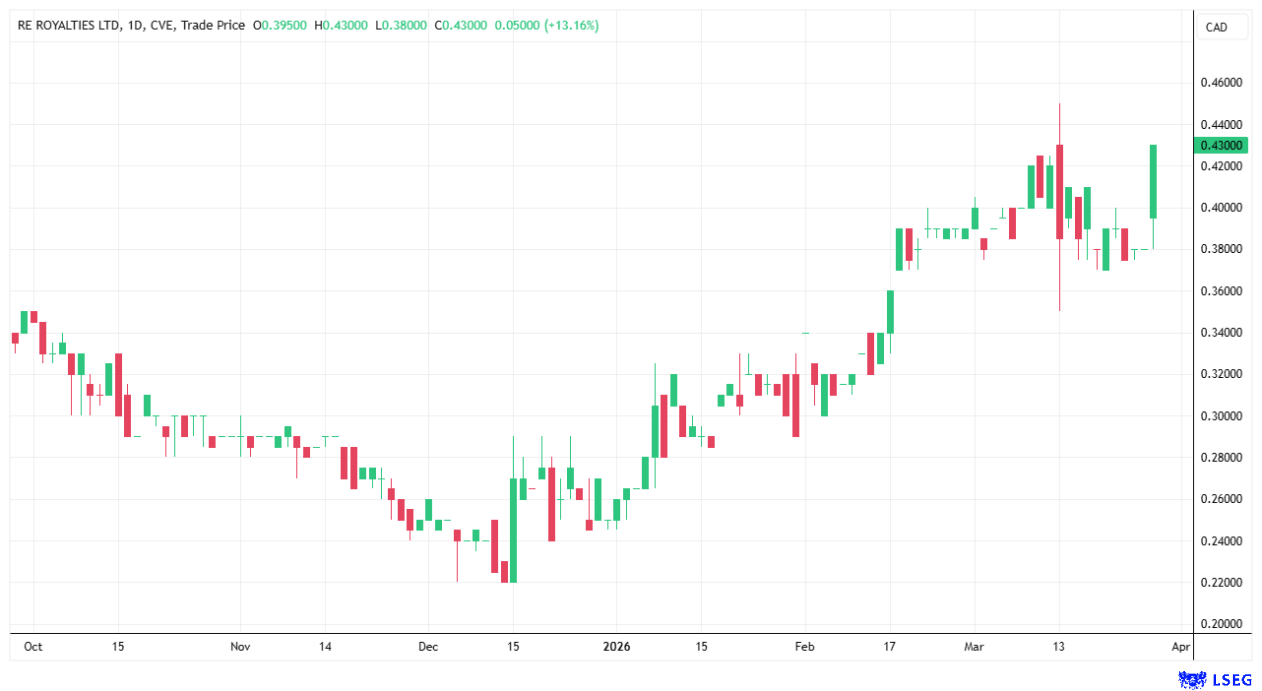
By far the most exciting approach comes from the Canadian company RE Royalties, which, as a pioneer in its sector, has applied the proven royalty model to renewable energy. The company provides capital to developers of solar, wind, or battery storage projects and, in return, receives a percentage share of gross revenue. This specific structure largely shields revenue from inflation-driven cost increases for operators and ensures stable cash flows through long-term power purchase agreements. The diversified portfolio already includes over 100 royalty agreements in North America, South America, and Asia. With a consistent quarterly dividend of CAD 0.01, the stock boasts an expected dividend yield of well over 10%.
Scalability and Excellent Interest Margins Drive Growth
A key success factor for RE Royalties lies in the asymmetric financing structure and the model's enormous scalability. By providing project developers with non-dilutive capital, they retain their voting rights and equity stakes, which drives demand for this financing instrument in the cleantech sector. At the same time, RE Royalties benefits from an excellent interest margin. While the company refinances itself via green bonds with an interest rate of around 9%, the licensed investments it makes typically target double-digit returns. Just how attractive this business is in practice is demonstrated by a recent letter of intent for a USD 8 million loan for a wind project in the US, which secures the company a 5% royalty on gross revenue over the entire lifetime of the facility. Since RE Royalties does not operate the renewable energy plants itself, the cost structure remains lean, allowing additional licenses to boost profits with a minimal increase in operating expenses. With a well-stocked investment pipeline of over CAD 200 million and a listing in Germany designed to specifically attract European capital, the foundation for the next phase of growth is solid.
Strategic Review as a Share Price Driver
In addition to its exceptionally high and operationally robust dividend, RE Royalties is also drawing attention for its share price potential. The company has been awarded the highest "Dark Green Rating" by sustainability analysts at S&P Global and successfully refinanced itself through green bonds. To finally reflect the company's hidden intrinsic value in the capital market, management recently launched a comprehensive strategic review with external financial advisors. The goal of this initiative is to explore lucrative options such as a full sale of the company or strong strategic partnerships. For investors, this creates a rare opportunity: they receive a double-digit dividend yield from a sustainable infrastructure business while simultaneously holding significant leverage toward an imminent revaluation of the stock.
Watch YouTube videoConflict of interest
Pursuant to §85 of the German Securities Trading Act (WpHG), we point out that Apaton Finance GmbH as well as partners, authors or employees of Apaton Finance GmbH (hereinafter referred to as "Relevant Persons") may hold shares or other financial instruments of the aforementioned companies in the future or may bet on rising or falling prices and thus a conflict of interest may arise in the future. The Relevant Persons reserve the right to buy or sell shares or other financial instruments of the Company at any time (hereinafter each a "Transaction"). Transactions may, under certain circumstances, influence the respective price of the shares or other financial instruments of the Company.
In addition, Apaton Finance GmbH is active in the context of the preparation and publication of the reporting in paid contractual relationships.
For this reason, there is a concrete conflict of interest.
The above information on existing conflicts of interest applies to all types and forms of publication used by Apaton Finance GmbH for publications on companies.
Risk notice
Apaton Finance GmbH offers editors, agencies and companies the opportunity to publish commentaries, interviews, summaries, news and the like on news.financial. These contents are exclusively for the information of the readers and do not represent any call to action or recommendations, neither explicitly nor implicitly they are to be understood as an assurance of possible price developments. The contents do not replace individual expert investment advice and do not constitute an offer to sell the discussed share(s) or other financial instruments, nor an invitation to buy or sell such.
The content is expressly not a financial analysis, but a journalistic or advertising text. Readers or users who make investment decisions or carry out transactions on the basis of the information provided here do so entirely at their own risk. No contractual relationship is established between Apaton Finance GmbH and its readers or the users of its offers, as our information only refers to the company and not to the investment decision of the reader or user.
The acquisition of financial instruments involves high risks, which can lead to the total loss of the invested capital. The information published by Apaton Finance GmbH and its authors is based on careful research. Nevertheless, no liability is assumed for financial losses or a content-related guarantee for the topicality, correctness, appropriateness and completeness of the content provided here. Please also note our Terms of use.