March 20th, 2026 | 08:15 CET
Defense Boom on Shaky Ground: Antimony Resources Reaps the Benefits, Risks at RTX and Olin
The defense industry is celebrating record orders, but supply chains for key raw materials reveal a structural weakness: the current defense boom is thus built on shaky ground. One example is the availability of the semimetal antimony. The US Geological Survey classifies antimony as a critical raw material, as there are no alternatives for its applications in modern defense technology. China controls an estimated 60 to 70% of global primary production and has recently dominated downstream processing through strict export controls on dual-use goods. This geopolitical instrumentalization of the raw material led to a price rally in which, according to media reports, antimony rose from USD 13,500 per ton in April 2024 to nearly USD 60,000 per ton at times. Rising prices are forcing the West to shift its focus to the beginning of the supply chain. Investors should shift their attention from the defense industry's multi-billion-dollar order books to securing raw materials, as the industry's giants depend on the development of secure North American deposits. This is where the still-small but promising company Antimony Resources comes into play.
time to read: 3 minutes | Author: Nico Popp
ISIN: ANTIMONY RESOURCES CORP | CA0369271014 | CSE: ATMY , OTCQB: ATMYF , RTX A/S NAM DK 5 | DK0010267129 , OLIN CORP. DL 1 | US6806652052
Table of contents:
Author

Nico Popp
At home in Southern Germany, the passionate stock exchange expert has been accompanying the capital markets for about twenty years. With a soft spot for smaller companies, he is constantly on the lookout for exciting investment stories.
Tag cloud
Shares cloud
RTX Corporation Feels the Technological Bottleneck
RTX Corporation is an example of the dilemma facing defense giants. In February, the company signed five framework agreements with the US Department of Defense to accelerate the production of guided missile systems such as the Tomahawk, the AMRAAM, and the Standard Missile. However, behind these expansion plans lies a critical dependence on high-purity antimony compounds for the infrared seeker heads of these weapons. Missiles like the AMRAAM rely on so-called indium antimonide detector technology for their precise targeting. Since China is blocking the supply of antimony derivatives for military purposes, RTX faces the challenge of securing production. A disruption in supplies could bring modern weapons factories to a standstill despite full order books, making the group's current valuation vulnerable.
Olin Corporation Suffers from Margin Pressure in Ammunition
While RTX operates in the high-tech sector with its guided missiles, Olin Corporation, through its Winchester division, specializes in traditional ammunition. Olin operates the Lake City Army Ammunition Plant, the US Army's central production facility. The quarterly figures highlight the raw materials crisis, as Winchester's segment profit plummeted in the fourth quarter of 2025 from USD 42.0 million in the prior year to USD 0.6 million, even though revenue remained stable at USD 449.4 million. The margin loss stems primarily from rising costs for raw materials such as antimony, which is essential for primer production. Since Olin maintains long-term supply contracts with the military, these costs could not be passed on immediately. The planned new 6.8 mm facility at the site now depends entirely on the availability of these ignition components.
Antimony Resources Provides the North American Solution
In the current environment of raw material shortages and geopolitical necessity, exploration companies like Antimony Resources are coming into focus. With Project Vault, the US has launched a strategic stockpiling program in which an initial USD 12 billion is to be invested to strengthen domestic supply chains. With the Bald Hill project in the Canadian province of New Brunswick, Antimony Resources controls the largest known antimony deposit in North America and is positioning itself to benefit from this development directly. The historically known deposit has been re-evaluated using modern exploration techniques and is characterized by high grades. For example, drilling returned 3 m with grades between 3% and 4% antimony, with individual sections yielding peak values of over 11%. A technical report from 2025 estimated the potential at approximately 2.7 million tons of mineralized rock, which would correspond to a metal content of 81,000 to 108,000 tons of pure antimony.
Drilling Program and Market Correction Offer Entry Opportunities
The year 2026 marks Antimony Resources' transition from explorer to developer. Management is currently carrying out a 10,000-meter drilling program designed to provide the data for an initial official resource estimate in accordance with the NI 43-101 standard. By mid-March, over 5,000 m of drilling had already been completed, with the discovery of the so-called Marcus Zone, featuring massive stibnite mineralization over a 25-meter length directly at surface, providing additional potential. The drilling program is scheduled to be completed in April, which will drive the news flow through subsequent lab results well into the summer.
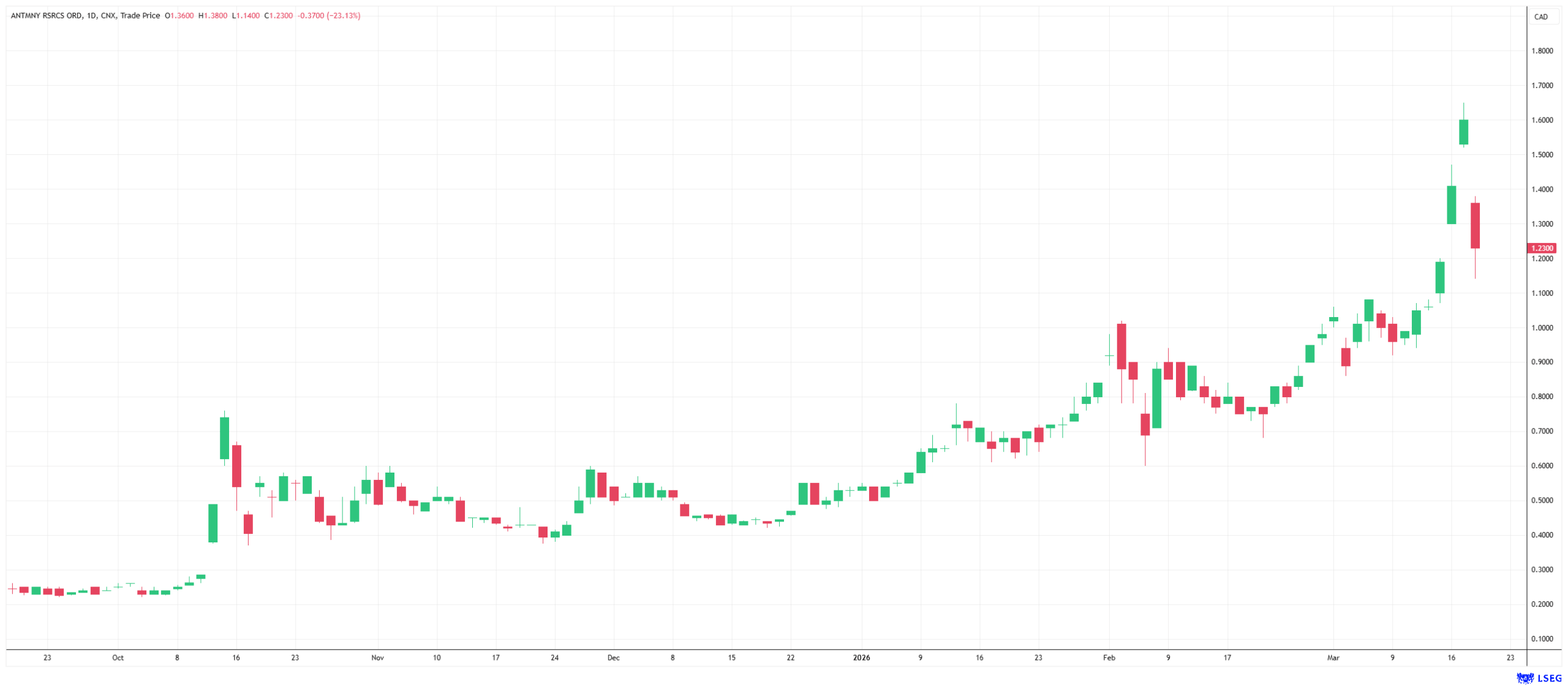
Last Wednesday, Antimony Resources' stock experienced a technical correction amid a sector-wide movement. Following a rally that drove the price to an all-time high the previous day, profit-taking occurred, partly due to a brief strengthening of the US dollar. For strategically oriented investors, this pullback opens a window of opportunity. The fundamental outlook has not deteriorated; rather, signals of scarcity from companies such as Olin and RTX are growing increasingly strong. Since NATO countries must replenish their stockpiles for the coming years regardless of economic cycles, structural demand for antimony is assured. The upcoming release of the first official resource estimate is likely to propel the company into a new phase. Investors find in Antimony Resources an exciting opportunity to invest at the beginning of the supply chain in a megatrend that must be considered extremely robust given the overall geopolitical situation.
Watch YouTube videoConflict of interest
Pursuant to §85 of the German Securities Trading Act (WpHG), we point out that Apaton Finance GmbH as well as partners, authors or employees of Apaton Finance GmbH (hereinafter referred to as "Relevant Persons") currently hold or hold shares or other financial instruments of the aforementioned companies and speculate on their price developments. In this respect, they intend to sell or acquire shares or other financial instruments of the companies (hereinafter each referred to as a "Transaction"). Transactions may thereby influence the respective price of the shares or other financial instruments of the Company.
In this respect, there is a concrete conflict of interest in the reporting on the companies.
In addition, Apaton Finance GmbH is active in the context of the preparation and publication of the reporting in paid contractual relationships.
For this reason, there is also a concrete conflict of interest.
The above information on existing conflicts of interest applies to all types and forms of publication used by Apaton Finance GmbH for publications on companies.
Risk notice
Apaton Finance GmbH offers editors, agencies and companies the opportunity to publish commentaries, interviews, summaries, news and the like on news.financial. These contents are exclusively for the information of the readers and do not represent any call to action or recommendations, neither explicitly nor implicitly they are to be understood as an assurance of possible price developments. The contents do not replace individual expert investment advice and do not constitute an offer to sell the discussed share(s) or other financial instruments, nor an invitation to buy or sell such.
The content is expressly not a financial analysis, but a journalistic or advertising text. Readers or users who make investment decisions or carry out transactions on the basis of the information provided here do so entirely at their own risk. No contractual relationship is established between Apaton Finance GmbH and its readers or the users of its offers, as our information only refers to the company and not to the investment decision of the reader or user.
The acquisition of financial instruments involves high risks, which can lead to the total loss of the invested capital. The information published by Apaton Finance GmbH and its authors is based on careful research. Nevertheless, no liability is assumed for financial losses or a content-related guarantee for the topicality, correctness, appropriateness and completeness of the content provided here. Please also note our Terms of use.