March 24th, 2026 | 07:30 CET
Critical Raw Material for Ammunition: Antimony Resources Approaching a Key Milestone – and Then a US Government Entry?
Raw materials are increasingly becoming a critical factor in ammunition production. Alongside tungsten, antimony is one such material. This largely unknown mineral is critical for flame retardants, batteries, alloys, electronics, and, of course, ammunition. At the same time, the US is 100% reliant on imports. Antimony Resources is developing what is likely one of the most promising deposits in North America. A resource estimate is expected to be released by June. Then, the US government might even step in. This is speculation, but there have already been examples since last year of the Trump administration taking such decisive action to secure critical raw materials.
time to read: 3 minutes | Author: Fabian Lorenz
ISIN: ANTIMONY RESOURCES CORP | CA0369271014 | CSE: ATMY , OTCQB: ATMYF
Table of contents:
Author

Fabian Lorenz
For more than twenty years, the Cologne native has been intensively involved with the stock market, both professionally and privately. He is particularly passionate about national and international small and micro caps.
Tag cloud
Shares cloud
Ammunition: "Reuters" reports on raw material shortages
Antimony is a critical raw material for many industries - such as flame retardants, batteries, alloys, and electronics. However, the current trigger for industry clearly lies in the defense sector, and particularly in ammunition.
Over the weekend, the picture of a growing ammunition shortage in the wake of the Iran war became even clearer. While the US and Israel continue their high ammunition consumption in air defense and attacks, "Reuters" reported that stocks of tungsten, a key raw material for high-performance ammunition, in particular, are rapidly dwindling due to the war against Iran, in addition to the strain caused by the war in Ukraine. The same is likely true for antimony. The US is 100% dependent on imports for both raw materials, and the main producer is China. Since 2024, the Chinese government has been intervening in antimony exports and repeatedly blocking them entirely. Currently, all exports require a license; the number of approved exporters is limited, and Western buyers continue to struggle with strained supply chains.
At the same time, according to "Reuters" and the "Wall Street Journal", Washington is pushing for a rapid expansion of weapons production and additional funding to replace spent systems such as Patriot, THAAD, Tomahawk, and other guided missiles. This underscores that the conflict is not only escalating geopolitically but is also putting increasing pressure on Western defense and supply chains. Antimony Resources is benefiting from this. The company is currently developing one of the most promising antimony projects in North America.
Stock Price Rewards Patient Investors
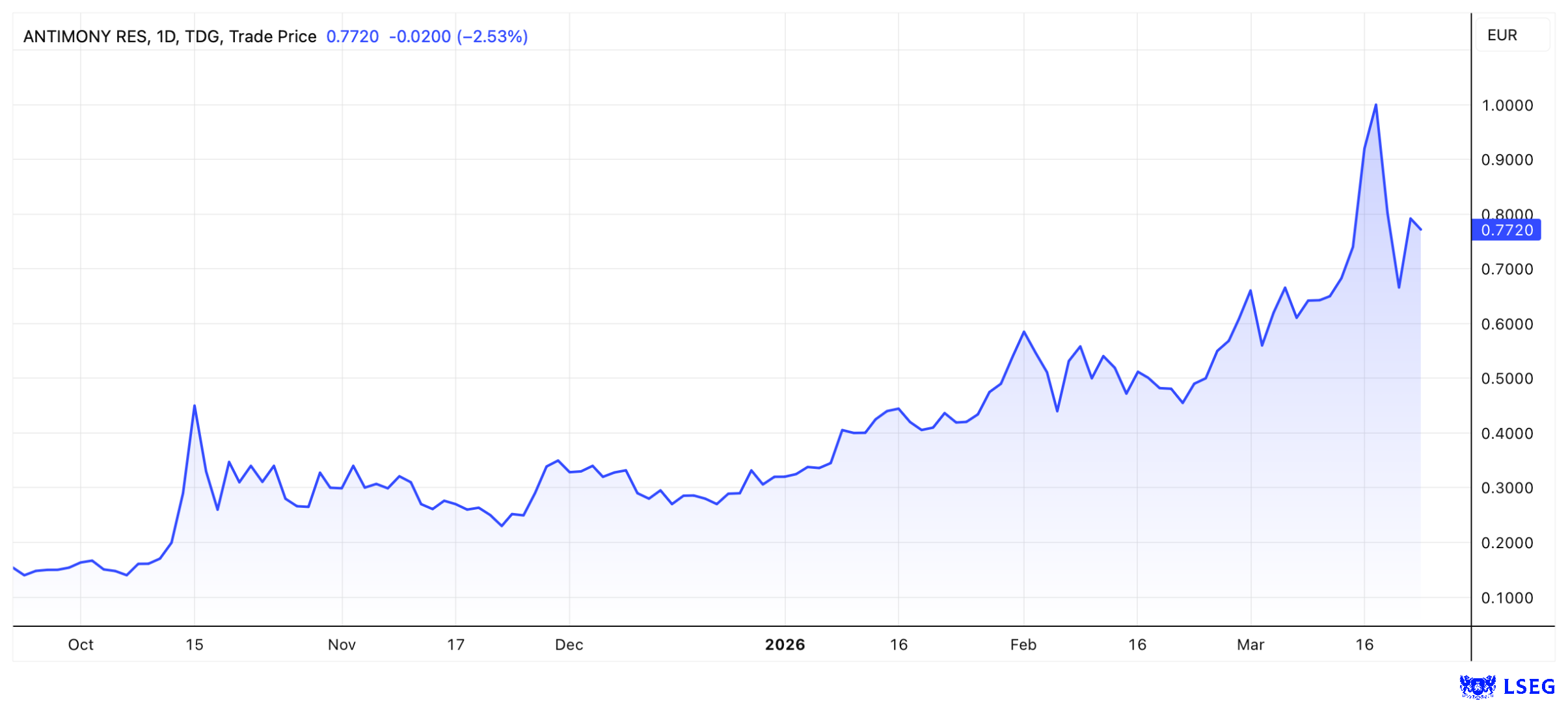
The stock is volatile but in a clear uptrend. Those with strong nerves who weathered the pullbacks or used them to buy more shares have been rewarded in recent months. This has also been the case in recent weeks. The week before last, an exploration update from the company caused the share price to jump from EUR 0.61 to just over EUR 1. This was followed by a sell-off back down to the original level. Yesterday, the stock was trading at EUR 0.79 again. So whenever the price dips, there are always massive buying sprees.
Exploration Update Triggered Price Jump
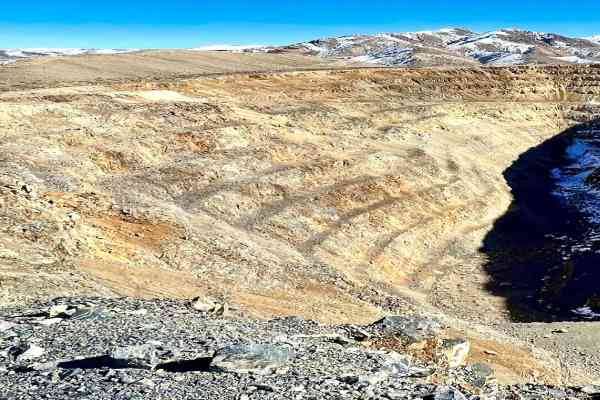
The reason for the price jump was that Antimony Resources is taking the next important step toward its first resource estimate for the Bald Hill antimony project in New Brunswick, Canada. There, the company is currently advancing a 10,000-meter definition drilling program in the Main Zone. The aim is to establish the data density required for a robust resource estimate. Three drilling rigs are already in operation, and approximately 5,000 m have already been completed. If everything goes according to plan, the program is expected to be completed by the end of April. The final report could then be available in June. Incidentally, the resource estimate is being supported by the renowned consulting firm SRK Consultants from Toronto. This brings Antimony Resources closer to a key milestone that could elevate the project to a new stage of development. The stock stands to benefit significantly from this.
In parallel, Antimony Resources is working on a continuously updated 3D model of the mineralization. This model is intended not only to support the resource estimate but also to help target further drilling at particularly promising areas. Management also notes that new zones with stibnite mineralization have already been identified on-site, which are to be further explored in 2026. Stibnite is the most important ore mineral for antimony and chemically consists of antimony sulfide (Sb₂S₃). The steel-gray to silvery-shiny mineral often occurs in long, needle-like crystals and is the primary natural source for antimony extraction.
Development Remains Promising
Development at Bald Hill remains promising. The project is considered a well-known high-grade antimony deposit with district potential. In the Main Zone, mineralization has already been identified over a length of more than 700 m and to a depth of at least 350 m. In addition, there are average thicknesses of 3 to 4 m with grades of 3% to 4% antimony. With more than 2,000 hectares of concession area, additional claims, and several other occurrences outside the Main Zone, Antimony Resources has significant expansion potential. If a convincing initial resource estimate is achieved, this should significantly strengthen the company's investment story.
Conclusion: First a Resource Estimate, then the US Government's Entry?
As a critical metal, antimony is less well-known but all the more important. Antimony Resources is developing one of the most promising deposits in North America. A convincing resource estimate is likely to open up entirely new opportunities. Demand is so high that the path from development to production is expected to be much faster today. The US government's involvement cannot be ruled out either. There have been several examples of this since last year.
Conflict of interest
Pursuant to §85 of the German Securities Trading Act (WpHG), we point out that Apaton Finance GmbH as well as partners, authors or employees of Apaton Finance GmbH (hereinafter referred to as "Relevant Persons") currently hold or hold shares or other financial instruments of the aforementioned companies and speculate on their price developments. In this respect, they intend to sell or acquire shares or other financial instruments of the companies (hereinafter each referred to as a "Transaction"). Transactions may thereby influence the respective price of the shares or other financial instruments of the Company.
In this respect, there is a concrete conflict of interest in the reporting on the companies.
In addition, Apaton Finance GmbH is active in the context of the preparation and publication of the reporting in paid contractual relationships.
For this reason, there is also a concrete conflict of interest.
The above information on existing conflicts of interest applies to all types and forms of publication used by Apaton Finance GmbH for publications on companies.
Risk notice
Apaton Finance GmbH offers editors, agencies and companies the opportunity to publish commentaries, interviews, summaries, news and the like on news.financial. These contents are exclusively for the information of the readers and do not represent any call to action or recommendations, neither explicitly nor implicitly they are to be understood as an assurance of possible price developments. The contents do not replace individual expert investment advice and do not constitute an offer to sell the discussed share(s) or other financial instruments, nor an invitation to buy or sell such.
The content is expressly not a financial analysis, but a journalistic or advertising text. Readers or users who make investment decisions or carry out transactions on the basis of the information provided here do so entirely at their own risk. No contractual relationship is established between Apaton Finance GmbH and its readers or the users of its offers, as our information only refers to the company and not to the investment decision of the reader or user.
The acquisition of financial instruments involves high risks, which can lead to the total loss of the invested capital. The information published by Apaton Finance GmbH and its authors is based on careful research. Nevertheless, no liability is assumed for financial losses or a content-related guarantee for the topicality, correctness, appropriateness and completeness of the content provided here. Please also note our Terms of use.