April 7th, 2026 | 07:25 CEST
Congo in Focus: Barrick and Ivanhoe Pave the Way for DRC Gold
The global mining industry is at a turning point—demand for new deposits is rising, while globalization is increasingly reaching its limits, making diversified and redundant supply chains essential. In this market environment, the Democratic Republic of the Congo (DRC) has moved beyond its traditional role as a mere raw material supplier and is undergoing a significant transformation. The progress being made in the country is exemplified by the successes of companies like Barrick Mining and Ivanhoe Mines. Their multi-billion-dollar investments demonstrate that large-scale operations are indeed feasible in the DRC. The country's geological potential has once again drawn attention due to the recent record production at Barrick Mining's Kibali mine. While major corporations are successfully advancing projects in the DRC, junior explorers are also increasingly attracting investor attention. DRC Gold is capitalizing on this momentum and identifying new resources through drilling programs in close proximity to existing projects. Against the backdrop of declining reserves among major producers such as Barrick and Ivanhoe, the smaller company, led by German CEO Klaus Eckhof, offers an exciting opportunity to benefit from the new growth in the Congo.
time to read: 3 minutes | Author: Nico Popp
ISIN: BARRICK MINING CORPORATION | CA06849F1080 | NYSE:B , TSX: ABX , IVANHOE MINES A | CA46579R1047 , DRC GOLD CORP. | CA23347H1064 | CSE: DRC
Table of contents:
Author

Nico Popp
At home in Southern Germany, the passionate stock exchange expert has been accompanying the capital markets for about twenty years. With a soft spot for smaller companies, he is constantly on the lookout for exciting investment stories.
Tag cloud
Shares cloud
Barrick Mining Sets the Technological Benchmark in Africa
Interest in the DRC is inextricably linked to the Kibali mine, which is operated by Barrick Mining and is now considered Africa's largest and most technologically advanced gold mine. In 2025, the mine achieved record revenue of USD 2.3 billion based on full capacity. According to company reports, this financial strength stems not only from the favorable market environment, with prices at times exceeding USD 4,500 per ounce of gold, but also from its consistent digital transformation. By deploying autonomous systems and remote-controlled drilling rigs, Barrick is boosting its efficiency and maintaining attractive margins even in an inflationary environment. To unlock valuation potential, CEO Mark Hill is currently preparing the initial public offering (IPO) of the North American gold assets, which will make Kibali an even more important growth driver within the African division.
Ivanhoe Mines Demonstrates Scalability for Copper
In base metals, Ivanhoe Mines has demonstrated with the Kamoa-Kakula copper complex in southern DR Congo that world-class projects can be rapidly scaled up in the region. To ensure the long-term stability of the infrastructure, management recently adjusted the production targets for 2026 to 290,000 to 330,000 metric tons of copper. As a long-term goal, the company aims to increase production to over 500,000 t per year starting in 2028 and expand Kamoa-Kakula into one of the three largest copper mines in the world. A key competitive advantage is the newly built copper smelter, which began operations at the end of 2025 and is already producing anode copper with a purity of 99.7%. New discoveries in the so-called Western Forelands also underscore the significant geological potential for additional standalone mining complexes in the region.
DRC Gold and the Moment for Junior Explorers
While the major producers are already trading at high valuations, DRC Gold offers investors the leverage typical of junior companies. The centerpiece of DRC Gold's strategy is the Giro Gold Project, located just under 39 km west of the Kibali Mine in the Kilo-Moto greenstone belt. The company has signed a binding agreement to acquire a majority stake of up to 65% in the project. The geological quality of the region is evident in promising historical drill results. Geologists encountered high-grade intervals that yielded, among other things, 8.71 g/t Au over 13 m. Operational leadership rests with CEO Klaus Eckhof, who is known in industry as the driving force behind the discovery of the Moto Project, which later gave rise to the Kibali Mine. In addition to Giro, the team is focusing on the Nizi Gold Project, which hosts the historic King Leopold Mine and, in the view of experienced geologist and Congo expert Eckhof, offers enormous potential for modern exploration technologies.
Geopolitical Drivers and Upcoming Catalysts
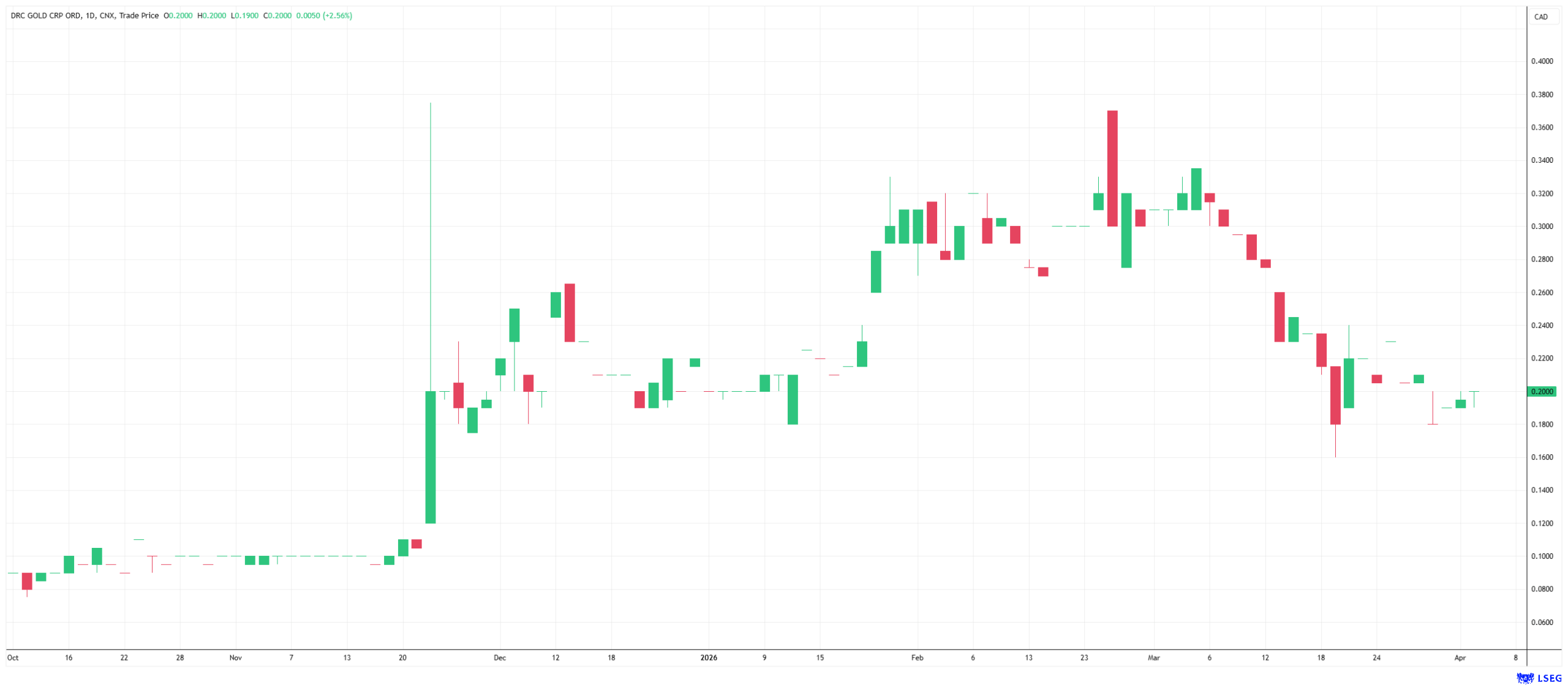
A key driver for DRC Gold's share price will be the resource update for the Giro project, expected as early as April. Should the estimate confirm the historical potential, the company could quickly become a takeover target for larger producers. At the same time, DRC Gold is benefiting from the improving regulatory environment in the country. According to reports, the Congolese central bank signed an agreement in February to purchase 15 tons of gold annually from small-scale miners to stabilize the national currency, the franc. This strategic move by the central bank creates additional demand for gold from the DRC, increases transparency in the sector, and offers investors an increasingly reliable operating environment. For investors, DRC Gold represents an opportunity to get in at an early stage and benefit from the country's upswing. Since Barrick Mining and Ivanhoe Mines have already demonstrated what is possible in the DR Congo with their mines, the up-and-coming gold explorer is by no means entering uncharted territory. Added to this is CEO Eckhof's expertise in the Congo. DRC Gold's stock is thus a speculative opportunity for risk-tolerant investors.
Watch YouTube videoConflict of interest
Pursuant to §85 of the German Securities Trading Act (WpHG), we point out that Apaton Finance GmbH as well as partners, authors or employees of Apaton Finance GmbH (hereinafter referred to as "Relevant Persons") may hold shares or other financial instruments of the aforementioned companies in the future or may bet on rising or falling prices and thus a conflict of interest may arise in the future. The Relevant Persons reserve the right to buy or sell shares or other financial instruments of the Company at any time (hereinafter each a "Transaction"). Transactions may, under certain circumstances, influence the respective price of the shares or other financial instruments of the Company.
In addition, Apaton Finance GmbH is active in the context of the preparation and publication of the reporting in paid contractual relationships.
For this reason, there is a concrete conflict of interest.
The above information on existing conflicts of interest applies to all types and forms of publication used by Apaton Finance GmbH for publications on companies.
Risk notice
Apaton Finance GmbH offers editors, agencies and companies the opportunity to publish commentaries, interviews, summaries, news and the like on news.financial. These contents are exclusively for the information of the readers and do not represent any call to action or recommendations, neither explicitly nor implicitly they are to be understood as an assurance of possible price developments. The contents do not replace individual expert investment advice and do not constitute an offer to sell the discussed share(s) or other financial instruments, nor an invitation to buy or sell such.
The content is expressly not a financial analysis, but a journalistic or advertising text. Readers or users who make investment decisions or carry out transactions on the basis of the information provided here do so entirely at their own risk. No contractual relationship is established between Apaton Finance GmbH and its readers or the users of its offers, as our information only refers to the company and not to the investment decision of the reader or user.
The acquisition of financial instruments involves high risks, which can lead to the total loss of the invested capital. The information published by Apaton Finance GmbH and its authors is based on careful research. Nevertheless, no liability is assumed for financial losses or a content-related guarantee for the topicality, correctness, appropriateness and completeness of the content provided here. Please also note our Terms of use.