July 6th, 2026 | 07:35 CEST
Cloud AI Blockbuster: Whoever Has the Data Rules the World! 100% with SAP, ServiceNow, Aspermont, Deutsche Telekom and SpaceX
In, out, up, down! That is exactly what the current roller-coaster ride on the NASDAQ feels like. While in recent weeks it was the dream gains in chip stocks that drove investor excitement, this week German defense stocks sit atop the winners' list. The correction in the cloud providers is also slowly coming to an end, or at least SAP and ServiceNow are showing first signs of life at low levels. Deutsche Telekom has likewise been run over. Elon Musk plans to push into the telco world with his SpaceX Starlink division. That is providing industry with worry lines and weighing on the titans of mobile communications. And then there is Australia's Aspermont, an AI-driven data marketer and investor-services provider from the commodities sector. Completely transformed from a traditional publishing house into an aggressively growing partner to the mining industry. It is worth taking a closer look.
time to read: 6 minutes | Author: André Will-Laudien
ISIN: ASPERMONT LTD. | AU000000ASP3 | ASX: ASP , SAP SE O.N. | DE0007164600 , SERVICENOW INC. DL-_001 | US81762P1021 , SPACE EXPLORATION TECHNOLOGIES CORP | US84615Q1031 | NASDAQ: SPCX , DT.TELEKOM AG NA | DE0005557508
Table of contents:
Author

André Will-Laudien
Born in Munich, he first studied economics and graduated in business administration at the Ludwig-Maximilians-University in 1995. As he was involved with the stock market at a very early stage, he now has more than 30 years of experience in the capital markets.
Tag cloud
Shares cloud
SAP and ServiceNow: When Will the Cloud-Stock Sell-off Stop?
The golden era of cloud stocks is currently undergoing a painful caesura, in which visionary narratives shatter against the hard cliffs of reality. Industry heavyweights such as SAP and ServiceNow have experienced a drastic sell-off with their share prices halving over the last 12 months, plunging investors worldwide into deep uncertainty. For years, investors pumped billions into the software giants; now, instead of vague promises, the market is demanding measurable revenue data from the monetization of artificial intelligence. A representative Bitkom study poured additional oil on the fire by revealing that 85% of domestic companies want to break their oppressive dependence on US cloud infrastructures. This looming turn away from transatlantic platforms is stoking fears of a far-reaching technological upheaval in the software sector, but it is also bringing SAP back into play ahead of its competitors Oracle and ServiceNow.
Despite this rapid downtrend, optimistic analysts on the LSEG platform remain firmly in the buyer's camp and regard the deep plunge as an exaggerated market overreaction. Experts at DZ Bank maintain a long-term positive outlook for the German heavyweight SAP. The median 12-month price target for SAP settles at a robust EUR 218, signaling a clear comeback potential of around 60%. For the US workflow specialist ServiceNow, too, which was pushed down to around USD 80, market observers paint an encouraging picture of the future. The consensus forecasts for ServiceNow were indeed heavily adjusted, yet they still stably fix fair value at targets between USD 125 and 160, putting the consensus at USD 143. 46 of 50 experts hold their thumbs up - what a right-skewed Gaussian curve! The fundamental business model of digital process automation has not, after all, vanished overnight. Once the thick dust on the stock markets settles, these adjusted valuations should form the foundation for the next upward wave.
Aspermont: From Trade Publisher to Intelligence Specialist with Scaling Potential
Australia's Aspermont is among the companies that can profit strongly from the global commodities boom without mining commodities themselves. Over the past years, the digital specialist has consistently evolved from a tradition-rich trade publisher with roots dating back to 1835 into an internationally active provider of data, intelligence and software solutions for the mining and commodities industry. What counts here is the veritable information edge and the dissemination of that knowledge! According to the International Energy Agency (IEA), critical raw materials continue to gain strategic importance for the energy transition, digitalization, defense and high technology, while global supply chains are simultaneously concentrating on ever fewer reliable countries. For companies like Aspermont, the value of reliable market information, proprietary databases and intelligent analysis tools thus rises considerably.
The company's foundation is now an extremely robust subscription business with more than 4,000 corporate customers in over 150 countries. Remarkably, recurring subscription revenues have already grown for 39 consecutive quarters, and the average revenue per customer has increased by around 17% annually since 2016. Such metrics are typical of scalable software and data companies and indicate strong customer loyalty as well as increasing pricing power within a clearly defined niche. At the same time, the operating subscription cash flow finances the expansion of new business areas and reduces dependence on cyclically sensitive individual projects.
Evidently, the marketing and communications platform Nexus is now gaining significant momentum as well. In the first half of 2026, the division already exceeded the revenue of the entire prior year and increased revenues outside the subscription business by 41%. Even more exciting, however, is the build-out of the Data & Intelligence division around Mining IQ. There, Aspermont combines its expertise built over more than 190 years with current market data and the application of artificial intelligence to provide corporate customers such as Rio Tinto with in-depth analyses and decision-making foundations. The latest financial figures reflect the progress of the transformation. In the first half, Aspermont generated revenue of AUD 7.48 million and a net profit of around AUD 0.6 million. At the same time, operating cash flow improved by around AUD 1.5 million compared with the previous quarter. As a precaution, management pushed back the timing of sustainably positive operating cash flow to the second half of fiscal year 2027, after two enterprise contracts with a combined volume of over AUD 1.5 million were delayed due to longer decision-making processes. At the same time, investments in the Data & Intelligence platform are being deliberately accelerated to tap additional revenue sources as early as 2027 and further extend the technological lead.
The analysts at GBC assess this growth path very optimistically. For the current fiscal year, revenue is expected to be around AUD 16.9 million, rising to over AUD 21 million by 2028. In parallel, EBITDA is expected to improve to nearly AUD 3 million. If Aspermont succeeds in monetizing its growing enterprise pipeline and its AI-supported data products, the current valuation should increasingly reflect an orientation toward international software and data providers rather than a classic publishing house. Risk-conscious investors should consider adding Aspermont to their portfolio to be on board for the next leap!
IIF host Lyndsay Malchuk spoke with CEO Alex Kent about the prospects for the current fiscal year.
Deutsche Telekom: SpaceX Pushes Into the Telcos' Domain
The traditional supremacy of global telecommunications giants such as Deutsche Telekom is coming under pressure from the unstoppable rise of satellite networks. Leading the charge, the space company SpaceX is aggressively pushing into the core business of the classic network operators with its Starlink system. While mobile operators relied for decades on the expensive build-out of ground-based infrastructure such as cell towers and fibre-optic cables, Elon Musk's satellite constellation now simply overrides these physical limits from orbit. Through the direct connection of satellites to conventional smartphones via the so-called "Direct-to-Cell" service, SpaceX is positioning itself not merely as a niche provider for remote regions but as a genuine mobile competitor.
This technological disruption enables seamless worldwide network coverage that works even in deep valleys or on the open sea. For established telcos, this development creates significant pressure to innovate, as they fear losing market share in the lucrative data and connectivity business. To avoid falling behind, Deutsche Telekom is already implementing strategic countermeasures and testing its own partnerships with satellite operators to offer hybrid solutions for mobile communications and space internet. Nevertheless, the balance of power in the telecommunications sector is shifting unstoppably in favour of players who master space as a new infrastructure layer. At the end of this technological race, the classic telecommunications providers could be reduced to mere administrators of local residual networks if they sleep through the transformation to the space age. The group's crown jewel, T-Mobile US, has thus already lost 23% over the last 12 months, and it fared little better at the parent, with a good 19% discount. A 2026 P/E ratio of 11.5 together with a 4.7% dividend can now be read on LSEG Refinitiv, plus 18 of 19 experts who calculate an average 12-month price target of EUR 37.46 - a good 50% upside potential for the world's number 4 among the telcos.
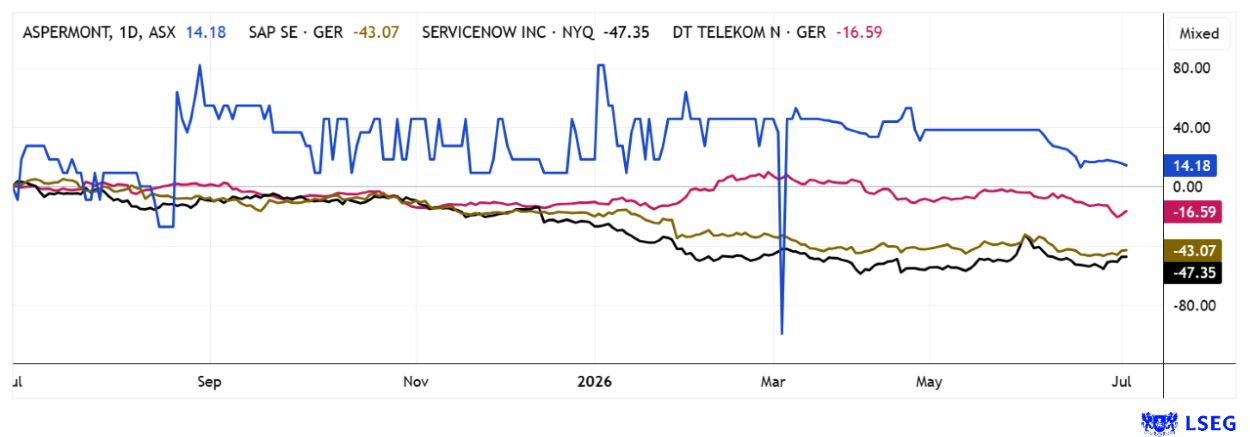
The stock market is currently unforgiving. Investors who hesitate risk missing opportunities—or being caught on the wrong side of the next move. Chip stocks raced ahead before suddenly hitting the brakes. The picture is different for AI, cloud, and data specialists. Sentiment toward the sector remains subdued, creating potentially attractive entry points. Meanwhile, Australia's Aspermont continues to build operational momentum, and its growth story may only just be beginning.
Conflict of interest
Pursuant to §85 of the German Securities Trading Act (WpHG), we point out that Apaton Finance GmbH as well as partners, authors or employees of Apaton Finance GmbH (hereinafter referred to as "Relevant Persons") currently hold or hold shares or other financial instruments of the aforementioned companies and speculate on their price developments. In this respect, they intend to sell or acquire shares or other financial instruments of the companies (hereinafter each referred to as a "Transaction"). Transactions may thereby influence the respective price of the shares or other financial instruments of the Company.
In this respect, there is a concrete conflict of interest in the reporting on the companies.
In addition, Apaton Finance GmbH is active in the context of the preparation and publication of the reporting in paid contractual relationships.
For this reason, there is also a concrete conflict of interest.
The above information on existing conflicts of interest applies to all types and forms of publication used by Apaton Finance GmbH for publications on companies.
Risk notice
Apaton Finance GmbH offers editors, agencies and companies the opportunity to publish commentaries, interviews, summaries, news and the like on news.financial. These contents are exclusively for the information of the readers and do not represent any call to action or recommendations, neither explicitly nor implicitly they are to be understood as an assurance of possible price developments. The contents do not replace individual expert investment advice and do not constitute an offer to sell the discussed share(s) or other financial instruments, nor an invitation to buy or sell such.
The content is expressly not a financial analysis, but a journalistic or advertising text. Readers or users who make investment decisions or carry out transactions on the basis of the information provided here do so entirely at their own risk. No contractual relationship is established between Apaton Finance GmbH and its readers or the users of its offers, as our information only refers to the company and not to the investment decision of the reader or user.
The acquisition of financial instruments involves high risks, which can lead to the total loss of the invested capital. The information published by Apaton Finance GmbH and its authors is based on careful research. Nevertheless, no liability is assumed for financial losses or a content-related guarantee for the topicality, correctness, appropriateness and completeness of the content provided here. Please also note our Terms of use.