July 1st, 2025 | 07:20 CEST
Climate protection meets infrastructure: Argo Living relies on graphene for low-emission concrete
The construction industry is responsible for approximately 8% of global CO₂ emissions, and construction is taking place virtually everywhere. Anyone in the cement manufacturing industry who can significantly reduce greenhouse gas emissions is making a measurable impact on global climate targets. This creates visibility, political support, and ESG relevance, all of which are drivers for rising company valuations. The topic is highly relevant because several trillion USD will be invested in new infrastructure worldwide by 2050, including through programs such as the US Inflation Reduction Act (IRA), the EU Green Deal, and the reconstruction of Ukraine once the time comes. Investors are specifically looking for companies that are also included in these public budgets, as green building materials are considered a key technology. Argo Graphene Solutions (formerly Argo Living Soils) is perfecting this concept, and its stock is on the rise.
time to read: 3 minutes | Author: André Will-Laudien
ISIN: ARGO LIVING SOILS CORP | CA04018T3064
Table of contents:
Author

André Will-Laudien
Born in Munich, he first studied economics and graduated in business administration at the Ludwig-Maximilians-University in 1995. As he was involved with the stock market at a very early stage, he now has more than 30 years of experience in the capital markets.
Tag cloud
Shares cloud
Innovative thinking, sustainable building: Graphene paves the way for the future of building materials
Since its founding in 2018, Argo Living Soils has pursued a clear mission: to connect nature and technology to address global environmental challenges. What began with the development of organic soil improvers and biochar has evolved into an ambitious platform for sustainable industrial applications. Today, Argo is driving the next revolution in construction: green high-performance concrete reinforced with graphene.
Graphene – The new key to environmentally friendly infrastructure
In collaboration with Graphene Leaders Canada (GLC), a leading supplier of carbon nanomaterials, Argo is developing an innovative additive based on graphene nanoplatelets (GNP). The goal: to produce high-performance ready-mixed concrete that is not only more robust and durable but also significantly reduces CO₂ emissions. Initial research results show:
- Up to 20% fewer greenhouse gases
- Lower water consumption
- Increased strength and service life of concrete
A true upgrade for an industry that currently accounts for around 8% of global emissions - and urgently needs to take action.
Circular economy in concrete construction: Argo sets new standards
With its subsidiary Argo Green Concrete Solutions Inc., the Company is strategically entering the market for sustainable building materials. The concept is clear: carbon binding through biochar and strength optimization through graphene. And all this within the framework of a circular production model. This not only helps reduce environmental impact but also meets growing demands from infrastructure programs, climate policy, and ESG initiatives. The joint development project with GLC began in May. The goal is to provide market-ready proof of the effective use of graphene in concrete. This initiative goes beyond research - it represents the beginning of a new standard for sustainable construction materials.
A billion-dollar market in ESG transformation
The market for ready-mixed concrete in North America was already estimated to be over USD 250 billion in 2024. Annual growth of 4.5% is expected by 2030, driven by government investment, urban development, and global pressure for sustainable construction. Particularly relevant is the anticipated reconstruction of Ukraine, which is expected to require 15 to 16 million tons of cement annually. Argo is strategically positioning itself here as a reliable solution provider with international potential. Pension funds, family offices, sovereign wealth funds, and impact investors are prioritizing ESG-compliant investments. Companies that can demonstrate measurable environmental benefits in traditionally dirty sectors, such as construction, are at the top of the shopping list – especially if they offer scalable technologies, like CO₂-reducing concrete or graphene solutions.
Technology meets timing – The project is now underway
Investors are already looking at Argo Living. With its new name, Argo Graphene, the Company combines innovative strength, environmental responsibility, and economic growth potential in a unique business model. The integration of state-of-the-art material technologies into an environmentally oriented strategy makes the Company a pioneer in sustainable construction. At the same time, the Company is poised to become a partner for ESG investors, government development projects, and the future-oriented construction industry. The ARGO share gained a full 100% between April and June, and the chart is currently testing the upper limit for a breakout. The topic has now established itself as a top investment priority and is currently receiving considerable attention. The ARGO journey is, therefore, likely to continue, especially against the backdrop of a still low market capitalization of around EUR 10 million. Exciting!
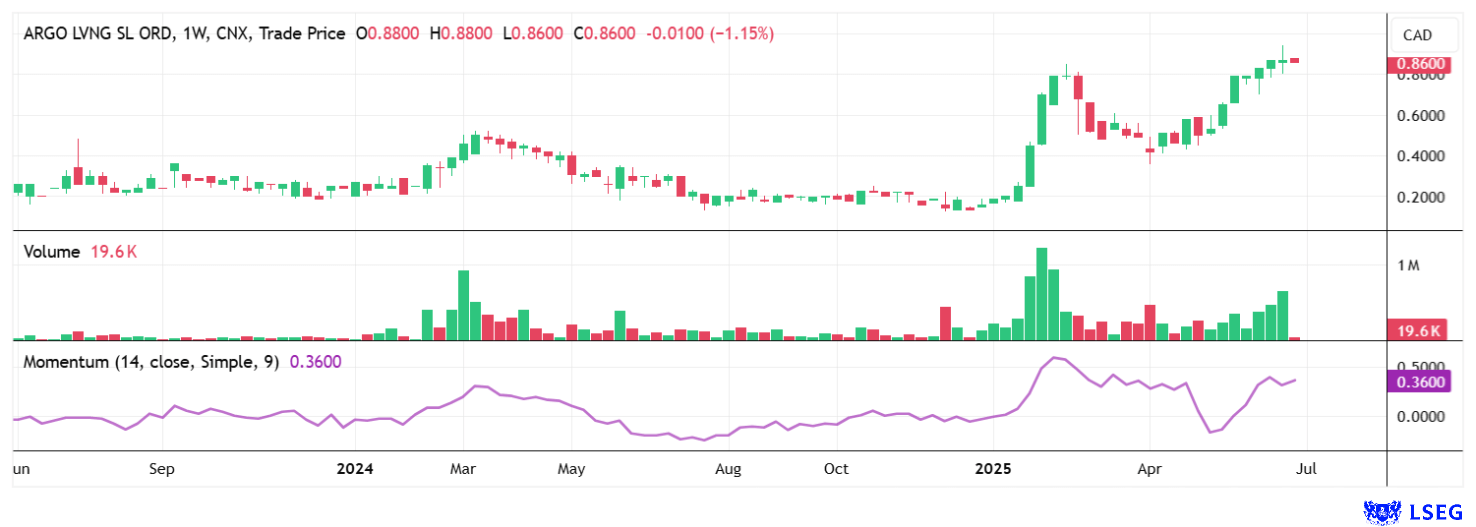
The revaluation in the major indices is already well advanced. Investors are currently on the lookout for interesting themes that could come to fruition even after a ceasefire in Ukraine. With its focus on sustainable construction and infrastructure modernization, Argo Graphene is in tune with the spirit of the times.
Conflict of interest
Pursuant to §85 of the German Securities Trading Act (WpHG), we point out that Apaton Finance GmbH as well as partners, authors or employees of Apaton Finance GmbH (hereinafter referred to as "Relevant Persons") currently hold or hold shares or other financial instruments of the aforementioned companies and speculate on their price developments. In this respect, they intend to sell or acquire shares or other financial instruments of the companies (hereinafter each referred to as a "Transaction"). Transactions may thereby influence the respective price of the shares or other financial instruments of the Company.
In this respect, there is a concrete conflict of interest in the reporting on the companies.
In addition, Apaton Finance GmbH is active in the context of the preparation and publication of the reporting in paid contractual relationships.
For this reason, there is also a concrete conflict of interest.
The above information on existing conflicts of interest applies to all types and forms of publication used by Apaton Finance GmbH for publications on companies.
Risk notice
Apaton Finance GmbH offers editors, agencies and companies the opportunity to publish commentaries, interviews, summaries, news and the like on news.financial. These contents are exclusively for the information of the readers and do not represent any call to action or recommendations, neither explicitly nor implicitly they are to be understood as an assurance of possible price developments. The contents do not replace individual expert investment advice and do not constitute an offer to sell the discussed share(s) or other financial instruments, nor an invitation to buy or sell such.
The content is expressly not a financial analysis, but a journalistic or advertising text. Readers or users who make investment decisions or carry out transactions on the basis of the information provided here do so entirely at their own risk. No contractual relationship is established between Apaton Finance GmbH and its readers or the users of its offers, as our information only refers to the company and not to the investment decision of the reader or user.
The acquisition of financial instruments involves high risks, which can lead to the total loss of the invested capital. The information published by Apaton Finance GmbH and its authors is based on careful research. Nevertheless, no liability is assumed for financial losses or a content-related guarantee for the topicality, correctness, appropriateness and completeness of the content provided here. Please also note our Terms of use.