September 18th, 2026 | 08:20 CEST
Cash Is King: How Barrick and PDI Gold Are Turning Mali into a Cash Cow – Desert Gold Set to Become a Gold Producer
In the past, West Africa was often seen as a region of missed opportunities and geopolitical uncertainties. But a closer look at Mali today shows a different picture. The Republic is focusing on legal certainty and cooperation, presenting itself as a robust and open destination for international investors. Evidence of this can be seen in the investments made by major mining conglomerates. While industry giants such as Barrick are investing in Mali, dynamic challenger Desert Gold is also coming into focus. Desert Gold is poised to become a gold producer. Here is why the company is entering a pivotal phase.
time to read: 3 minutes
|
Author:
Nico Popp
ISIN:
DESERT GOLD VENTURES | CA25039N4084 | TSXV: DAU , OTCQB: DAUGF , BARRICK MINING CORPORATION | CA06849F1080 | NYSE: B , TSX: ABX
Table of contents:
Author

Nico Popp
At home in Southern Germany, the passionate stock exchange expert has been accompanying the capital markets for about twenty years. With a soft spot for smaller companies, he is constantly on the lookout for exciting investment stories.
Tag cloud
Shares cloud
The Power of Capital: How Barrick Mining Dominates the Mining Industry
Traditionally well-established in Mali, the industry leader knows how to handle headwinds. In 2024, Barrick Mining had to contend with operational disruptions at the Loulo-Gounkoto complex due to a dispute with the government. Today, there is hardly a trace of that left. The company secured a 10-year license extension through a pragmatic agreement with the Malian government, which included a compensation payment of approximately USD 430 million (CFA 244 billion francs). Thanks to this breakthrough, Barrick Mining is targeting production of 260,000 to 290,000 ounces at this facility for the current year. The extensive reserves of the entire complex, approximately 57 million metric tons at 3.99 g/t gold (as of the end of 2023), as well as the outlook confirmed as part of the license extension for 6 years of open-pit mining and 16 years of underground mining, strengthen the group's position. Such substantial investments cement the region's status as a safe haven for long-term commitments.
Mali Property Attracted Interest: Robex Resources Joined Forces with PDI Gold
The situation differs for mid-sized players in Mali. Robex Resources is using the cash flow from its Nampala mine to fund further activities. Even with a low gold price, Robex's site generates a net present value of around USD 70 million, while sustainable production costs remain at a manageable USD 1,106 per ounce. These key operating metrics made Robex Resources attractive to PDI Gold last April—the two companies merged. The merger aims to develop a project in the neighbouring Republic of Guinea. The strategy is clear. The company is milking the easily minable geological cash cow in Mali to organically finance the expensive development of new mining areas. This is a smart move and could serve as a blueprint for Desert Gold.
Promotion to the Big Leagues: Desert Gold Drives Cash Flow
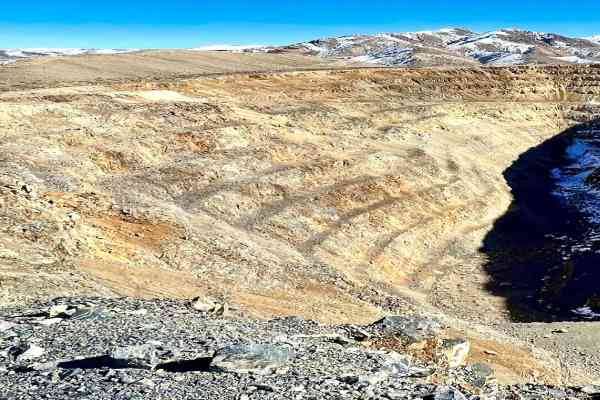
With the SMSZ project, Desert Gold controls an impressive 440 km² over West Africa's most productive shear zone. However, rather than remaining a perpetual explorer and merely identifying new deposits, management has changed course. Desert Gold is installing a modular starter mine at the Barani East deposit. Just recently, the gravity processing plant, along with a powerful 650-kVA generator, arrived on the property. Oxidized ores allow for cost-effective gravity separation, as the heavy precious metal sinks in the water bath. According to Desert Gold, metallurgical tests on the drill cores showed promising gold grades. The project's economic viability is compelling. According to the updated PEA, even a selling price of USD 2,850 per ounce catapults the project's net present value to USD 61 million. At the same time, the study shows the Barani project generates a whopping 57% internal rate of return. Desert Gold is already planning its first commercial gold pour for the fourth quarter of 2026, thereby finally becoming a producer. This will significantly reduce Desert Gold's risk, as it has previously relied on external capital injections.
Second Pillar and Acquisition Potential: Desert Gold's Pipeline
Those who manage their affairs wisely diversify their risk. Desert Gold is doing exactly that and expanding into neighbouring Côte d'Ivoire. The Tiegba project there covers 297 km² and, according to the company, offers great geological potential. With a modest exploration budget of USD 535,000 for the first phase, Desert Gold is pushing ahead with the identification of drill targets. This strategic diversification works in Desert Gold's favour. At the same time, Desert Gold is also an exciting prospect for other reasons: major neighbours are constantly searching for new resources for their processing plants. In the past, smaller companies in Mali have been acquired by larger producers: B2Gold, for example, bought the explorer Oklo Resources and paid an average of USD 86 per ounce at the time.
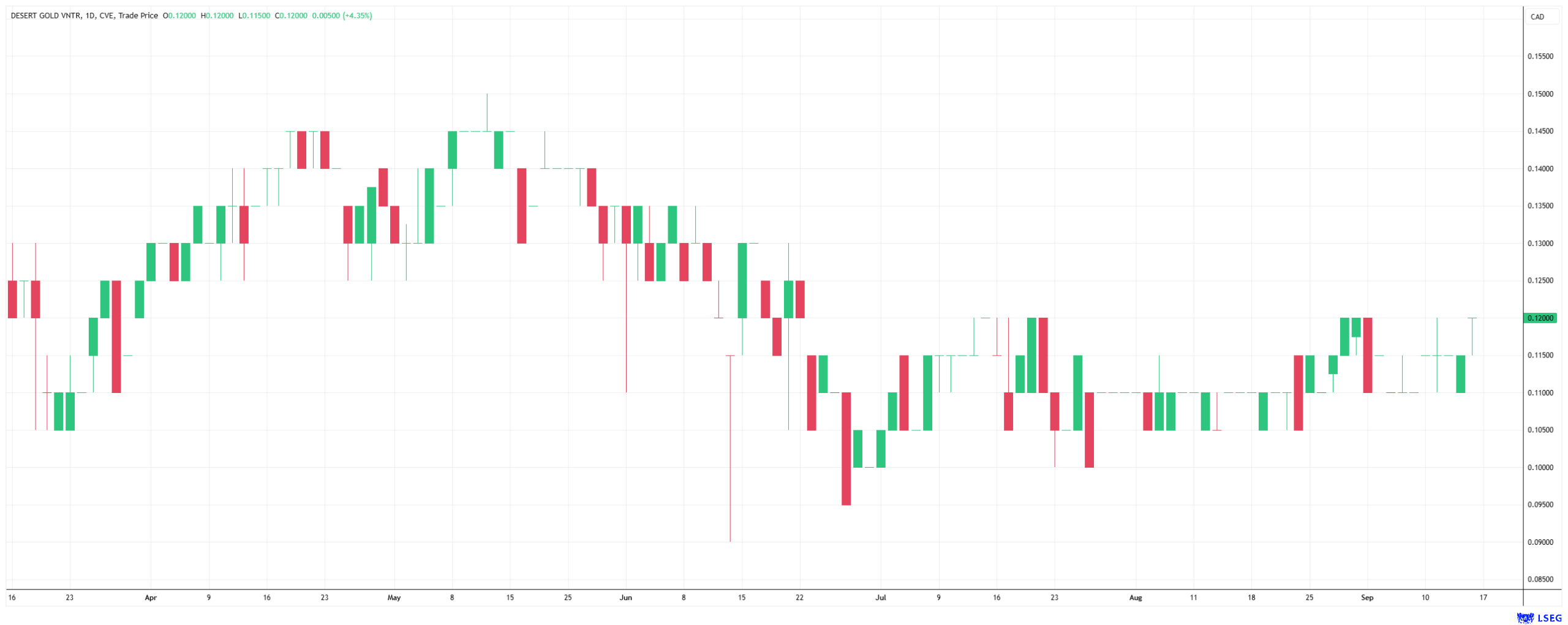
The transition to producer status is forcing the capital market to rethink its approach. Currently, Desert Gold has a market capitalization of just CAD 41.5 million. However, analysts at GBC Research paint a different picture in a commissioned study. According to the research firm's study, the stock's fundamental fair value is CAD 0.93, or EUR 0.59. This represents significant upside potential of nearly 800% from the current price. Once the plant is operating stably in the fall, the market could begin to close this valuation gap. While risks remain, such as those associated with the plant's ramp-up or the West African rainy season, Desert Gold is currently in a promising phase. Since the stock has not made any major moves in months, speculative investors should keep a close eye on it.
Conflict of interest
Pursuant to §85 of the German Securities Trading Act (WpHG), we point out that Apaton Finance GmbH as well as partners, authors or employees of Apaton Finance GmbH (hereinafter referred to as "Relevant Persons") currently hold or hold shares or other financial instruments of the aforementioned companies and speculate on their price developments. In this respect, they intend to sell or acquire shares or other financial instruments of the companies (hereinafter each referred to as a "Transaction"). Transactions may thereby influence the respective price of the shares or other financial instruments of the Company.
In this respect, there is a concrete conflict of interest in the reporting on the companies.
In addition, Apaton Finance GmbH is active in the context of the preparation and publication of the reporting in paid contractual relationships.
For this reason, there is also a concrete conflict of interest.
The above information on existing conflicts of interest applies to all types and forms of publication used by Apaton Finance GmbH for publications on companies.
Risk notice
Apaton Finance GmbH offers editors, agencies and companies the opportunity to publish commentaries, interviews, summaries, news and the like on news.financial. These contents are exclusively for the information of the readers and do not represent any call to action or recommendations, neither explicitly nor implicitly they are to be understood as an assurance of possible price developments. The contents do not replace individual expert investment advice and do not constitute an offer to sell the discussed share(s) or other financial instruments, nor an invitation to buy or sell such.
The content is expressly not a financial analysis, but a journalistic or advertising text. Readers or users who make investment decisions or carry out transactions on the basis of the information provided here do so entirely at their own risk. No contractual relationship is established between Apaton Finance GmbH and its readers or the users of its offers, as our information only refers to the company and not to the investment decision of the reader or user.
The acquisition of financial instruments involves high risks, which can lead to the total loss of the invested capital. The information published by Apaton Finance GmbH and its authors is based on careful research. Nevertheless, no liability is assumed for financial losses or a content-related guarantee for the topicality, correctness, appropriateness and completeness of the content provided here. Please also note our Terms of use.