May 28th, 2026 | 06:55 CEST
BYD and Xiaomi Struggle in Price War—Is dynaCERT Set to Take Off?
When it comes to electric vehicles, the investment world also keeps a close eye on the Asian market, where a fierce price war is currently raging. Former investor darlings have come under unexpected and significant pressure in recent months—and in some cases still are—and are having to accept losses in profits. But while these companies are struggling, a Canadian cleantech company is increasingly coming into focus for investors. With interesting solutions for fuel savings and emissions reduction, it strikes exactly the right chord. In light of surging fuel costs, freight companies worldwide are desperately searching for solutions. And this is precisely where a lucrative opportunity is emerging. Discover the potential of an up-and-coming company like dynaCERT.
time to read: 4 minutes | Author: Matthias Schomber
ISIN: DYNACERT INC. | CA26780A1084 | TSX: DYA , OTCQB: DYFSF , BYD CO. LTD H YC 1 | CNE100000296 , XIAOMI CORP. CL.B | KYG9830T1067
Table of contents:
Author

Matthias Schomber
Raised in Giessen, Hesse, Matthias Schomber discovered his passion for the financial markets as early as the 1990s—at a time when stock trading was still largely the domain of true, die-hard traders. After completing his banking apprenticeship, he worked for a private bank there and witnessed the rise and fall of the Neuer Markt firsthand on the trading floor of the Frankfurt Stock Exchange, drawing lessons from the experience that continue to shape his thinking as a trader, author, and trading system developer to this day.
Tag cloud
Shares cloud
BYD: Tough Times for the Industry Leader
Chinese automotive and battery giant BYD is currently at the center of a fierce price war in its home market. Although the company has shone in the past with rapid growth, recent developments in spring 2026 suggest progress is slowing. Fierce competition is forcing the group to offer ever-deeper discounts, which is having a massive impact on margins. As a result, BYD suffered a sharp drop in profits of over 50% in the first quarter of 2026. At the same time, revenue also weakened. There is a silver lining in the export figures, which saw strong growth. However, that is currently not enough to fully dispel investors' concerns. As a result, the stock has put its recovery attempts on hold for now. It is trading below key technical moving averages again. As long as clear buy signals are missing here, the risk of further setbacks unfortunately remains high. Investors are now eagerly watching the coming weeks and months. It will likely become clear then whether international sales can compensate for domestic weaknesses.
Xiaomi: Margin Pressure and Costly Visions
The current situation at Xiaomi ties in seamlessly with this tense environment. The tech conglomerate is also feeling the headwinds currently sweeping through the Asian economy. Xiaomi is currently fighting on several fronts at once. On the one hand, extremely expensive memory chips are weighing heavily on margins in the traditional smartphone business. This recently caused EBIT to plummet by a significant 70%. On the other hand, the ambitious and cost-intensive expansion into the electric vehicle sector is devouring astronomical sums. Investments in artificial intelligence are also taking their toll. All of this needs to be paid for. Although the launch of a new hybrid SUV is imminent, cost pressures are making the markets uncertain as to whether everything will go as planned. Consequently, Xiaomi shares have taken a significant hit not only in May 2026 but also over the past several months. It has broken through key support levels on the downside. The negative trend has solidified for the time being. Many analysts are adopting a wait-and-see attitude for now, as the hoped-for economies of scale have yet to materialize.
Note that some institutional reports (like Jefferies) cite an analyst-adjusted 70% EBIT plunge against initial peak targets.
dynaCERT: Smart Solutions
While the big corporations are wearing themselves out in price wars over the mobility of tomorrow, a pragmatic solution for the here and now from a smaller provider is coming into focus. A look at the Canadian cleantech specialist dynaCERT reveals a picture that is once again promising, including from a technical chart perspective, but more on that below. The company is dedicated to optimizing the technology that continues to drive our global logistics: the classic internal combustion engine. Especially in times of high fossil fuel prices, freight forwarders and industrial companies are forced to save every drop of fuel.
This is exactly where dynaCERT's HydraGEN technology comes in. By generating hydrogen and oxygen on demand directly on board, the combustion of diesel engines is significantly optimized. This not only protects the environment by reducing emissions but also, above all, benefits operators' bottom lines. In addition, the costly use of diesel exhaust fluid (DEF) is reduced by up to 51%. Maintenance costs also drop. The service life of diesel particulate filters increases by 33%. At the same time, oil changes can be reduced by 25%. The payback period for such a system is impressively fast, with the initial investment paying for itself after just 7 months or 126,428 km driven. That is a solid economic argument for any fleet operator.
On the operational front, dynaCERT also has promising news that could reinforce the current upward trend. On April 27, 2026, the company announced an accelerated market entry into the rapidly growing Vietnamese market. Vietnam is a massive market for commercial vehicles and is significantly affected by high energy import prices. To quickly gain a foothold here, dynaCERT has signed key letters of intent. One is with the Ho Chi Minh City University of Technology (HCMUT), and the other with a large, state-controlled oil and gas conglomerate. The first pilot systems are already running successfully on heavy trucks and container forklifts in the country's major economic hubs.
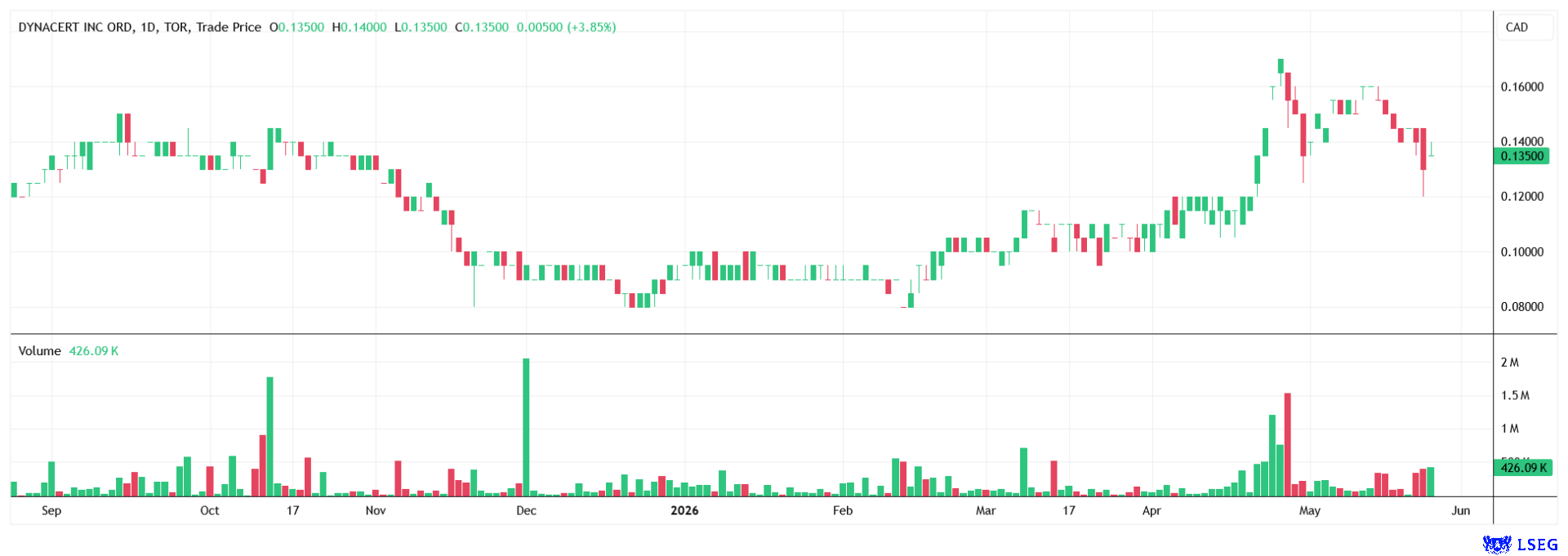
From a technical chart perspective, the situation also looks extremely promising. The stock price has recently turned sharply upward and, according to the chart pattern, could continue trending higher. The stock has already tested the breakout once and briefly executed it when it broke through the CAD 0.15 mark from below. Afterward, the rapid rise was healthily corrected during a consolidation phase. Now, the stock is moving quite steadily and consistently in an intact upward trend. The momentum looks good and is also pointing north. It could carry the stock quite quickly toward CAD 0.16 and even beyond to CAD 0.30. For interested observers, this could therefore present a good entry opportunity now, before the stock rises even further.
Conclusion
In summary, the tech world currently presents a mixed picture. BYD and Xiaomi are undeniably strong companies with grand visions. However, they are currently suffering from a fierce price war and spiralling costs in Asia. Investors need strong nerves and a bit of patience here. The situation is different for dynaCERT. The cleantech company offers an immediately available, economically sound solution to a pressing, global cost problem with fossil fuels. Its expansion into Southeast Asia and the tangible benefits for the environment and the wallet provide a solid foundation. Investors looking for a stock with a functioning business model and emerging chart momentum should consider adding dynaCERT to their watchlist.
Conflict of interest
Pursuant to §85 of the German Securities Trading Act (WpHG), we point out that Apaton Finance GmbH as well as partners, authors or employees of Apaton Finance GmbH (hereinafter referred to as "Relevant Persons") may hold shares or other financial instruments of the aforementioned companies in the future or may bet on rising or falling prices and thus a conflict of interest may arise in the future. The Relevant Persons reserve the right to buy or sell shares or other financial instruments of the Company at any time (hereinafter each a "Transaction"). Transactions may, under certain circumstances, influence the respective price of the shares or other financial instruments of the Company.
In addition, Apaton Finance GmbH is active in the context of the preparation and publication of the reporting in paid contractual relationships.
For this reason, there is a concrete conflict of interest.
The above information on existing conflicts of interest applies to all types and forms of publication used by Apaton Finance GmbH for publications on companies.
Risk notice
Apaton Finance GmbH offers editors, agencies and companies the opportunity to publish commentaries, interviews, summaries, news and the like on news.financial. These contents are exclusively for the information of the readers and do not represent any call to action or recommendations, neither explicitly nor implicitly they are to be understood as an assurance of possible price developments. The contents do not replace individual expert investment advice and do not constitute an offer to sell the discussed share(s) or other financial instruments, nor an invitation to buy or sell such.
The content is expressly not a financial analysis, but a journalistic or advertising text. Readers or users who make investment decisions or carry out transactions on the basis of the information provided here do so entirely at their own risk. No contractual relationship is established between Apaton Finance GmbH and its readers or the users of its offers, as our information only refers to the company and not to the investment decision of the reader or user.
The acquisition of financial instruments involves high risks, which can lead to the total loss of the invested capital. The information published by Apaton Finance GmbH and its authors is based on careful research. Nevertheless, no liability is assumed for financial losses or a content-related guarantee for the topicality, correctness, appropriateness and completeness of the content provided here. Please also note our Terms of use.