September 16th, 2026 | 07:10 CEST
Big Data, More Cloud, Less Energy – Who Has the Best Memory Chips? AMD, Infineon, Aspermont and SK Hynix in Focus
The hunt for the decade's hottest AI returns is officially on. The appetite for data is growing relentlessly, sending server rooms worldwide into overdrive. Four enticing stock market contenders are vying for investors' capital and laying their cards on the table. Memory specialist AMD is proudly flexing its muscles and aims to dominate the field with brute computing power. The chipmaker is pushing deep into cloud infrastructure, leaving the competition green with envy. Infineon, meanwhile, entices with pure efficiency and knows exactly how to achieve maximum endurance with less energy. The Munich-based company is making servers sexy by drastically curbing the giants' power appetite. The Korean firm SK Hynix dominates the high-bandwidth memory segment and feeds AI applications with fresh data at record speed. As a wild underdog, Aspermont brings a breath of fresh air to the game and provides the necessary insight into the commodities universe. What starts as a fling creates a real buzz in the portfolio. This quartet keeps share prices dancing daily and makes analysts break out in a sweat. Investors should decide now which of these tech darlings they want to firmly include in their portfolio. After all, there is not much time left until Christmas to let those little lights shine brightly.
time to read: 6 minutes | Author: André Will-Laudien
ISIN: ASPERMONT LTD. | AU000000ASP3 | ASX: ASP , INFINEON TECH.AG NA O.N. | DE0006231004 , SK HYNIX INC GDR | US78392B1070 , ADVANCED MIC.DEV. DL-_01 | US0079031078
Table of contents:
Author

André Will-Laudien
Born in Munich, he first studied economics and graduated in business administration at the Ludwig-Maximilians-University in 1995. As he was involved with the stock market at a very early stage, he now has more than 30 years of experience in the capital markets.
Tag cloud
Shares cloud
AMD: The Valuation Dance Continues
Down 6% yesterday, then up 4% again today. That is what we are seeing every day right now. Apparently, investors are not quite sure whether the stock's rapid appreciation over the last 12 months is sustainable. US chip designer AMD has stormed into the market for ultra-fast memory and AI solutions with impressive momentum. The latest financial results for Q2 2026 impressively underscore this aggressive expansion strategy. Revenue soared 50% year-over-year to USD 11.54 billion. At the same time, the operating margin turned strongly positive, reaching 17% after a loss last year. Earnings per share also climbed significantly to USD 1.38, while free cash flow swelled to USD 1.56 billion. This financial muscle gives AMD the ammunition to fuel next-generation infrastructure with continued innovation. Wall Street is reacting with visible enthusiasm and continues to issue a clear "Buy" recommendation. The renowned US research firm Bernstein Research recently reaffirmed a clear "Outperform" rating for the stock with a price target of USD 650. Analyst Stacy A. Rasgon thus elegantly brushes aside recent concerns about a possible sudden halt in AI infrastructure expansion. According to experts, even regulatory debates over AI speed limits do not necessarily jeopardize the giant's capital expenditures. The outlook therefore remains promising, as AMD is likely to maintain the upper hand in various market scenarios thanks to its strategic flexibility. Incidentally, the expert consensus on the LSEG Refinitiv platform stands at a whopping USD 606—about 20% above yesterday's closing price.
Infineon: The Green Giant in the Server Room
Despite these long-term sector warnings, the German semiconductor group Infineon is still showing strong momentum, increasing quarterly revenue by 13% to an impressive EUR 4.17 billion. The Munich-based company is showing strong operational health, with an improved segment profit margin of 19.1% and a significant free cash flow turnaround to a positive EUR 599 million. While AMD, as an aggressive chip designer, is fighting on the very front lines of the AI arms race and is thus extremely vulnerable to cyclical saturation waves in the cloud infrastructure market, Infineon operates more as a defensive beneficiary in the background. The German company primarily supplies indispensable energy-efficiency infrastructure and power semiconductors essential to the operation and cooling of modern server facilities, even as the pace of expansion slows.
However, sentiment in the sector appears somewhat subdued. In a research report dated September 11, the major Swiss bank UBS confirmed its "Neutral" rating for Infineon Technologies AG and did not set a price target. While 25 of 29 analysts on the LSEG Refinitiv platform remain very positive about the stock and expect an average 12-month price target of EUR 89, the share price is reacting very sharply and has fallen back to EUR 54. The upside: new investors are looking at a 2027/28 P/E ratio of 14.3. The Munich-based high-tech powerhouse has never been this cheap. Even if the "hangover" predicted by UBS following the AI frenzy does indeed set in starting in 2028, the more broadly diversified Infineon is likely to weather the lean period much more smoothly than the highly focused AI sprinter AMD.
SK Hynix: Sold Out as Far as the Eye Can See
The South Korean memory giant SK Hynix has done everything right by positioning itself early on, and with brutal consistency, as the undisputed king of High-Bandwidth Memory (HBM). Thanks to this technological trailblazing, the company controls well over half of the global market for this ultra-fast, specialized AI memory. The decisive stroke of genius, however, was the exclusive, deeply integrated partnership with AI monopolist Nvidia, whose high-performance graphics cards simply would not work without SK Hynix's components. Because demand for computing power completely overwhelmed production, the company's order books are completely booked well into the future, leading to fantastic gross margins of over 70%. This historic monopoly in one of the world's fastest-growing industries triggered a share-price explosion of over 1,000% within 3 years—even the domestic icon Samsung was coldly overtaken in the wake of this semiconductor supercycle. SK Hynix thus provides the ultimate proof that in the AI gold rush, you do not necessarily have to design the shovels—instead, by exclusively owning the best steel, you can build an even more profitable business.
Aspermont: The Data Turbo for the Next Generation of Mining
From computing power to data power! The true raw material of the coming mining era is not just copper, lithium, or rare earths—it is data. Here, the Australian company Aspermont holds an extraordinary competitive advantage. Step by step, the company is transforming nearly two centuries of industry expertise, real-time market data, and information on more than 12,000 mining projects into a scalable data-and-intelligence platform. The long-established publisher of Mining Journal and Mining Magazine is thus evolving into a B2B data company that no longer merely publishes information but aims to monetize it as a basis for decision-making for mining companies, investors, financial institutions, and governments. The market opportunity is enormous. A recent industry study projects that the global AI-in-mining market could surge from USD 41.3 billion in 2025 to USD 453.6 billion by 2032. In this environment, high-quality proprietary data is becoming a strategic asset.
The foundation of this transformation remains the subscription-based core business, which has now been growing continuously for 40 quarters and generates annual recurring revenue of more than AUD 11 million. At the same time, Aspermont has largely completed its multi-year investment phase and is now entering a scaling phase in which additional data products can be rolled out to the existing customer base with relatively little additional capital. The latest figures underscore this turning point. In Q3 2026, revenue surged 25% to a record AUD 4.50 million, while normalized EBITDA nearly reached break-even after a loss of AUD 0.60 million in the same quarter the previous year. After nine months, revenue thus totals AUD 11.90 million, with subscriptions and data licensing continuing to form a stable foundation, while advertising, Nexus, and events provide additional growth momentum.
IIF host Lyndsay Malchuk interviewed company founder and CEO Alex Kent about the company's future prospects.
The real lever, however, lies with Mining IQ, as Aspermont is attempting to transform its historical data set into a recurring enterprise business with significantly higher value creation. With Rio Tinto, a blockbuster client is already on board. The crucial next step would be to convert project-based contracts into long-term, recurring enterprise contracts; GBC analysts also view this as one of the most important growth drivers for the coming years. At the same time, Aspermont is developing large language model and generative AI applications based on its archive, which will enable the creation of new search, forecasting, risk assessment, and decision-making tools from historical content in the future. In light of this, analysts expect a significant improvement in earnings over the next few years through operational scaling. Despite slight delays in the annual plan, GBC reaffirms its "Buy" recommendation and sets the fair value at AUD 5.20 per share, or EUR 3.15, for the investment horizon through September 2027. By Adam Riese's calculations, that is significant upside. Exciting!
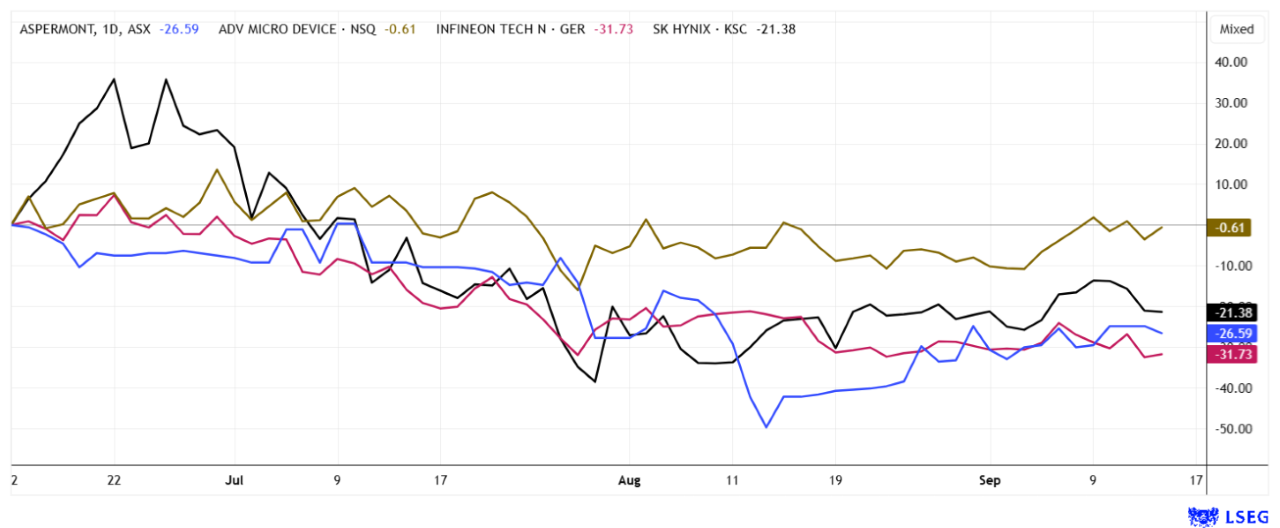
The fierce four-way race for the heart of AI infrastructure impressively demonstrates that yield seekers can bet on completely different semiconductor strategies. While AMD dominates the cloud as an aggressive computing powerhouse, Infineon stands out with cool, green energy efficiency. The undisputed memory king, SK Hynix, continues to grow, and Aspermont has now laid the necessary groundwork as well. Ultimately, investors must find the right balance between explosive growth potential and a robust long-term strategy.
Conflict of interest
Pursuant to §85 of the German Securities Trading Act (WpHG), we point out that Apaton Finance GmbH as well as partners, authors or employees of Apaton Finance GmbH (hereinafter referred to as "Relevant Persons") currently hold or hold shares or other financial instruments of the aforementioned companies and speculate on their price developments. In this respect, they intend to sell or acquire shares or other financial instruments of the companies (hereinafter each referred to as a "Transaction"). Transactions may thereby influence the respective price of the shares or other financial instruments of the Company.
In this respect, there is a concrete conflict of interest in the reporting on the companies.
In addition, Apaton Finance GmbH is active in the context of the preparation and publication of the reporting in paid contractual relationships.
For this reason, there is also a concrete conflict of interest.
The above information on existing conflicts of interest applies to all types and forms of publication used by Apaton Finance GmbH for publications on companies.
Risk notice
Apaton Finance GmbH offers editors, agencies and companies the opportunity to publish commentaries, interviews, summaries, news and the like on news.financial. These contents are exclusively for the information of the readers and do not represent any call to action or recommendations, neither explicitly nor implicitly they are to be understood as an assurance of possible price developments. The contents do not replace individual expert investment advice and do not constitute an offer to sell the discussed share(s) or other financial instruments, nor an invitation to buy or sell such.
The content is expressly not a financial analysis, but a journalistic or advertising text. Readers or users who make investment decisions or carry out transactions on the basis of the information provided here do so entirely at their own risk. No contractual relationship is established between Apaton Finance GmbH and its readers or the users of its offers, as our information only refers to the company and not to the investment decision of the reader or user.
The acquisition of financial instruments involves high risks, which can lead to the total loss of the invested capital. The information published by Apaton Finance GmbH and its authors is based on careful research. Nevertheless, no liability is assumed for financial losses or a content-related guarantee for the topicality, correctness, appropriateness and completeness of the content provided here. Please also note our Terms of use.