February 9th, 2026 | 07:30 CET
Bayer shares in the fast lane! Partner MustGrow Biologics facing revaluation!
For Bayer, things are currently going extremely well. The group is bringing its problem areas under control while reporting tangible progress in its pharmaceutical business. In the shadow of this, the company has secured the license for a new biologically safe product platform for fertilizers. Its partner in this venture is MustGrow Biologics. The company is on the verge of transitioning from research to commercialization, with management planning a market launch later this year. Production capacities are already being expanded in Asia. Against this backdrop, MustGrow shares appear poised for a revaluation - and the company is increasingly emerging as a potential takeover candidate.
time to read: 3 minutes | Author: Fabian Lorenz
ISIN: MUSTGROW BIOLOGICS CORP. | CA62822A1030 , BAYER AG NA O.N. | DE000BAY0017
Table of contents:
Author

Fabian Lorenz
For more than twenty years, the Cologne native has been intensively involved with the stock market, both professionally and privately. He is particularly passionate about national and international small and micro caps.
Tag cloud
Shares cloud
Revaluation through commercialization
Companies that make the leap from the research phase to commercialization often offer investors particularly high opportunities because, in this transition phase, technological progress translates into scalable sales for the first time. On the stock market, this is typically rewarded with a revaluation. MustGrow Biologics is currently in precisely this phase. The company has developed a natural fertilizer for agriculture. The proof of concept was recently published. Over the past two years, the TerraMG™ product has been used on 40 hectares (400,000 square meters) under real-world conditions. The results are revolutionary. Yields increased in the wet year of 2024 and the dry year of 2025. Soil and plant health also improved.
Management optimistic and ambitious
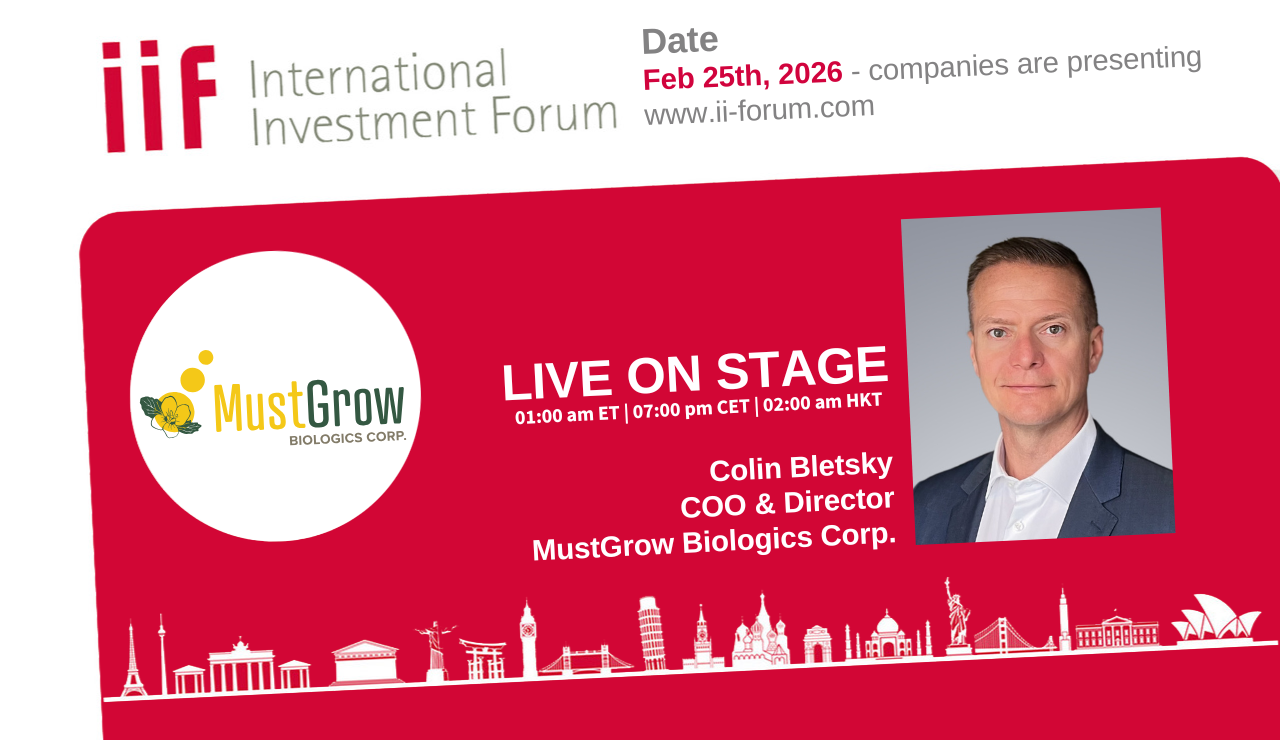
MustGrow COO Colin Bletsky is optimistic and ambitious. In an interview with Lyndsay Malchuk from the International Investment Forum, he emphasized that many "biologicals" have failed for decades due to one central problem: a lack of effectiveness under real-world conditions. MustGrow addresses this issue by extracting natural active ingredients from mustard (the same raw material that ends up on our tables) and putting them into a form that is practical for agricultural use. This includes compatibility with existing agricultural hardware. This allows the company to compete directly with synthetic solutions in terms of effectiveness, without farmers having to fundamentally change their processes or invest in new equipment.
According to Bletsky, the most challenging part of commercialization is less internal than external. This is because agricultural products are highly regulated. The step from patent to scaling is correspondingly lengthy. Success depends largely on approvals and subsequent market adoption. MustGrow is deliberately taking a hands-on approach to this adoption. The team works directly with farmers and local retail structures, scientifically demonstrates the benefits on the respective farm, and supports practical application - an approach that many newcomers have failed at. He cites TerraSante as tangible proof. Due to its convincing field performance in various crops along the US West Coast, the product has been sold out since June 2025.
https://youtu.be/QdRWwgygRbY?si=dLOe46EJIykHXiWw
Bayer Group from partner to buyer?
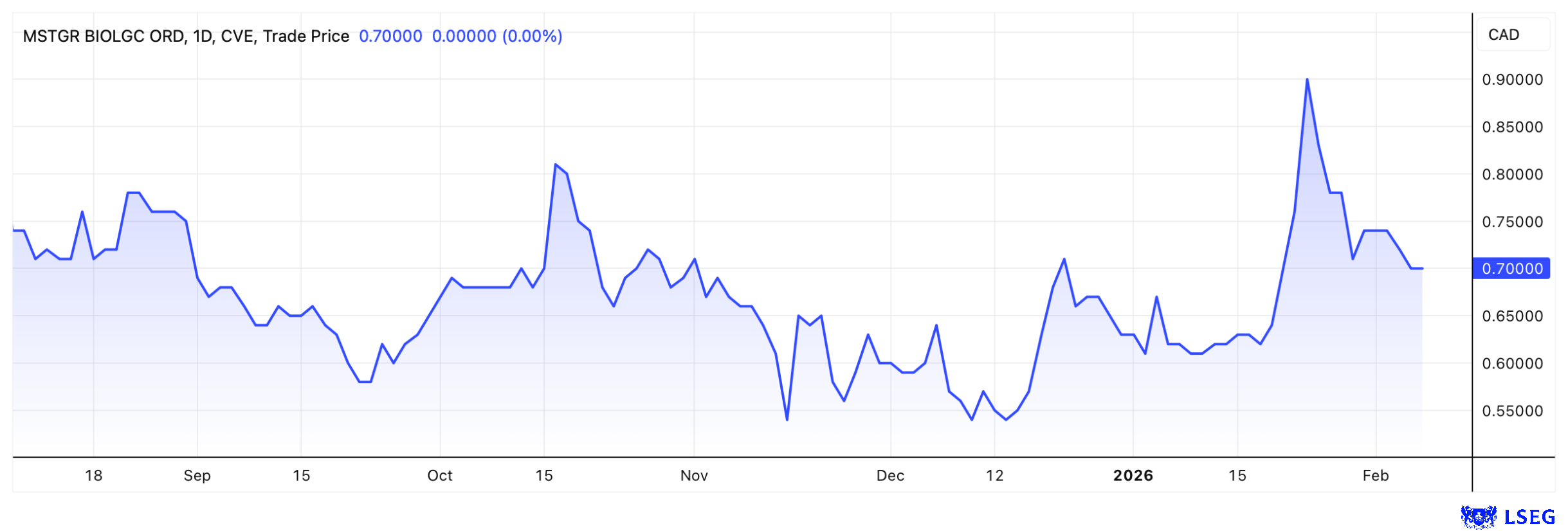
MustGrow derives a clear scaling and growth story from the "sold out" moment. Following the successful capital increase, production at contract manufacturers in Asia is now being ramped up to continuous processes in order to reliably serve the US seasonal window. At the same time, the company sees international pull potential. After the initial focus on North America, Europe, South America, and Australia are set to follow. MustGrow is benefiting from regulatory pressure on synthetic agents. Another plus point is the collaboration with Bayer. The German group is licensing the TerraMG technology for Europe, the Middle East, and Africa and is covering the high costs of approval and market launch there. Following the glyphosate fiasco, the company is likely to be very interested in biologically safe products. It cannot be ruled out that Bayer's role could evolve from strategic partner to acquirer over time. With MustGrow's market capitalization of CAD 63 million and a takeover premium, the price should certainly not be an obstacle.
Conclusion: Revaluation and takeover speculation
MustGrow is in the process of rolling out a billion-dollar market. The products work and are well-received by farmers. Growth capital is also available thanks to the latest financing round. With Bayer, the company not only has a global corporation as a partner, but also a potential buyer. This means that a revaluation of the stock is likely imminent.
Conflict of interest
Pursuant to §85 of the German Securities Trading Act (WpHG), we point out that Apaton Finance GmbH as well as partners, authors or employees of Apaton Finance GmbH (hereinafter referred to as "Relevant Persons") may hold shares or other financial instruments of the aforementioned companies in the future or may bet on rising or falling prices and thus a conflict of interest may arise in the future. The Relevant Persons reserve the right to buy or sell shares or other financial instruments of the Company at any time (hereinafter each a "Transaction"). Transactions may, under certain circumstances, influence the respective price of the shares or other financial instruments of the Company.
In addition, Apaton Finance GmbH is active in the context of the preparation and publication of the reporting in paid contractual relationships.
For this reason, there is a concrete conflict of interest.
The above information on existing conflicts of interest applies to all types and forms of publication used by Apaton Finance GmbH for publications on companies.
Risk notice
Apaton Finance GmbH offers editors, agencies and companies the opportunity to publish commentaries, interviews, summaries, news and the like on news.financial. These contents are exclusively for the information of the readers and do not represent any call to action or recommendations, neither explicitly nor implicitly they are to be understood as an assurance of possible price developments. The contents do not replace individual expert investment advice and do not constitute an offer to sell the discussed share(s) or other financial instruments, nor an invitation to buy or sell such.
The content is expressly not a financial analysis, but a journalistic or advertising text. Readers or users who make investment decisions or carry out transactions on the basis of the information provided here do so entirely at their own risk. No contractual relationship is established between Apaton Finance GmbH and its readers or the users of its offers, as our information only refers to the company and not to the investment decision of the reader or user.
The acquisition of financial instruments involves high risks, which can lead to the total loss of the invested capital. The information published by Apaton Finance GmbH and its authors is based on careful research. Nevertheless, no liability is assumed for financial losses or a content-related guarantee for the topicality, correctness, appropriateness and completeness of the content provided here. Please also note our Terms of use.