October 4th, 2023 | 08:15 CEST
Battery vs. hydrogen! Buy Nel ASA now? Or is FREYR Battery or Altech Advanced Materials better?
Should investors bet on battery stocks over hydrogen stocks? At least when looking at investor darlings like Nel and Plug Power, the answer to this question seems to be "yes" at the moment. The Nel share, in particular, has been hit hard. In local currency, it is trading at its lowest level since the beginning of 2020. Is there hope for a rebound? Or are investors better off betting on battery newcomers like FREYR Battery or Altech Advanced Materials? In terms of share price, Germany's Altech has been the best performer this year, and at the recent Capital Markets Day, management expressed confidence that it would soon take the battery market by storm. So, what is the current status of hopes for hydrogen and batteries?
time to read: 5 minutes | Author: Fabian Lorenz
ISIN: NEL ASA NK-_20 | NO0010081235 , Freyr Battery | LU2360697374 , ALTECH ADV.MAT. NA O.N. | DE000A31C3Y4
Table of contents:
Author

Fabian Lorenz
For more than twenty years, the Cologne native has been intensively involved with the stock market, both professionally and privately. He is particularly passionate about national and international small and micro caps.
Tag cloud
Shares cloud
Altech: Share ready for year-end rally
Batteries are becoming increasingly versatile. They are not only seen as the leading technology for cars but are also starting to outpace hydrogen in the truck industry. And, of course, there is also a huge market for energy storage systems to harness wind and solar energy efficiently. At the same time, technological progress seems to be much faster than with hydrogen. Altech Advanced Materials is working on a new generation of batteries. A pilot plant for the production of performance-enhancing anode material (Silumina) for use in electromobility is already being built in the Schwarze Pumpe chemical park in Saxony. The Company recently invited investors and financial journalists to the site.
On-site, the financial community was able to get an idea of the progress, and the management was confident. The plant is scheduled to go into operation this month so that customers from the automotive industry can test the innovation. In the future, 10,000 tons of the graphite-silicon anodes with a patented ceramic nano-coating will be produced annually for use in high-performance lithium-ion batteries. Altech's technology is expected to significantly improve today's batteries: more range and faster charging. After the preliminary profitability study had convinced with an annual EBITDA of USD 65 million and a cash value of more than USD 500 million, the final study is expected by the end of the year. If this confirms the initial results, the stock should gain new momentum.
Altech shares are also benefiting from a second exciting project: the CERENERGY® Sodium-Chloride Solid State battery (SCSS). These are being developed jointly with Fraunhofer IKTS and are intended to solve the major problem of renewable energies. For example, energy from wind is only available when it blows and from the sun only when it shines. Current energy storage systems are far too expensive. Yet experts estimate that the market for energy storage is expected to grow to 15.1 billion by 2027 - in 2022, the figure was USD 4.4 billion. Altech and Fraunhofer want to take a big slice of this pie with a solid-state battery based on common salt and nickel. The feasibility study is to be published before the end of the year. This also offers upside potential for the share price.
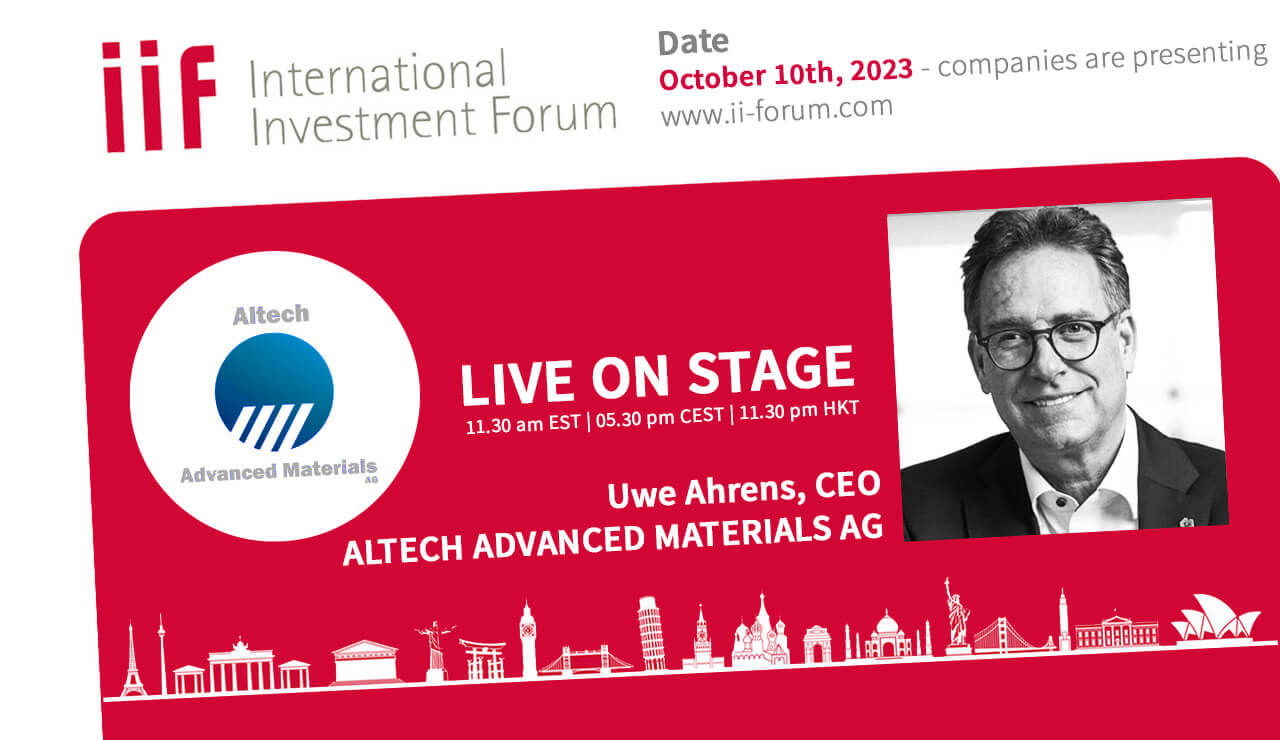
Altech Advanced Materials holds a 25% and 18.75% stake in the projects. The remaining shares are held by the Australian parent company or Fraunhofer. This is positive, as it means that the investments do not have to be borne alone, and the market capitalization would then probably not be "only" EUR 31 million. The Altech management will present at the 8th iif - International Investment Forum - virtual investor conference on October 10, 2023. Also included are exciting companies such as K+S and 3U Holdings. Click here to register for free.
FREYR Battery: Don't catch a falling knife
FREYR Battery is also working on developing next-generation energy storage devices. However, the Company is already valued at a proud USD 658 million – one could still say because the stock price has roughly halved within a year. High investments in an environment of rising interest rates and a change in top management created selling pressure.
While the test run begins at the factory in Norway, preparations are underway for a factory in the US. Project-level capital raising for "Giga America" is to be completed by the end of 2023 in order to make the final investment decision. The accelerated development is intended to accelerate FREYR's expansion in the US to meet customer requests for purpose-built storage solutions and maximize financial incentives. This means FREYR wants to tap into the US government's billion-dollar pot of renewable energy funding. Previously, they had secured EUR 100 million in EU funding. Now, they are targeting the US.
Fittingly, FREYR's Board of Directors has approved an action plan for relocating the holding company's headquarters from Luxembourg to the US, to be completed by the end of 2023. It is quite openly communicated that this is to maximize subsidies from the US Inflation Reduction Act ("IRA"). Previously, the resignation of the Company's founder, Torstein Dale Sjøtveit, as CEO had caused turmoil. His successor is former Microsoft executive Birger Stehen.
The FREYR share lost more than 2% again yesterday and is now trading just above EUR 4, marking a new all-time low.
Nel: Get in now?
There is currently also a significant drop in Nel's stock price. After breaking through the NOK 10 mark to the downside in September, it is in free fall and was quoted at NOK 7.75 yesterday. The share was last quoted at this level at the beginning of 2020, so is it worth getting in now? In addition to the stock market wisdom do not catch a falling knife, there are further warnings to consider. Nel is still valued at over NOK 12 billion. This is offset by a large order backlog but also an unprofitable operating business. On October 25, Nel will report on its third quarter. Even though the loss has been reduced, analysts expect the Company to increase its capital until it reaches breakeven. Hopefully, the Company will use the quarterly report to provide clarity here.
Operatively, there has been little news from Nel recently, except for the announcement of finding a site for its planned factory in the US. The factory will be located in a suburb of Detroit, Michigan, with an annual total capacity of 4 GW for alkaline and PEM technology. It is expected to be one of the largest electrode production plants in the world. "Plymouth Charter Township is an ideal location for Nel. Here, we have access to a well-educated workforce, universities and research facilities, and we are close to our cooperation partner, General Motors. In addition, the Michigan government and authorities have put together a very attractive financial support package for us," says Håkon Volldal, CEO of Nel. So far, Nel has received over USD 50 million in support for its Michigan site, and this amount could increase to around USD 150 million, pending approval of additional state and federal applications.
Battery and hydrogen both have a right to exist in the future. Those looking to profit should take a close look at Altech Advanced Materials. The Company is "only" a junior partner in both projects, but the market potential is enormous, the valuation is not high, and the investments are mainly made by the larger partner. Nel and FREYR are, in principle, also technologically interesting, but the share prices speak a clear language, and the valuations are still high despite the share price declines.
Conflict of interest
Pursuant to §85 of the German Securities Trading Act (WpHG), we point out that Apaton Finance GmbH as well as partners, authors or employees of Apaton Finance GmbH (hereinafter referred to as "Relevant Persons") may hold shares or other financial instruments of the aforementioned companies in the future or may bet on rising or falling prices and thus a conflict of interest may arise in the future. The Relevant Persons reserve the right to buy or sell shares or other financial instruments of the Company at any time (hereinafter each a "Transaction"). Transactions may, under certain circumstances, influence the respective price of the shares or other financial instruments of the Company.
In addition, Apaton Finance GmbH is active in the context of the preparation and publication of the reporting in paid contractual relationships.
For this reason, there is a concrete conflict of interest.
The above information on existing conflicts of interest applies to all types and forms of publication used by Apaton Finance GmbH for publications on companies.
Risk notice
Apaton Finance GmbH offers editors, agencies and companies the opportunity to publish commentaries, interviews, summaries, news and the like on news.financial. These contents are exclusively for the information of the readers and do not represent any call to action or recommendations, neither explicitly nor implicitly they are to be understood as an assurance of possible price developments. The contents do not replace individual expert investment advice and do not constitute an offer to sell the discussed share(s) or other financial instruments, nor an invitation to buy or sell such.
The content is expressly not a financial analysis, but a journalistic or advertising text. Readers or users who make investment decisions or carry out transactions on the basis of the information provided here do so entirely at their own risk. No contractual relationship is established between Apaton Finance GmbH and its readers or the users of its offers, as our information only refers to the company and not to the investment decision of the reader or user.
The acquisition of financial instruments involves high risks, which can lead to the total loss of the invested capital. The information published by Apaton Finance GmbH and its authors is based on careful research. Nevertheless, no liability is assumed for financial losses or a content-related guarantee for the topicality, correctness, appropriateness and completeness of the content provided here. Please also note our Terms of use.