September 21st, 2026 | 07:20 CEST
Barrick Mining, Desert Gold, B2Gold: From Reliable Cash Flow to Significant Leverage in Mali's Resurgent Gold Region
Mali is back on the map for gold investors. Between January and June 2026, the country produced 23.5 metric tons of gold—about 30% more than in the same period the previous year and more than the government had anticipated (21.2 metric tons). At the same time, the price per troy ounce exceeds USD 4,300. High prices and mines resuming operations are working in producers' favour, while developers hope to make the leap into production. Investors looking to profit from this trend have a choice between steady cash flow, the significant upside potential of a production launch, and regional growth. We therefore take a closer look at three companies active in Mali: Barrick Mining, Desert Gold and B2Gold.
time to read: 5 minutes
|
Author:
Armin Schulz
ISIN:
BARRICK MINING CORPORATION | CA06849F1080 | NYSE: B , TSX: ABX , DESERT GOLD VENTURES | CA25039N4084 | TSXV: DAU , OTCQB: DAUGF , B2GOLD CORP. | CA11777Q2099
Table of contents:
Author

Armin Schulz
Born in Mönchengladbach, he studied business administration in the Netherlands. In the course of his studies he came into contact with the stock exchange for the first time. He has more than 25 years of experience in stock market business.
Tag cloud
Shares cloud
Barrick Mining: Mali Is Back in Operation, but the IPO Is in Jeopardy
Mali remains a tough market for Barrick Mining. The Loulo-Gounkoto complex resumed operations in the first half of 2026, earlier than planned. Across the group, 796,000 ounces of gold were produced in the second quarter—11% more than the previous quarter and above the company's forecast of 730,000 to 770,000 ounces. The 2023 Mining Code raised royalty rates and government stakes, and Bamako holds a 20% stake in the mine. The Africa region posted all-in sustaining costs of USD 1,944 per ounce for the first half of the year.
On September 2, Bloomberg reported news that threw the timeline into disarray. According to the report, Barrick is considering postponing the initial public offering (IPO) of its North American gold division until 2027. As recently as August 10, Mark Hill, who is set to lead the new unit, had told analysts that the deal would close by the end of the year. Goldman Sachs is advising on the transaction and is in talks with other banks. One hurdle has already been cleared. In August, Barrick reached an agreement with its competitor Newmont to restructure the Nevada joint venture. Investors were not satisfied with the deal, as Barrick had to contribute the promising Fourmile project.
Operations are running smoothly. In the second quarter, the company generated just under USD 5.3 billion in revenue, with operating cash flow of approximately USD 1.7 billion, resulting in a net profit of USD 1.217 billion. However, attributable free cash flow was meagre at USD 141 million. Management is sticking to its forecast of 2.90 to 3.25 million ounces of gold. In August, the company declared a quarterly dividend of USD 0.175 per share, paid on September 15, and also conducted share buybacks totaling USD 1.209 billion. If the restart in Mali proves sustainable, upside remains.
Desert Gold: Processing Plant Arrives, First Gold Expected in Q4 2026
On September 16, Desert Gold reported that the gravity processing plant and the 650-kVA generator had arrived at the Barani site. Both are part of the Senegal Mali Shear Zone (SMSZ) project in the Kayes region of western Mali, which is 100% owned by the company. The plant is designed for a nominal capacity of 200 metric tons per day. The generator arrived at the port of Dakar in July 2026, followed by the plant in mid-August 2026. Both units had undergone factory acceptance testing prior to being cleared for delivery. The delivery was the biggest hurdle, and it has now been cleared.
Meanwhile, site preparation and civil engineering work continued. Equipment and construction materials are being moved into the active work areas. The main access road from the village of Bourdala to the Barani mine site has been rehabilitated and is now used to transport plant equipment. For the water supply, Desert Gold completed a hydrogeological and geophysical program comprising 15 survey lines and 688 stations. Four boreholes were drilled; three of them yielded flow rates of 24, 9, and 8 m³/h. The final report is still pending. So far in 2026, no safety, occupational health, or community incidents have been reported. This works in the schedule's favour.
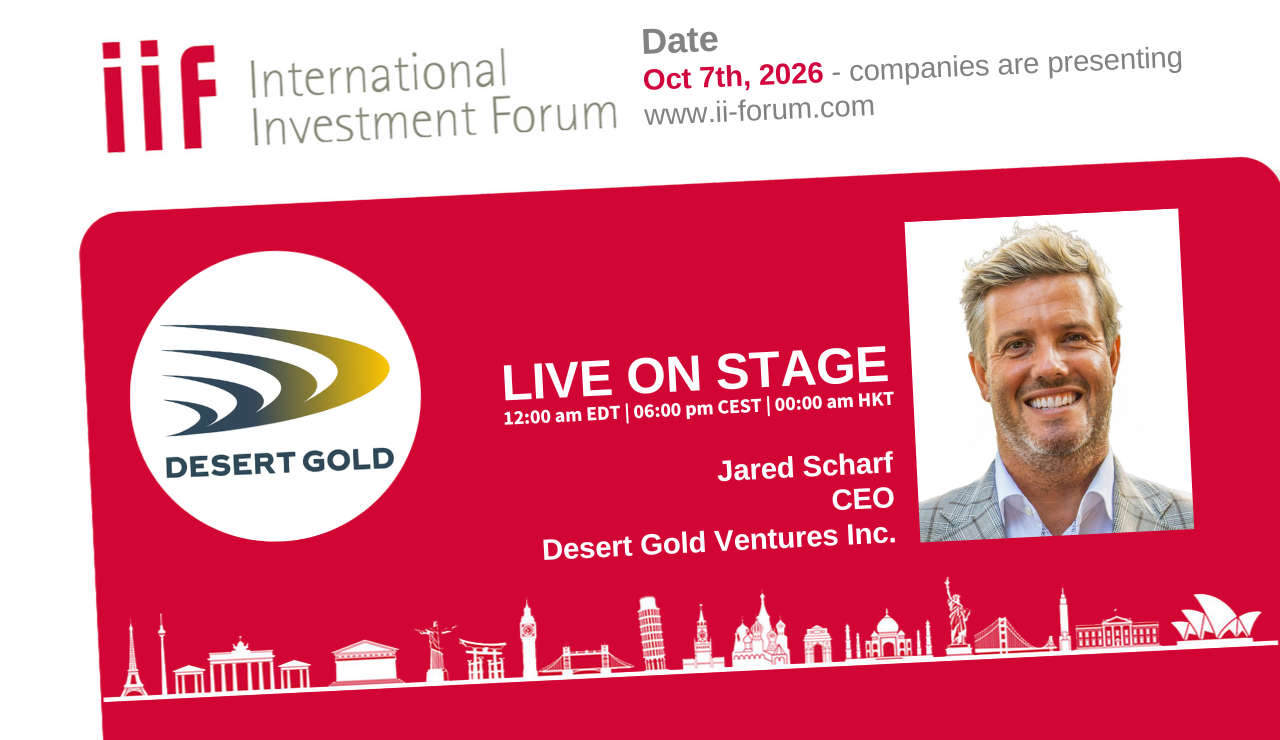
As an investor, one naturally wants to know when the first gold will be produced. The timeline is set. By the end of October 2026, the remaining civil engineering work, mechanical and electrical installation, and commissioning are scheduled for completion. The ramp-up and initial processing are scheduled for November 2026. If this process goes according to plan, Desert Gold aims to begin gold production in the fourth quarter of 2026. With the rainy season in western Mali drawing to a close, site productivity is expected to pick up. The company would then transition from an explorer to a producer. October could be an important month to watch. Once gold production begins, the company could turn its attention to additional exploration targets, including the Tiegba project in Côte d'Ivoire.
B2Gold: Menankoto Permit Paves the Way in Mali
For B2Gold, Mali is not a side project but the heart of its production. On August 7, 2026, the government granted the Malian subsidiary the Menankoto mining permit. This clears a major hurdle. The Fekola Regional area is located about 20 km from the Fekola Mine and is expected to produce more than 150,000 ounces of gold annually from 2028 through the mid-2030s. The company holds an 80% stake in the mine and a 65% stake in Fekola Regional. Since 2014, more than USD 2.0 billion has flowed into the country. More than 3,300 people work there.
In the second quarter of 2026, the Fekola complex produced 116,281 ounces; in the first half of the year, production totaled 233,731 ounces, up from 220,166 ounces in the prior year. Higher mill throughput and better ore grades worked in the company's favour. The realized gold price climbed to USD 4,529 per ounce, up from USD 3,276 in the same quarter of the previous year. Gold revenue rose to USD 518.0 million from USD 377.3 million. However, costs are rising. Cash costs stood at USD 1,185 per ounce produced, while all-in sustaining costs were USD 2,289 per ounce sold.
The annual forecast for the Fekola Complex was cut to 390,000 to 420,000 ounces; the group-wide plan calls for 820,000 to 920,000 ounces. The bottom line for the quarter was a net profit of USD 417 million; on an adjusted basis, it was just USD 41 million. Free cash flow was negative USD 258 million. Tax payments and gold collar contracts, which cost USD 71 million, took a toll. The contracts will be settled in January 2027. The company distributed USD 224 million to shareholders in the first half of the year. If the ramp-up at Fekola Regional is successful by the end of 2027, the tide could turn.
Mali is shining again, and all three companies are well-positioned to benefit. Barrick Mining provides a solid foundation with ongoing cash flow and benefits from the high gold price. Desert Gold is on the verge of transitioning from an explorer to a producer and could pour its first gold in the fourth quarter of 2026. B2Gold has paved the way for Fekola Regional with Menankoto, thereby securing long-term growth in a strong gold-producing region. Political progress and clear plans currently make Mali an attractive investment story. This opens up an exciting environment for investors.
Conflict of interest
Pursuant to §85 of the German Securities Trading Act (WpHG), we point out that Apaton Finance GmbH as well as partners, authors or employees of Apaton Finance GmbH (hereinafter referred to as "Relevant Persons") currently hold or hold shares or other financial instruments of the aforementioned companies and speculate on their price developments. In this respect, they intend to sell or acquire shares or other financial instruments of the companies (hereinafter each referred to as a "Transaction"). Transactions may thereby influence the respective price of the shares or other financial instruments of the Company.
In this respect, there is a concrete conflict of interest in the reporting on the companies.
In addition, Apaton Finance GmbH is active in the context of the preparation and publication of the reporting in paid contractual relationships.
For this reason, there is also a concrete conflict of interest.
The above information on existing conflicts of interest applies to all types and forms of publication used by Apaton Finance GmbH for publications on companies.
Risk notice
Apaton Finance GmbH offers editors, agencies and companies the opportunity to publish commentaries, interviews, summaries, news and the like on news.financial. These contents are exclusively for the information of the readers and do not represent any call to action or recommendations, neither explicitly nor implicitly they are to be understood as an assurance of possible price developments. The contents do not replace individual expert investment advice and do not constitute an offer to sell the discussed share(s) or other financial instruments, nor an invitation to buy or sell such.
The content is expressly not a financial analysis, but a journalistic or advertising text. Readers or users who make investment decisions or carry out transactions on the basis of the information provided here do so entirely at their own risk. No contractual relationship is established between Apaton Finance GmbH and its readers or the users of its offers, as our information only refers to the company and not to the investment decision of the reader or user.
The acquisition of financial instruments involves high risks, which can lead to the total loss of the invested capital. The information published by Apaton Finance GmbH and its authors is based on careful research. Nevertheless, no liability is assumed for financial losses or a content-related guarantee for the topicality, correctness, appropriateness and completeness of the content provided here. Please also note our Terms of use.