January 29th, 2026 | 07:45 CET
Antimony: Critical raw material becomes a geopolitical factor – Antimony Resources poised for revaluation
Antimony Resources is quietly emerging as a raw materials story with enormous strategic impact. The critical raw material antimony is relevant to security, indispensable to industry, and too unevenly distributed globally. In an environment where supply chains are politicized and critical raw materials are becoming geopolitical weapons, the Company is set to increasingly come into focus with Bald Hill, the largest antimony project in North America. Investors who recognize the trend early on are securing a place at the beginning of a highly exciting and lucrative investment story.
time to read: 4 minutes | Author: Carsten Mainitz
ISIN: ANTIMONY RESOURCES CORP | CA0369271014
Table of contents:
Author

Carsten Mainitz
The native Rhineland-Palatinate has been a passionate market participant for more than 25 years. After studying business administration in Mannheim, he worked as a journalist, in equity sales and many years in equity research.
Tag cloud
Shares cloud
Antimony – From an overlooked by-product to a critical factor in modern economies
Antimony plays a special role in key industries and is gaining strategic importance due to the increasingly problematic global supply and demand structure. Most countries classify the semi-metal as a critical raw material. Over 70% of global production comes from China. Other significant quantities come from politically problematic areas such as Russia and Tajikistan.
By far the largest area of application is in flame retardants. Antimony compounds are added to plastics, textiles, cable sheathing, and building materials to significantly reduce their flammability. In addition, it is important for energy storage and electrification. This role and the resulting demand are still greatly underestimated in times of growing power grids and decentralized energy storage.
However, its use in military and security-related areas is of central importance. Antimony is used in special alloys, ammunition, optical systems, infrared technology, and electronic components. Antimony is practically indispensable in military applications – in times of geopolitical tensions and national initiatives for the security of raw material supplies and supply chains, this is an important factor.
Antimony Resources – Strategic asset with geopolitical significance
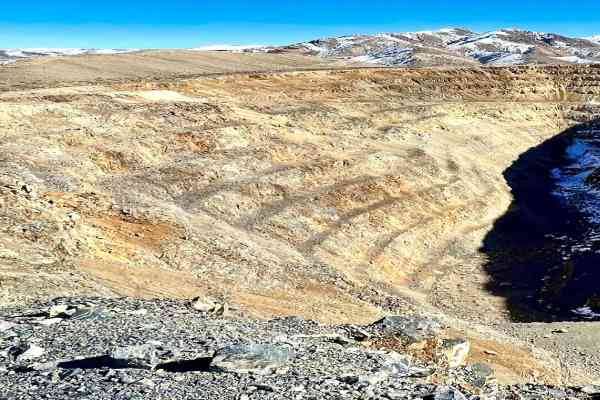
The exploration company is focused on the Bald Hill Project in the Canadian province of New Brunswick, a resource-friendly jurisdiction with favorable conditions. The 1,100-hectare property is considered one of the largest known antimony projects in North America. Historically, more than 13,800 meters of drilling has been completed on the property, including a good 8,000 meters last year.
The data, including the latest information released just a few days ago, shows excellent results, high antimony mineralization, and indicates a high-grade and extensive system. The Main Zone was significantly expanded last year and now extends over a length of more than 700 meters and reaches depths of more than 400 meters.
Indication of potential size
A technical report from the fourth quarter of 2025 provided an initial important indication of the potential size of the deposits. The report calculated that the Bald Hill Project comprises approximately 2.7 million tons of rock with grades of 3 to 4% antimony. This translates into an "occurrence" of 81,000 to 108,000 tons of pure metal, representing a large deposit, even on a global scale.
The next logical step is to prepare a resource estimate in accordance with Canadian standard NI 43-101. The Company has announced that this will be completed by the end of the year, or by spring 2027 at the latest. This is an important milestone for investors in assessing the size, value and economic viability of the project. Such a resource estimate often leads to a jump in a company's valuation.
New data on the drilling program
A few days ago, Antimony Resources published new results from the ongoing drilling program at Bald Hill. The data once again confirms sections with robust antimony mineralization across several zones. The mineralization is repeated, consistent, and occurs in geological structures that indicate potential for expansion.
Antimony Resources reported further massive antimony-bearing stibnite deposits ("Sb") with 5.10% Sb over 4.0 meters, 2.15% Sb over 6.85 meters, and 2.38% Sb over 9.60 meters. The data further confirms that 75% to 80% of all drill holes return high-grade antimony-bearing stibnite mineralization. The average grade of the mineralization remains between 3% and 4% Sb, according to the Company.
Great potential in sight
In the current year, the Company plans to investigate two unexplored zones with antimony-bearing mineralization south (Bald Hill South) and west (Marcus Zone) of the Main Zone. The Company sees great potential in the Marcus Zone in particular. The expansion drilling planned for the Main Zone in the current year is essential for the planned resource estimate. All measures can be easily financed by the CAD 9 million capital increase carried out last year.
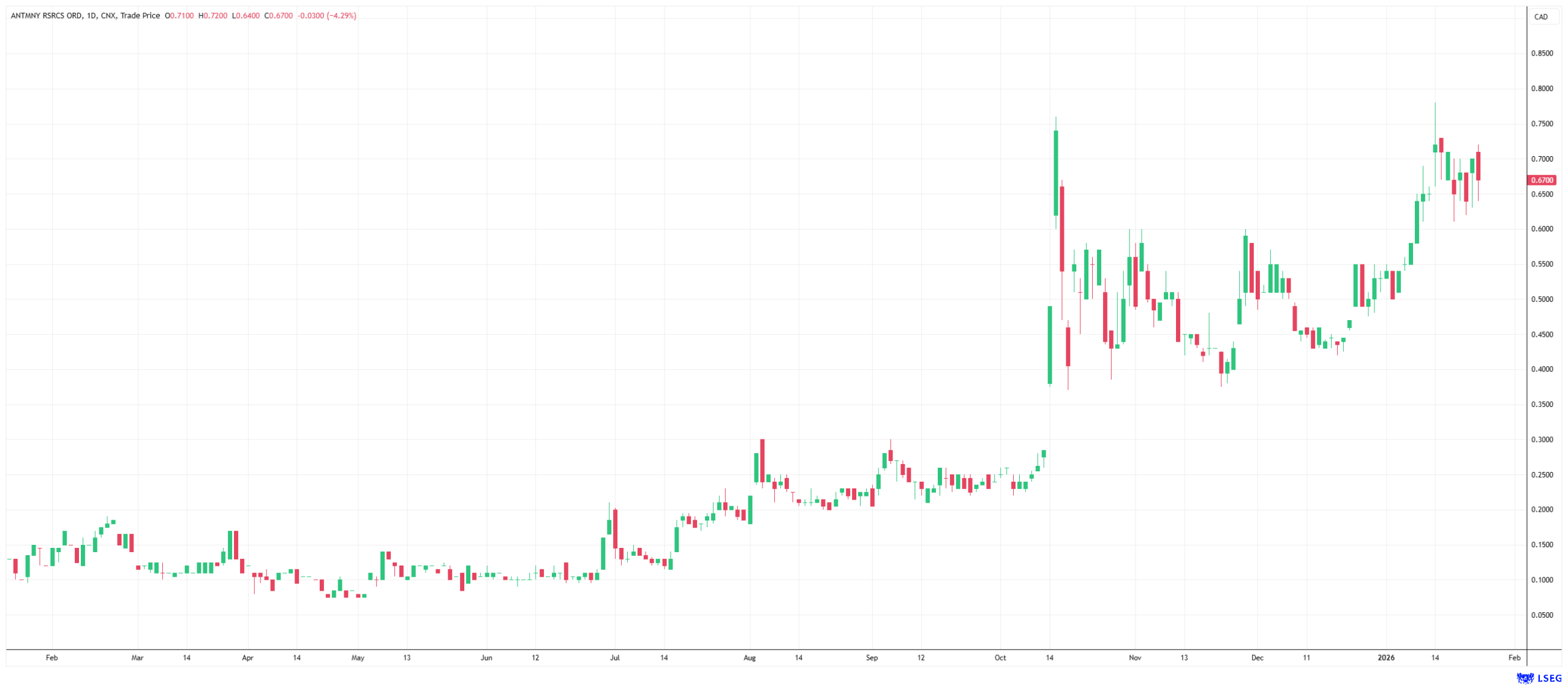
Good drilling data and evidence of high-grade and thick antimony mineralization have boosted the stock in recent months. The share price has multiplied. Last year's technical report provided an initial good indication of the high value of the project. This contrasts with a current market capitalization of a modest CAD 53 million. New drilling data and the further development of the Bald Hill project will provide positive momentum for the stock.
Conclusion
The critical raw material antimony is still little known, but is rapidly and inexorably gaining geopolitical importance. Its applications are systemically important, its substitutability is low, and its production is too heavily concentrated in China and other politically problematic countries. Western industries and governments are desperately seeking secure and reliable sources of supply. With Bald Hill, the Company owns the largest antimony deposit in North America, which is characterized by its high mineralization grades. With this strategic asset, Antimony Resources is gaining geopolitical importance, which will gradually be reflected in a structural revaluation of the Company. Antimony Resources is currently valued at a modest CAD 53 million. Further data from the drilling program is expected to have a positive impact on the share price.
Conflict of interest
Pursuant to §85 of the German Securities Trading Act (WpHG), we point out that Apaton Finance GmbH as well as partners, authors or employees of Apaton Finance GmbH (hereinafter referred to as "Relevant Persons") currently hold or hold shares or other financial instruments of the aforementioned companies and speculate on their price developments. In this respect, they intend to sell or acquire shares or other financial instruments of the companies (hereinafter each referred to as a "Transaction"). Transactions may thereby influence the respective price of the shares or other financial instruments of the Company.
In this respect, there is a concrete conflict of interest in the reporting on the companies.
In addition, Apaton Finance GmbH is active in the context of the preparation and publication of the reporting in paid contractual relationships.
For this reason, there is also a concrete conflict of interest.
The above information on existing conflicts of interest applies to all types and forms of publication used by Apaton Finance GmbH for publications on companies.
Risk notice
Apaton Finance GmbH offers editors, agencies and companies the opportunity to publish commentaries, interviews, summaries, news and the like on news.financial. These contents are exclusively for the information of the readers and do not represent any call to action or recommendations, neither explicitly nor implicitly they are to be understood as an assurance of possible price developments. The contents do not replace individual expert investment advice and do not constitute an offer to sell the discussed share(s) or other financial instruments, nor an invitation to buy or sell such.
The content is expressly not a financial analysis, but a journalistic or advertising text. Readers or users who make investment decisions or carry out transactions on the basis of the information provided here do so entirely at their own risk. No contractual relationship is established between Apaton Finance GmbH and its readers or the users of its offers, as our information only refers to the company and not to the investment decision of the reader or user.
The acquisition of financial instruments involves high risks, which can lead to the total loss of the invested capital. The information published by Apaton Finance GmbH and its authors is based on careful research. Nevertheless, no liability is assumed for financial losses or a content-related guarantee for the topicality, correctness, appropriateness and completeness of the content provided here. Please also note our Terms of use.