June 9th, 2026 | 08:30 CEST
Almonty Industries: Rebound After the Bond Shock? Deutsche Telekom Shifts to AI, Munich Re Buys the Dip!
The stock markets in June 2026 remain volatile and dynamic. While established blue chips such as Deutsche Telekom AG are upgrading their networks with artificial intelligence ahead of the upcoming FIFA World Cup, Munich Re is navigating the challenges of climate volatility and declining share prices. Against this turbulent backdrop, Almonty—which is becoming increasingly important strategically—is causing a huge stir in the markets. The tungsten specialist recently placed a large-scale bond issuance. The market reacted with a sharp sell-off last Friday, initially driven by shock over the announcement. However, this apparent setback could now be creating a compelling opportunity for discerning investors. We take a look behind the scenes at these three stocks.
time to read: 5 minutes | Author: Matthias Schomber
ISIN: ALMONTY INDUSTRIES INC. | CA0203987072 | TSX: AII , NASDAQ: ALM , ASX: AII , DEUTSCHE TELEKOM ADR 1 | US2515661054 , MUENCH.RUECKVERS.VNA O.N. | DE0008430026
Table of contents:
Author

Matthias Schomber
Raised in Giessen, Hesse, Matthias Schomber discovered his passion for the financial markets as early as the 1990s—at a time when stock trading was still largely the domain of true, die-hard traders. After completing his banking apprenticeship, he worked for a private bank there and witnessed the rise and fall of the Neuer Markt firsthand on the trading floor of the Frankfurt Stock Exchange, drawing lessons from the experience that continue to shape his thinking as a trader, author, and trading system developer to this day.
Tag cloud
Shares cloud
Deutsche Telekom: The "AI Powerhouse"
Anyone who still considers Deutsche Telekom a sluggish, boring dividend play is missing the real story. The share is currently trading at around EUR 27.50 and has indeed taken a hit year-over-year. Operationally, however, a real growth momentum is building here. The often-criticized, ruinous price war in the German home market is subsiding. Competitors like Telefonica Deutschland and 1&1 are offering massive discounts to new customers and limiting data allowances even on their entry-level plans. The industry is escaping the low-cost trap—a spiral that could be ruinous. The focus is shifting toward high-value bundled offerings combining mobile, landline, and entertainment services. This plays right into Telekom's hands with its well-known "Magenta EINS" program. Even Telefonica's new initiative with "O2 Mobile Plus" (set to launch on June 10) ultimately stabilizes price levels across the entire market.
But the real catalyst, however, lies on the other side of the Atlantic. The US subsidiary T-Mobile US is proving to be a driving force for Telekom. Just in time for the World Cup, which kicks off in North America on June 11, the company is launching the next technological phase. With the new "Dynamic CX" system, artificial intelligence controls the mobile network in real time. The AI analyzes event data and online activity to proactively manage massive crowds in the stadiums. This is a major step forward. Economically, the US subsidiary is already the mainstay. Of the group's total revenue of EUR 29.9 billion in the first quarter of 2026, the US segment accounted for EUR 19.7 billion. In terms of adjusted EBITDA, the Americas delivered the lion's share of the total result, at EUR 7.7 billion. Thanks to these strong figures, management is raising its annual targets. EBITDA growth to EUR 47.5 billion and free cash flow of over EUR 19.8 billion are planned. For investors, there is likely to be a dividend increase to EUR 1.13 per share. Despite short-term interest rate fears and domestic labour disputes, Telekom remains an extremely solid cash flow machine and now also offers genuine AI potential.
This may not yet be fully priced in. However, the reality is that dependence on the US business has become very high.
Munich Re: Is There a Bargain at Current Lows?
We are moving away from Telekom's digital data streams toward real-world insurance or protection with Munich Re. This company ensures that global catastrophes do not destabilize the economic system. Nevertheless, the stock market is not always logical—sometimes it is illogical and paradoxical—because the world's largest reinsurer is raking in profits like crazy. In the first quarter, profits skyrocketed by a staggering 57% to EUR 1.71 billion, and management is seizing the opportunity to launch a EUR 2.25 billion share buyback program. In total, the group has already taken over 750,000 shares off the market. Combined with a planned record dividend of EUR 24.00 per share, shareholders stand to benefit significantly.
But despite this strength, the share price is languishing around EUR 448—dangerously close to the year's low of EUR 437.50. The market is not just looking at the good news from the past and the here and now; rather, it is looking ahead with concern. During the April renewal rounds, prices in the property and casualty business fell by 3.1%. Absolute pricing power appears to be showing slight cracks. In addition, the onset of an El Niño cycle is completely reshuffling the global risk landscape. While the hurricane season in the Atlantic is likely to be milder, the danger is shifting to the Northwest Pacific. Experts at Munich Re anticipate up to 27 named storms and 11 severe typhoons in Asia. This will affect extremely densely populated economic regions in Japan, China, and South Korea. This geographical shift in risks is causing short-term nervousness. However, anyone looking at the company's massive capital base may see the current share price as a potentially attractive entry opportunity.
Almonty Industries: On the Verge of a Rebound
While Munich Re calculates and hedges climate risks, Almonty supplies tungsten to the Western high-tech and defence industries. Without critical metals, there would be neither modern data centers nor advanced defence systems. Last Friday, however, the stock suffered a severe setback, losing significant value. Many retail investors reacted with panic to the latest news. But those who understand market mechanisms might see this setback as a classic overreaction, which is likely to be followed very soon by a strong upward rebound.
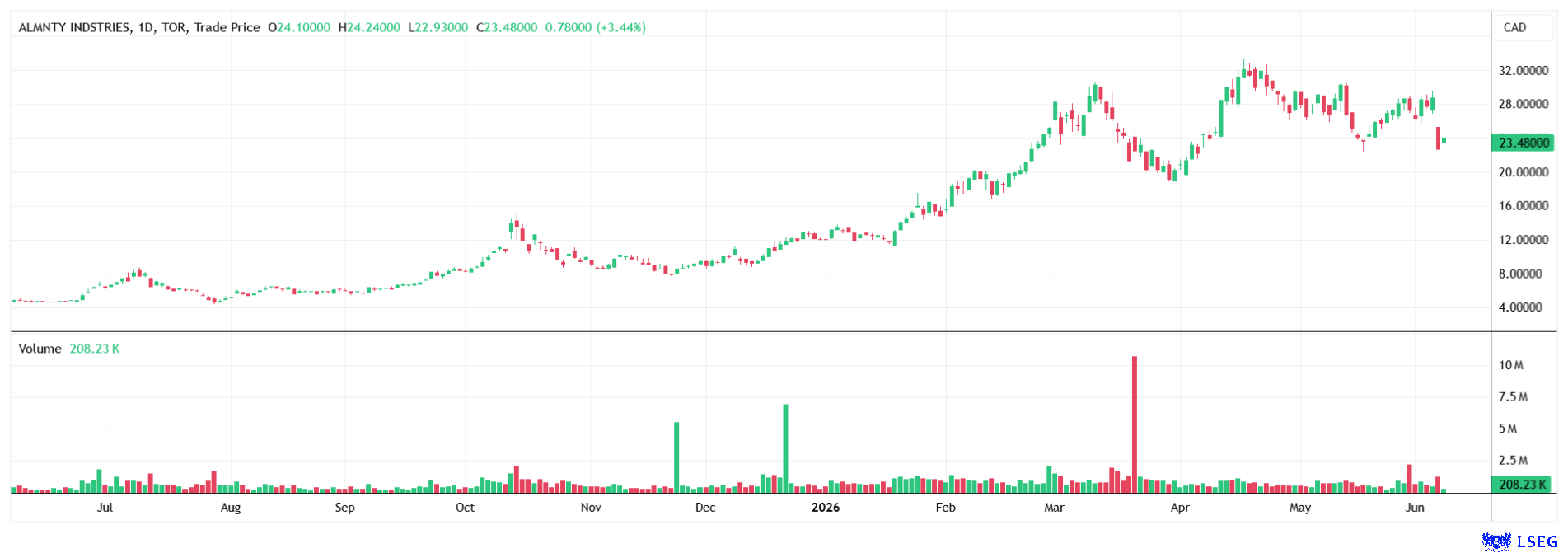
What actually happened? On June 4, Almonty announced a convertible bond placement. The offering was massively oversubscribed and priced at a volume of USD 700 million. The interest rate of 2.25% is extremely favourable given the current market environment. The funds will be used for refinancing and further growth. To prevent dilution for existing shareholders, hedging transactions were concluded at the same time. Friday's price drop may therefore have been a purely technical phenomenon in an initial reaction. Institutional investors who buy such convertible bonds often hedge their positions by short-selling the stock as a standard practice. This mechanical pressure has nothing to do with the company's fundamental value. This, in turn, puts downward pressure on the share price. However, this is often only observed on the first day or during the first few days.
On the contrary, the fundamental story is stronger than ever. This is evident from the news of the past two weeks. On May 28, the company announced that it would be added to the prestigious US indices Russell 1000 and Russell 3000 as of the end of June. This is likely to "force" countless ETFs and funds to buy the stock. On June 1, CEO Lewis Black reminded investors of the upcoming annual general meeting on June 9 and took stock of the situation. The flagship Sangdong mine in South Korea has commenced active mining operations. It will be one of the largest tungsten mines outside of China. In addition, a major drilling project was launched in Portugal, the headquarters were relocated to the US, and the Gentung project in Montana was acquired. A look at Almonty's latest presentation shows that Phase One in Sangdong is fully funded. The company expects high gross margins there of between 50% and 60%. In the current global and geopolitical landscape, tungsten is the strategic gold. Friday's short-term price dip could, therefore, upon closer inspection, turn out to be a clear gift for forward-thinking investors.
Three stocks with different opportunities in June. Deutsche Telekom impresses with its use of AI in its US business and a more stable pricing environment in Europe. Munich Re is weathering climate risks, such as El Niño, with share buybacks and could be a bargain at current levels. At Almonty Industries, on the other hand, last Friday's convertible bond shock has temporarily distorted the picture. The fundamentals of the tungsten producer remain completely unaffected by this, and given the upcoming index upgrade and profitable mining projects, an upward rebound could occur quite quickly.
Conflict of interest
Pursuant to §85 of the German Securities Trading Act (WpHG), we point out that Apaton Finance GmbH as well as partners, authors or employees of Apaton Finance GmbH (hereinafter referred to as "Relevant Persons") may hold shares or other financial instruments of the aforementioned companies in the future or may bet on rising or falling prices and thus a conflict of interest may arise in the future. The Relevant Persons reserve the right to buy or sell shares or other financial instruments of the Company at any time (hereinafter each a "Transaction"). Transactions may, under certain circumstances, influence the respective price of the shares or other financial instruments of the Company.
In addition, Apaton Finance GmbH is active in the context of the preparation and publication of the reporting in paid contractual relationships.
For this reason, there is a concrete conflict of interest.
The above information on existing conflicts of interest applies to all types and forms of publication used by Apaton Finance GmbH for publications on companies.
Risk notice
Apaton Finance GmbH offers editors, agencies and companies the opportunity to publish commentaries, interviews, summaries, news and the like on news.financial. These contents are exclusively for the information of the readers and do not represent any call to action or recommendations, neither explicitly nor implicitly they are to be understood as an assurance of possible price developments. The contents do not replace individual expert investment advice and do not constitute an offer to sell the discussed share(s) or other financial instruments, nor an invitation to buy or sell such.
The content is expressly not a financial analysis, but a journalistic or advertising text. Readers or users who make investment decisions or carry out transactions on the basis of the information provided here do so entirely at their own risk. No contractual relationship is established between Apaton Finance GmbH and its readers or the users of its offers, as our information only refers to the company and not to the investment decision of the reader or user.
The acquisition of financial instruments involves high risks, which can lead to the total loss of the invested capital. The information published by Apaton Finance GmbH and its authors is based on careful research. Nevertheless, no liability is assumed for financial losses or a content-related guarantee for the topicality, correctness, appropriateness and completeness of the content provided here. Please also note our Terms of use.