November 24th, 2025 | 07:00 CET
AI as a growth driver? This small-cap has found its niche! UMT United Mobility Technology, Amazon, SAP
By now, even many of the skeptics are likely to be convinced: AI is a powerful tool that can significantly increase efficiency and productivity. The beauty of AI is that while traditional data processing works precisely, AI can also cope with less exact instructions. This feature ensures that AI agents are taking on more and more tasks that humans did just a few years ago – including "thinking" outside the box. Three examples from different sectors illustrate this development: UMT United Mobility Technology, a niche provider with ambitious plans; Amazon, the market leader and retail giant; and SAP, the specialist for enterprise software. We examine the business models, current figures, and developments from an investor's perspective.
time to read: 4 minutes | Author: Nico Popp
ISIN: UMT UNITED MOBILITY TECHNOLOGY AG | DE000A40ZVU2 , AMAZON.COM INC. DL-_01 | US0231351067 , SAP SE O.N. | DE0007164600
Table of contents:
Author

Nico Popp
At home in Southern Germany, the passionate stock exchange expert has been accompanying the capital markets for about twenty years. With a soft spot for smaller companies, he is constantly on the lookout for exciting investment stories.
Tag cloud
Shares cloud
Amazon is investing heavily in AI – and laying off employees
Amazon is not only a retail giant; its cloud division AWS is also enormous and now generates around 60% of the Company's operating profit – even though only about 15% of Amazon's revenue originates there. Amazon is also investing heavily in AI, pumping billions into its own Trainium2 chips, training clusters for large language models, and power capacities to supply its high-performance servers. Amazon is also trying to use AI in its retail business to automate processes. For example, the AI assistant Alexa+ is to be deeply integrated into Fire TV and other Amazon offerings. Logistics is also benefiting: Amazon promises Prime members record delivery speeds throughout the year, and same-day grocery deliveries are being rolled out in many communities across the US. Amazon's advertising business is also growing at double-digit rates, thanks in part to AI.
But AI also has a downside – at least for Amazon employees. The Company recently announced that it would be cutting around 14,000 jobs across the group. According to Reuters, Amazon itself stated that AI tools would replace routine tasks and increase efficiency. Given the current skepticism about AI on the stock market, Amazon appears to be a heavyweight that is betting everything on AI and may be overshooting the mark. Specifically, these investments are strengthening the Company's market position. However, doubts are also justified – it remains to be seen whether the hype surrounding ever-new language models is justified.
UMT United Mobility Technology saves logistics companies time and money thanks to AI
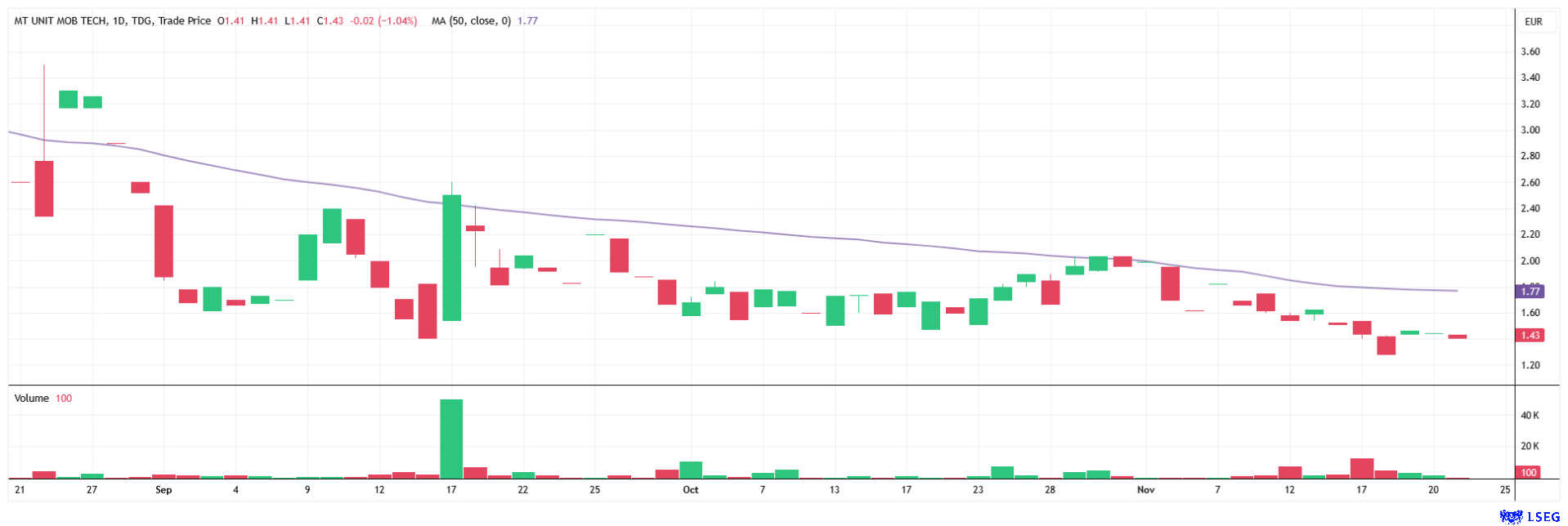
Munich-based company UMT United Mobility Technology also plans to significantly improve the efficiency of its customers. UMT is currently focusing its business entirely on AI-based solutions: With UMS Vision AI, the Company is developing a B2B SaaS platform for automated process handling in the areas of logistics and supply chain management. Vision AI automatically extracts data from transport orders and emails in various formats and assigns them digitally. Logistics service provider Loth is the first customer to use Vision AI to process incoming freight orders in real time - without manual training. This reduces sources of error and saves considerable time and money. The example also highlights how profoundly modern language models have changed software development: Five or more years ago, the buzzwords AI and machine learning were still associated with digital tools that had to be trained with realistic data sets by developers, but today, anyone can work with AI. Simply provide feedback via chat, and the AI learns – this is sometimes easier than training a new colleague.
UMT operates a flexible subscription model that allows logistics companies to deploy AI without high upfront investment. CEO Erik Nagel emphasizes that AI is becoming part of everyday operations in the logistics industry and that UMT's SaaS approach lowers the barriers to entry. The Company is already seeing initial success. In June 2025, UMT won a major customer in the British customs consultant BGM Logistics, which now uses Vision AI for complex customs processes between the United Kingdom and the EU. Especially since Brexit, the British market is "an important and relevant core market for UMT," Nagel said in a company announcement in June. The automation of previously manual customs tasks by Vision AI significantly reduces the duration of checks and the complexity of administrative processes. With this experience, the agile Munich-based company could soon successfully expand into additional application areas.
SAP plans to offer 400 AI functions by the end of 2025
SAP's performance in recent quarters also demonstrates the potential of AI in business. The business software specialist is perfectly positioned to roll out new AI solutions for its customers - the reason: many companies have been maintaining their most critical operational data in SAP systems for decades. Modern AI now only needs to access, interpret, and contextualize this data to generate insights. "We are gaining market share as customers accelerate their adoption of solutions across the entire Business Suite, including Business Data Cloud and AI," explained SAP CEO Christian Klein when presenting Q3 2025 results. SAP's focus is on end-to-end solutions that enable intelligent business processes. This includes AI features such as the integrated assistant SAP Joule, which supports everything from data analysis to routine process automation. By the end of 2025, SAP intends to offer more than 400 AI-powered features. Last quarter, the Company received ISO 42001 certification for AI governance** - a clear signal that SAP is preparing for the ethical and regulatory requirements that will arise with the upcoming EU AI Act.
UMT has the greatest leverage – and the greater risk
While Amazon and SAP are billion-dollar companies, investors in UMT United Mobility Technology shares have a greater opportunity to benefit dynamically from AI due to a market capitalization in the low single-digit millions. However, the enormous resources that Amazon and SAP are investing in this area are also a warning. In the game of the big players, small companies must be agile and occupy niches. UMT appears to have found a good entry point in the logistics sector. Interested investors should definitely continue to follow UMT's progress – any news here could change everything.
Conflict of interest
Pursuant to §85 of the German Securities Trading Act (WpHG), we point out that Apaton Finance GmbH as well as partners, authors or employees of Apaton Finance GmbH (hereinafter referred to as "Relevant Persons") may hold shares or other financial instruments of the aforementioned companies in the future or may bet on rising or falling prices and thus a conflict of interest may arise in the future. The Relevant Persons reserve the right to buy or sell shares or other financial instruments of the Company at any time (hereinafter each a "Transaction"). Transactions may, under certain circumstances, influence the respective price of the shares or other financial instruments of the Company.
In addition, Apaton Finance GmbH is active in the context of the preparation and publication of the reporting in paid contractual relationships.
For this reason, there is a concrete conflict of interest.
The above information on existing conflicts of interest applies to all types and forms of publication used by Apaton Finance GmbH for publications on companies.
Risk notice
Apaton Finance GmbH offers editors, agencies and companies the opportunity to publish commentaries, interviews, summaries, news and the like on news.financial. These contents are exclusively for the information of the readers and do not represent any call to action or recommendations, neither explicitly nor implicitly they are to be understood as an assurance of possible price developments. The contents do not replace individual expert investment advice and do not constitute an offer to sell the discussed share(s) or other financial instruments, nor an invitation to buy or sell such.
The content is expressly not a financial analysis, but a journalistic or advertising text. Readers or users who make investment decisions or carry out transactions on the basis of the information provided here do so entirely at their own risk. No contractual relationship is established between Apaton Finance GmbH and its readers or the users of its offers, as our information only refers to the company and not to the investment decision of the reader or user.
The acquisition of financial instruments involves high risks, which can lead to the total loss of the invested capital. The information published by Apaton Finance GmbH and its authors is based on careful research. Nevertheless, no liability is assumed for financial losses or a content-related guarantee for the topicality, correctness, appropriateness and completeness of the content provided here. Please also note our Terms of use.