September 14th, 2026 | 08:30 CEST
A Breakout That Was Predicted: How AI Is Leading Volatus Aerospace, SoftBank, and SAP Out of Their Downward Trends
Three broken downward trends, one common catalyst: artificial intelligence. For Volatus Aerospace, SoftBank, and SAP, the chart picture looks completely different from what it did just a few weeks ago—and in all three cases, there is a strong fundamental story behind it. The Canadian drone specialist is securing major new contracts from the defence sector, the Japanese investment holding company is benefiting from the upcoming Anthropic IPO, and the German software giant is proving with strong cloud figures that it should be counted among the AI winners rather than its victims. Three completely different business models, three trend reversals—and the question of how much potential these stocks still hold.
time to read: 7 minutes | Author: Jens Castner
ISIN: VOLATUS AEROSPACE INC | CA92865M1023 | TSXV: FLT , OTCQB: TAKOF , SOFTBANK GROUP CORP. | JP3436100006 , SAP SE O.N. | DE0007164600
Table of contents:
Author

Jens Castner
The Nuremberg native brings over three decades of capital markets experience, backed by a career shaped by deep market insight and a genuine passion for investing. His journey began in 1994 through an investment club among colleagues – a formative experience that sparked a lifelong dedication to identifying compelling investment opportunities.
Following senior editorial roles at Nürnberger Nachrichten, €uro am Sonntag, and €uro, he went on to serve as Editor-in-Chief of the renowned investor magazine Börse Online from 2014, where he played a key role in shaping high-quality financial journalism for a broad investor audience.
Tag cloud
Shares cloud
Volatus Aerospace: Government Contract Confirms the Breakout
Late last week, Volatus Aerospace announced its biggest milestone to date for its fledgling defence division. The Canadian government has awarded the company a 5-year contract to supply tactical ISR (Intelligence, Surveillance, and Reconnaissance) drone systems. The initial order comprises 100 systems, and Canada's armed forces also have the option to expand the contract to up to 5,000 units. The total contract value is up to CAD 25 million, and delivery of the first batch is scheduled to begin as early as the fourth quarter of this year. In addition to the aircraft, the contract includes sensors, ground stations, data links, training, spare parts, software and maintenance services.
The defence contract is the logical continuation of a trend that has accelerated since the beginning of this month. On September 3, Volatus was selected as a qualified supplier for the Canadian government's Defence Drone Initiative (DDI) Marketplace, followed on September 8 by confirmation that Volatus will be eligible to bid on contracts in all conceivable areas: unmanned aerial systems and their defence, communications and data technology, development and integration services, testing and training, and the evaluation of new technologies. The current contract is the first concrete order from Volatus's new business model, with more likely to follow. In an interview with IIF host Lyndsay Malchuk, CEO Glen Lynch explains the company's new strategy:
This marks the continuation of a transformation the company has been driving for over a year. Originally, Volatus was solely an operator of flight services. Approximately 28 manned aircraft and over 100 drones continue to cover about 1.7 million km annually in pipeline inspections, generating recurring revenue of around CAD 20 million per year. However, the strategic focus is increasingly shifting away from hardware and surveillance flights toward intelligent control. At the heart of this strategy is SKYDRA, a software subscription model (Software as a Service, or SaaS for short) for planning drone defence operations, which already achieved a 35% margin in the first quarter of 2026—significantly higher than the lower-margin core business. SKYDRA is complemented by the flight controller V-CORTEX, a box measuring just 3.5 x 3.5 cm and weighing less than 15 g, which uses artificial intelligence to enable navigation even when no satellite signal is available.
On the defence side, additional components include participation in the US Drone Dominance Program; a four-phase defence program with planned investments of USD 1.1 billion for more than 300,000 cost-effective autonomous systems, as well as NATO training contracts. In June 2026, Volatus commissioned a 53,000-square-foot manufacturing and integration facility at Montréal-Mirabel Airport, designed to generate up to CAD 250 million in annual revenue. The expansion is financially secured: With cash on hand of CAD 59.2 million, the company has the strongest financial foundation in its history.
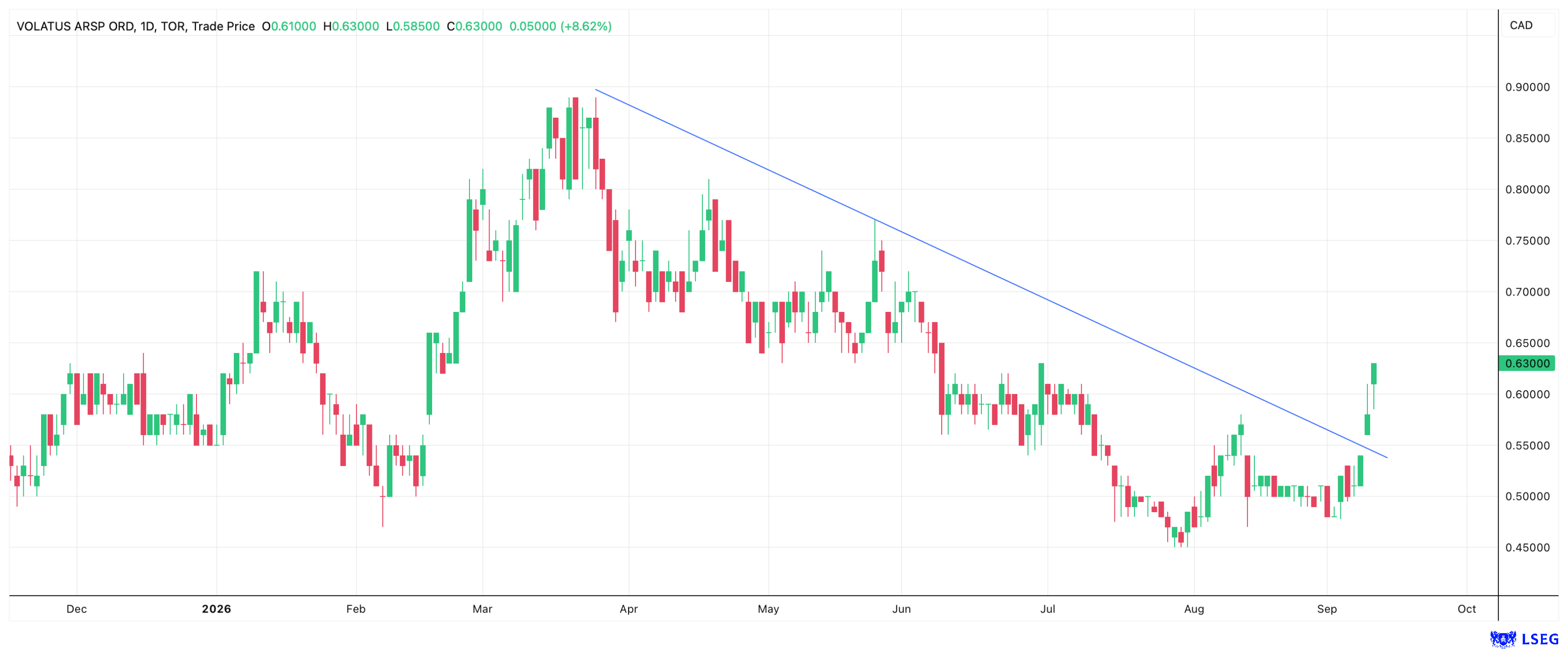
From a technical analysis perspective, the chart confirms what the military contracts fundamentally promise: a strong rally at the start of the year was followed by a prolonged correction phase beginning in March. But the downward trend has now been broken. The previously key resistance levels at CAD 0.55 and 0.56 have been breached, and the stock is currently trading at CAD 0.62 (EUR 0.38 on German exchanges). The next target is the range around CAD 0.70; if the order book remains strong, advances toward CAD 0.80 to 1.00 also appear possible. Analysts at Canaccord Genuity and Stifel estimate the stock's fair value at CAD 1.00—which implies upside potential of about 60%.
SoftBank: Short-Term Trend Break with AI as a Catalyst
Japan's SoftBank Group shows what a broken downtrend can bring. In early May, the stock reached a high of JPY 9,074; by the end of July, the price fell below JPY 5,000 at times. Since then, the picture has reversed. The stock is currently trading at JPY 6,540 (the share, which is tradable in Germany, is priced at around EUR 37), and most analysts are confident there is room for further gains. Admittedly, experts' estimates for the investment holding company naturally vary widely given the breadth of its tech investments. The average 12-month price target is around JPY 7,850, about 20% above the current level, with individual estimates ranging from JPY 3,140 to 11,100. About 75% of analysts currently recommend buying the stock.
Here, too, artificial intelligence is the key driver, albeit indirectly through the holding company's structure: SoftBank holds significant stakes in several AI companies. Mizuho analysts recently upgraded the subsidiary Arm to "Outperform" with a price target of USD 400, driven by the expectation that specialised processors for artificial intelligence (AGI CPUs) could contribute about USD 1 billion in revenue by fiscal year 2028. Added to this is the stake in Anthropic. According to media reports, the AI company has reached a USD 35 billion agreement with data centre provider Lambda to secure computing capacity in Texas and is apparently aiming for an initial public offering as early as October. Market experts estimate the potential valuation at up to USD 965 billion. At the same time, the subsidiary SB Energy is preparing its own initial public offering (IPO), which is expected to benefit from the global rise in energy demand for AI data centres.
Here, too, the driving force is artificial intelligence—albeit indirectly through the investment structure: SoftBank holds significant stakes in several AI companies. Mizuho analysts recently upgraded the subsidiary Arm to "Outperform" with a price target of USD 400, driven by the expectation that specialised processors for artificial intelligence (AGI CPUs) could contribute about USD 1 billion in revenue by fiscal year 2028. Added to this is the 13% stake in OpenAI: Although the AI company has postponed its IPO until next year, competitor Anthropic is reportedly already aiming for an initial public offering as early as October, according to media reports. Market experts estimate the potential valuation at up to USD 965 billion. This could also significantly boost the value of the OpenAI stake. At the same time, the subsidiary SB Energy, which is benefiting from the global rise in energy demand for AI data centres, is preparing for its IPO.
SAP: From AI Loser to Potential Winner
At SAP, the downward trend dates back much further than for the other two stocks. From a high of EUR 244.30 in October 2025, the stock slipped to a multi-year low of EUR 127.50 by July 23, 2026—a price drop of nearly 50%. On that very day, shortly after the US stock market closed, SAP released its second-quarter results—thereby triggering the turnaround. The Current Cloud Backlog, that is, the revenue expected from cloud subscription contracts over the next 12 months, grew by EUR 27% to 22.9 billion. Total revenue rose by 9% to EUR 9.88 billion, while earnings per share came in at EUR 1.89, significantly exceeding the expected EUR 1.76. The only cloud on the horizon was a slight adjustment to the full-year forecast. The Executive Board now expects operating profit to grow by 13 to 17% instead of the previously projected 14 to 18%—a result of the margin-diluting acquisitions of Dremio and Prior Labs, which were completed in July. CEO Christian Klein attributed the strong demand in the cloud contract portfolio to the Group's AI strategy, specifically to the positive customer response to the SAP Autonomous Suite and the SAP Business AI Platform.
The market reacted positively to the figures despite the lowered forecast. The stock jumped 9.3% to EUR 140.20 the following day—marking the start of a recovery of approximately 40% from its July low. At the close of trading on Friday, SAP was trading at EUR 178.50. The recovery was also aided by easing regulatory pressures—the European Commission and the German Federal Cartel Office concluded their investigations into SAP's maintenance practices and data access rules, respectively, without imposing any sanctions. This was accompanied by a broad recovery in the software and AI sectors: Atlassian and Cloudflare significantly exceeded expectations, while Palantir reported a 93% increase in revenue and raised its full-year forecast. Such signals put into perspective the previously widespread concern that SaaS providers might be among the AI losers. Dr Hendrik Leber, founder of the Frankfurt-based fund management company ACATIS, also sees this shift in sentiment. In the latest monthly report, he points to Veeva Systems and Salesforce, both of which have recently gained nearly 40%. The realisation that SaaS providers are strengthened rather than weakened by the smart use of AI is slowly gaining traction in the market. The analyst consensus remains clearly positive overall. Across 28 covered companies, the average price target stands at EUR 207.77; 24 analysts recommend "Buy", 4 recommend "Hold", and none recommend "Sell". Based on the analyst average and the current price level, there remains upside potential of more than 15%.
Conclusion: Three Broken Trends, One Common Denominator
Whether it is a Canadian drone specialist, a Japanese investment holding company, or a German software group, the trend reversal in all three cases coincides with specific AI-related news. For Volatus, it is the direct monetisation through defence contracts and autonomous control technology; for SoftBank, it is the valuation of its AI investments, Arm and Anthropic; and for SAP, it is the reassessment of its business model as a potential AI beneficiary rather than an AI casualty. In all three cases, analysts' price targets signal room for further upside—albeit with varying risk profiles. Volatus Aerospace has the highest upside potential, but the company is significantly smaller, and its stock is therefore more speculative than those of the two established large corporations.
Conflict of interest
Pursuant to §85 of the German Securities Trading Act (WpHG), we point out that Apaton Finance GmbH as well as partners, authors or employees of Apaton Finance GmbH (hereinafter referred to as "Relevant Persons") may hold shares or other financial instruments of the aforementioned companies in the future or may bet on rising or falling prices and thus a conflict of interest may arise in the future. The Relevant Persons reserve the right to buy or sell shares or other financial instruments of the Company at any time (hereinafter each a "Transaction"). Transactions may, under certain circumstances, influence the respective price of the shares or other financial instruments of the Company.
In addition, Apaton Finance GmbH is active in the context of the preparation and publication of the reporting in paid contractual relationships.
For this reason, there is a concrete conflict of interest.
The above information on existing conflicts of interest applies to all types and forms of publication used by Apaton Finance GmbH for publications on companies.
Risk notice
Apaton Finance GmbH offers editors, agencies and companies the opportunity to publish commentaries, interviews, summaries, news and the like on news.financial. These contents are exclusively for the information of the readers and do not represent any call to action or recommendations, neither explicitly nor implicitly they are to be understood as an assurance of possible price developments. The contents do not replace individual expert investment advice and do not constitute an offer to sell the discussed share(s) or other financial instruments, nor an invitation to buy or sell such.
The content is expressly not a financial analysis, but a journalistic or advertising text. Readers or users who make investment decisions or carry out transactions on the basis of the information provided here do so entirely at their own risk. No contractual relationship is established between Apaton Finance GmbH and its readers or the users of its offers, as our information only refers to the company and not to the investment decision of the reader or user.
The acquisition of financial instruments involves high risks, which can lead to the total loss of the invested capital. The information published by Apaton Finance GmbH and its authors is based on careful research. Nevertheless, no liability is assumed for financial losses or a content-related guarantee for the topicality, correctness, appropriateness and completeness of the content provided here. Please also note our Terms of use.