May 5th, 2026 | 07:35 CEST
A Billion-Dollar Market in the Shadow of E-Mobility – Plug Power, dynaCERT, and Daimler Truck Unlock the Potential
Geopolitical tensions are exposing the risks of reliance on fossil fuels. At the same time, pressure is mounting on logistics and heavy-duty transport to decarbonize economically. While e-mobility is making strides in passenger vehicles, long-haul and construction fleets remain a challenge. Range, frequency, and existing fleets are forcing a rethink. This is precisely where a market is emerging for retrofit solutions with immediate impact, hydrogen integration, and more efficient powertrains. Immediate CO₂ and cost benefits are taking precedence over purely futuristic visions. Plug Power, dynaCERT, and Daimler Truck are addressing this tension with very different but complementary approaches.
time to read: 5 minutes | Author: Armin Schulz
ISIN: PLUG POWER INC. DL-_01 | US72919P2020 , DYNACERT INC. | CA26780A1084 | TSX: DYA , OTCQB: DYFSF , Daimler Truck Holding AG | DE000DTR0013
Table of contents:
Author

Armin Schulz
Born in Mönchengladbach, he studied business administration in the Netherlands. In the course of his studies he came into contact with the stock exchange for the first time. He has more than 25 years of experience in stock market business.
Tag cloud
Shares cloud
Plug Power – Slowly Becoming An Operational Contender
Plug Power achieved a positive gross margin of 2.4% for the first time in Q4 2025, a jump of 125 percentage points compared to the previous year. The internal cost-cutting program "Project Quantum Leap" significantly reduced costs, and cash burn fell by more than a quarter. With the new CEO, Jose Luis Crespo, a long-time insider, the focus is now on operational discipline. For investors, it is becoming clear that the business model is slowly moving into the black after years of relying solely on vision. However, the decision in February 2026 to double the authorized shares to 3 billion calls for caution in valuation.
Plug Power holds the keys to two massive markets. First is the demand for green hydrogen in industry. The major contract for a 275-megawatt electrolyzer system for Hy2gen in Quebec demonstrates that large-scale projects are becoming a reality. The global project pipeline totals around USD 8 billion. At the same time, the energy hunger of AI data centers opens a second door. Plug is negotiating the supply of up to 250 megawatts of hydrogen power to the US PJM power grid. This is an opportunity to capitalize on the bottleneck issue. Whether these volumes will actually be drawn upon, however, depends on the customers' final investment decisions.
Three mechanisms bolster liquidity. First, the completed sale of an unused factory site for at least USD 132.5 million; second, the planned monetization of power rights (over USD 275 million); and last but not least, the existing USD 1.66 billion loan guarantee from the US Department of Energy. Added to this is the extended tax credit for hydrogen production. This bridges the gap until the targeted positive operating result at the end of 2026. The risks include high debt and the danger of further capital dilution. Additionally, the class-action lawsuit alleging misrepresentation regarding the DOE loan is still pending. The stock is currently trading at USD 3.11.
dynaCERT - The Operational Turnaround Is Taking Shape
The Canadian cleantech company dynaCERT has been working for years on a retrofit solution for diesel engines. The principle is straightforward: an electrolysis unit produces hydrogen and oxygen from distilled water, which are then injected into the combustion process. This can improve fuel efficiency and reduce emissions. What was long considered a niche concept is now increasingly moving toward commercial traction.
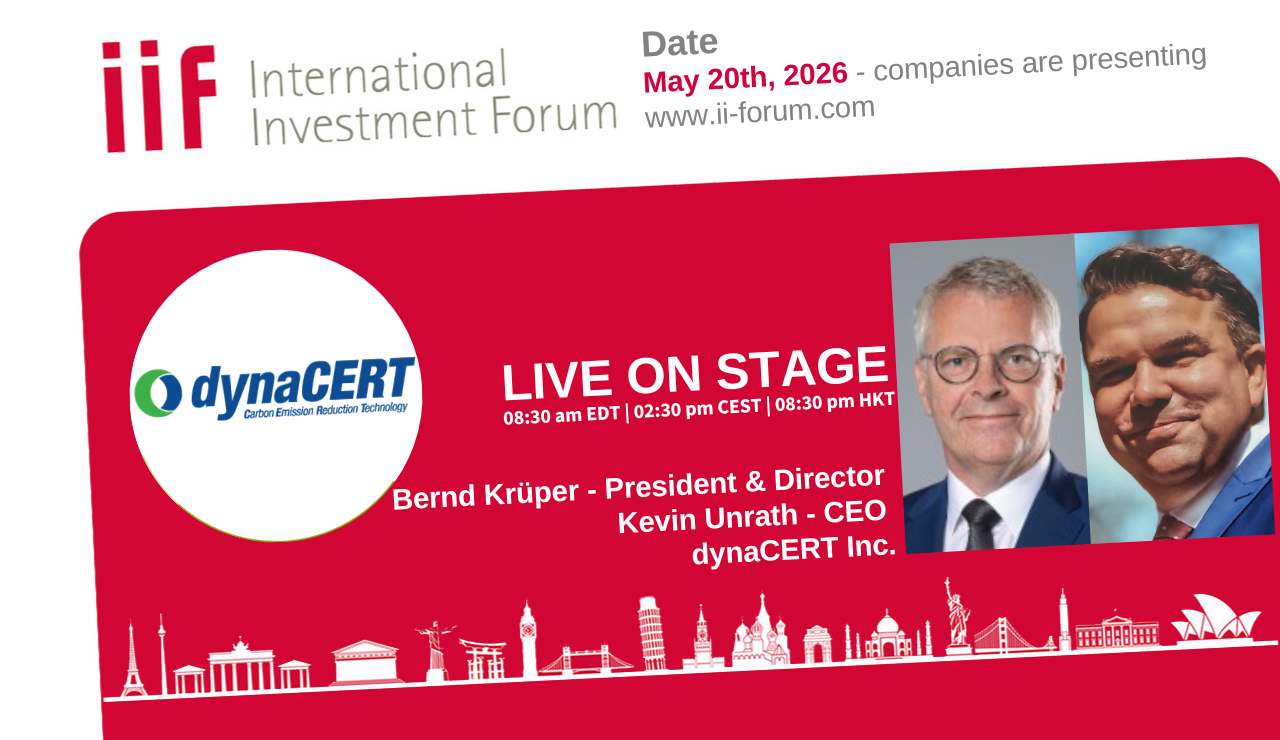
With Kevin Unrath as the new CEO, operational implementation is taking center stage. It is not a radical restart, but rather an acceleration. Unrath's predecessor, Jim Payne, is moving to the supervisory board to ensure continuity. Bernd Krüper has been appointed president to oversee international expansion—a clear signal that scaling up is now a serious priority.
The Southeast Asian market is heating up, especially Vietnam. dynaCERT has commissioned pilot systems on heavy-duty trucks and container forklifts in Ho Chi Minh City, Hanoi, and Haiphong. In addition, there are strategic memorandums of understanding with the Ho Chi Minh City University of Technology and a state-owned oil company. The government aims to be climate-neutral by 2050, and with over 3.5 million diesel vehicles on the road, the demand is enormous. The technology is being validated under local conditions. The first 10 installations have been completed, and series orders could follow soon, based on discussions with generator operators.
In parallel with the hardware deals, dynaCERT is expanding its second pillar of business: emissions credits. The methodology is already Verra-certified, opening access to the global market for tradable CO₂ credits. The company's proprietary telematics platform, HydraLytica, provides the measurable data required for certification. With new CEO Kevin Unrath at the helm, the company has someone with a background in operations who knows exactly how to turn pilot projects into structured revenue streams. Added to this is a new CAD 2 million loan and a strategic realignment toward growth regions such as Mexico and Texas. The direction is right; the next quarterly figures should confirm this. The stock is currently trading at CAD 0.14.
Daimler Truck - Hydrogen Partnership as a Long-Term Driver
The first week of May brings two key decisions for the commercial vehicle manufacturer. On Wednesday, management will present the Q1 figures, while the Annual General Meeting will vote on the dividend. Following a 15% rise in the share price since the start of the year, investors are now looking closely at the US. There, sales are plummeting by a quarter, while Trump threatens new tariffs on EU imports. The domestic business, however, is holding its own. Mercedes-Benz Trucks increased sales by 13% in the first quarter. The real question is how the Executive Board intends to manage the multiple risks posed by tariffs, market weakness, and structural change.
The consolidation of Asian operations into the new ARCHION Corporation is fundamentally changing the balance sheet. The reduction in equity holdings will generate EUR 1.5–2 billion for the Group. That is money that goes directly into free cash flow. For 2026, the Executive Board is targeting revenue of EUR 42–46 billion, with a return of 6–8%. The dividend is expected to remain stable at EUR 1.90 per share, which at current prices represents a payout of just under 4.4%. In addition, the company launched a EUR 400 million share buyback program in March. Operational control over the Asian brands is now purely an equity stake.
By the end of 2026, a small series of 100 hydrogen trucks will be rolled out to selected customers. The latest prototypes passed an Alpine test carrying 40 tons, and Toyota's planned entry into the cellcentric fuel cell joint venture underscores the strategic importance. But profitability remains an issue. The hydrogen price of EUR 11–13 per kg would need to be halved, and there are only two liquid hydrogen refuelling stations nationwide. Analysts are divided, with price targets ranging from EUR 34 to EUR 50. The median remains slightly positive, but the upcoming AGM will show whether the group can turn headwinds into stable growth. Currently, a share costs EUR 42.80.
Plug Power may show operational progress, but looming capital dilution and pending lawsuits still make the hydrogen specialist a risky candidate until the final turnaround. dynaCERT delivers immediate CO2 and fuel savings with its diesel retrofit solution and is establishing a second revenue stream in emissions credits through Verra certification. Daimler Truck remains stable thanks to revenue from Asia and share buybacks, while the hydrogen truck will only bear fruit in the long term. However, US tariffs are clouding the picture.
Conflict of interest
Pursuant to §85 of the German Securities Trading Act (WpHG), we point out that Apaton Finance GmbH as well as partners, authors or employees of Apaton Finance GmbH (hereinafter referred to as "Relevant Persons") currently hold or hold shares or other financial instruments of the aforementioned companies and speculate on their price developments. In this respect, they intend to sell or acquire shares or other financial instruments of the companies (hereinafter each referred to as a "Transaction"). Transactions may thereby influence the respective price of the shares or other financial instruments of the Company.
In this respect, there is a concrete conflict of interest in the reporting on the companies.
In addition, Apaton Finance GmbH is active in the context of the preparation and publication of the reporting in paid contractual relationships.
For this reason, there is also a concrete conflict of interest.
The above information on existing conflicts of interest applies to all types and forms of publication used by Apaton Finance GmbH for publications on companies.
Risk notice
Apaton Finance GmbH offers editors, agencies and companies the opportunity to publish commentaries, interviews, summaries, news and the like on news.financial. These contents are exclusively for the information of the readers and do not represent any call to action or recommendations, neither explicitly nor implicitly they are to be understood as an assurance of possible price developments. The contents do not replace individual expert investment advice and do not constitute an offer to sell the discussed share(s) or other financial instruments, nor an invitation to buy or sell such.
The content is expressly not a financial analysis, but a journalistic or advertising text. Readers or users who make investment decisions or carry out transactions on the basis of the information provided here do so entirely at their own risk. No contractual relationship is established between Apaton Finance GmbH and its readers or the users of its offers, as our information only refers to the company and not to the investment decision of the reader or user.
The acquisition of financial instruments involves high risks, which can lead to the total loss of the invested capital. The information published by Apaton Finance GmbH and its authors is based on careful research. Nevertheless, no liability is assumed for financial losses or a content-related guarantee for the topicality, correctness, appropriateness and completeness of the content provided here. Please also note our Terms of use.