September 18th, 2026 | 08:00 CEST
What If Diesel Stays Longer Than Expected? dynaCERT's Bridge Technology, Deutz and Renk in Focus
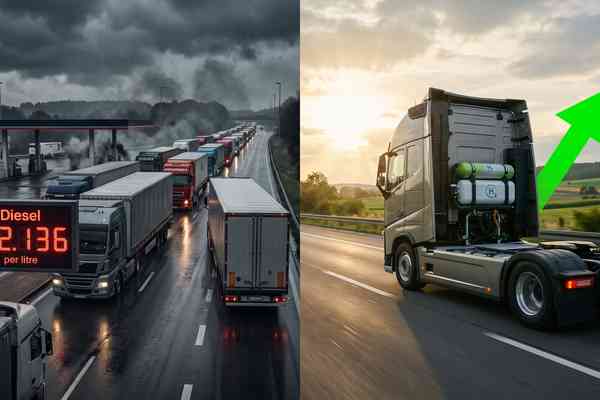
The stock market loves clear visions of the future: batteries instead of internal combustion engines, green hydrogen instead of fossil fuels, electric motors instead of diesel engines. Turning these visions into reality takes time and is more challenging than many assume. Investments, service life, cost-effectiveness, and infrastructure all add complexity to the decision-making process. This makes bridge technologies even more important, since millions of trucks and construction machines will not disappear overnight. This is where dynaCERT comes in. The Canadian company does not aim to replace diesel, but rather to make its operation more efficient. Its proprietary HydraGEN™ solution generates hydrogen and oxygen on demand and feeds the gases into the diesel engine's air intake system, reducing fuel consumption and emissions. How are the automotive and defence industries positioning themselves in light of these developments? What conclusions can investors draw regarding Deutz, Renk, and dynaCERT, and where do the best opportunities lie?
time to read: 3 minutes | Author: Carsten Mainitz
ISIN: DYNACERT INC. | CA26780A1084 | TSX: DYA , OTCQB: DYFSF , DEUTZ AG O.N. | DE0006305006 , RENK AG O.N. | DE000RENK730
Table of contents:
Author

Carsten Mainitz
The native Rhineland-Palatinate has been a passionate market participant for more than 25 years. After studying business administration in Mannheim, he worked as a journalist, in equity sales and many years in equity research.
Tag cloud
Shares cloud
dynaCERT: Efficiency Advantages as a Key Strength
With HydraGEN™, the Canadian company has brought a smart retrofit solution for existing diesel fleets to the market. This solution offers several advantages. First and foremost, fuel and emissions savings are among the key benefits. Another advantage is that users do not have to replace either the engine or the vehicle. This keeps investment costs manageable.
The company focuses on heavy-duty transportation, mining and construction, oil and gas, port operations, and stationary power generation. Applications with high operating hours and high diesel consumption are particularly relevant to this strategy. Looking ahead, combining hardware and data opens up exciting, potentially highly scalable opportunities to expand the business model. With HydraLytica, fuel consumption and emissions can be measured and documented. In addition, measurable CO₂ savings could enable emissions-credit trading.
dynaCERT itself has prioritized converting commercial discussions into concrete agreements and contractually agreed-upon installations by 2026. In June, the company announced its first production order from a Vietnamese trucking and logistics company following a successful pilot installation. At the same time, the company installed several HydraGEN™ systems on trucks and container lifters at a major port operator in Vietnam.
In addition, the company aims to build momentum through a stronger presence at trade shows and discussions with potential customers, existing contacts, and industry partners. With the placement in June of a CAD 5 million convertible bond with a two-year term and a 6% interest rate, the Canadian company now has sufficient financial flexibility as it ramps up commercialization.
Deutz: Moving Forward with Fresh Capital
The Cologne-based engine manufacturer shows that the old and new worlds of propulsion do not necessarily have to be at odds. Deutz is further developing its business in the areas of service, energy, and defence while simultaneously pursuing various propulsion technologies. In addition to traditional diesel engines, the group is developing solutions for hydrogen, alternative fuels, and electrified powertrains.
With the acquisition of Flensburger Fahrzeugbau Gesellschaft (FFG), valued at approximately EUR 1.6 billion, Deutz is making the defence sector another key pillar of the group. To this end, the company recently tapped the capital market and raised approximately EUR 179 million gross through a 10% capital increase at EUR 11.70 per share. As is typical, this led to a slight dip in the share price, but the share has already regained the EUR 12 mark.
In addition, analysts are consistently positive and attest to further upside for the shares. The half-year results showed a 28.7% increase in order intake to EUR 1.33 billion. Revenue rose by 10.7% to EUR 1.12 billion, while adjusted EBIT climbed disproportionately by 43.1% to EUR 79.7 million.
Renk: 60% Upside
The group supplies high-performance drives and transmissions for military and civilian applications. The focus is on systems where power density, reliability, and service life are critical. In addition to conventional solutions, the specialist also develops hybrid and electric propulsion systems. But reality shows that just because new technologies are emerging, existing propulsion technology does not automatically disappear.
The defence business is the growth engine that is running at full speed. In the first half of the year, order intake rose by 29.7% to EUR 1.2 billion. As a result, the order backlog reached a new record high of EUR 7.4 billion. Revenue climbed 2.7% to EUR 637.2 million, while adjusted operating profit (EBIT) grew much more strongly, rising 10.1% to EUR 98.2 million. For the full year, Renk confirmed its forecast of more than EUR 1.5 billion in revenue and adjusted EBIT between EUR 255 million and EUR 285 million.
The stock is currently trading at around EUR 40, giving the group a market capitalization of EUR 4 billion. The 2027 P/E ratio of 21.3 is considered moderate for the industry. Analysts see upside potential of just under 60% from current levels.
With its bridge technology, dynaCERT is targeting the millions of existing diesel engines in operation. The focus is now on accelerating the commercialization of this innovative technology. Deutz is expanding into a key growth area, and the stock market is optimistic. According to analysts, the specialist Renk has upside potential of around 60%.
Conflict of interest
Pursuant to §85 of the German Securities Trading Act (WpHG), we point out that Apaton Finance GmbH as well as partners, authors or employees of Apaton Finance GmbH (hereinafter referred to as "Relevant Persons") may hold shares or other financial instruments of the aforementioned companies in the future or may bet on rising or falling prices and thus a conflict of interest may arise in the future. The Relevant Persons reserve the right to buy or sell shares or other financial instruments of the Company at any time (hereinafter each a "Transaction"). Transactions may, under certain circumstances, influence the respective price of the shares or other financial instruments of the Company.
In addition, Apaton Finance GmbH is active in the context of the preparation and publication of the reporting in paid contractual relationships.
For this reason, there is a concrete conflict of interest.
The above information on existing conflicts of interest applies to all types and forms of publication used by Apaton Finance GmbH for publications on companies.
Risk notice
Apaton Finance GmbH offers editors, agencies and companies the opportunity to publish commentaries, interviews, summaries, news and the like on news.financial. These contents are exclusively for the information of the readers and do not represent any call to action or recommendations, neither explicitly nor implicitly they are to be understood as an assurance of possible price developments. The contents do not replace individual expert investment advice and do not constitute an offer to sell the discussed share(s) or other financial instruments, nor an invitation to buy or sell such.
The content is expressly not a financial analysis, but a journalistic or advertising text. Readers or users who make investment decisions or carry out transactions on the basis of the information provided here do so entirely at their own risk. No contractual relationship is established between Apaton Finance GmbH and its readers or the users of its offers, as our information only refers to the company and not to the investment decision of the reader or user.
The acquisition of financial instruments involves high risks, which can lead to the total loss of the invested capital. The information published by Apaton Finance GmbH and its authors is based on careful research. Nevertheless, no liability is assumed for financial losses or a content-related guarantee for the topicality, correctness, appropriateness and completeness of the content provided here. Please also note our Terms of use.