March 24th, 2026 | 07:00 CET
Volatus Aerospace: TSX Uplisting Signals a New Phase for the Drone and Defense Specialist
At the intersection of technology and national security, a Canadian company is gaining significant traction: Volatus Aerospace. In a short time, the company has evolved from a niche specialist into a recognized player in unmanned aviation and is now listed on the Toronto Stock Exchange. Drones are no longer mere gadgets - they have become essential tools in modern defense and industrial applications. Conflicts such as those in Ukraine and rising tensions around Iran underscore a clear shift: traditional weapons systems are often too costly, inflexible, and slow to deploy. This report examines how Volatus is capitalizing on this transition through targeted acquisitions, government support, and a clearly defined strategic roadmap.
time to read: 6 minutes | Author: Mario Hose
ISIN: VOLATUS AEROSPACE INC | CA92865M1023 | TSXV: FLT , OTCQB: TAKOF
Table of contents:
Author

Mario Hose
Born and raised in Hannover, Lower Saxony follows social and economic developments around the globe. As a passionate entrepreneur and columnist he explains and compares the most diverse business models as well as markets for interested stock traders.
Tag cloud
Shares cloud
The Stock Market's Seal of Approval: The Rise to the Top League
There are moments in a company's history that change everything. Sometimes, it opens up paths to even greater new dimensions. High growth suddenly becomes easier and possible. For Volatus Aerospace, March 20, 2026, was exactly such a day, when the bell rang at the Toronto Stock Exchange.
With the move from the Venture segment to the main market, Volatus has finally left its infancy behind. This step is not merely a formal change of trading venue. Rather, it serves as a prestigious seal of approval that now also paves the way for large institutional and international investors. While the ticker symbol FLT remains the same, the clout behind it has increased massively. Glen Lynch, the company's CEO, aptly emphasized that this milestone strengthens Volatus's ability to elevate Canadian aerospace innovations to a global stage. This is not just about prestige, but about trust. It enables the company to support critical infrastructure and national security missions with even greater vigor. Some investors are now eagerly watching this player, which has proven that it meets the strict requirements of the senior market.
Drones as a Game-Changer: The New Architecture of War
Current conflicts, such as those in Ukraine or the Middle East, clearly demonstrate that large, expensive weapons systems are losing their significance. Volatus Aerospace recognized this shift early on and is developing unmanned systems that can play a decisive role in modern conflicts. Drones are critical in these scenarios because they deliver unprecedented precision while minimizing risk to personnel. A key factor here is the cost structure, because while a conventional fighter jet or cruise missile costs millions, state-of-the-art drones cost only a fraction of that. This enables armed forces to deploy a sheer mass of systems that present the enemy with insurmountable challenges. Volatus provides not only the hardware but also the entire intelligence infrastructure behind it, from reconnaissance to logistical support in extremely dangerous zones. The ability to conduct real-time aerial reconnaissance while simultaneously providing cost-effective, autonomous solutions for tactical missions makes the company an indispensable partner for national security.
In today's world, where efficiency determines victory or defeat, Volatus offers precisely the capabilities that are essential for defense strategies in the here and now, in the 21st century.
Innovation Through Funding: The Powerhouse Condor XL
A shining example of Volatus's technological dominance is the Condor XL project. The recent commitment by the National Research Council of Canada to provide funding of up to CAD 320,000 proves that this project is well-founded. This funding will go directly toward the development of a heavy-lift drone system powered by a gasoline engine and designed for long-range missions. The Condor XL will be deployed where conventional logistics no longer work - for example, when transporting critical goods to crisis zones or for projects in hard-to-reach regions. The system is designed for reliability and autonomous operation. The funding from the IRAP program also underscores Volatus's importance to Canada's defense strategy. The goal is to build sovereign capabilities in the field of autonomous aerospace and reduce dependence on foreign technologies. The Condor XL is far more than just a means of transport. It is a platform for integrating state-of-the-art flight capabilities and AI-controlled flight behavior. With this, Volatus is sending a clear signal: the company is building the systems that will define tomorrow's standards, and is doing so with the full support of government research institutions.
Strategic Impact: The Complete Acquisition of Synergy Aviation
However, growth at Volatus is not limited to the lab - it also stems from smart business decisions. On March 13, 2026, the company announced the successful completion of the acquisition of Synergy Aviation. Having already held a majority stake since 2022, the remaining 41.53% of the shares now also belong to the group. To achieve this goal, Volatus issued a total of 2,444,243 of its own common shares to Synergy's minority shareholders. This move is certainly a wise one, as it greatly simplifies coordination between the aviation, training, engineering, and manufacturing divisions. Synergy Aviation is now a wholly-owned subsidiary, enabling Volatus to pool the group's entire expertise and resources without any obstacles. The integration of manned and unmanned aviation under one roof is a unique selling point that sets Volatus apart from many pure-play drone startups. It creates a robust platform capable of perfectly supporting both commercial flight operations and highly specialized military missions. This comprehensive package is key to meeting even the most challenging customer requirements from a single source.
Glen Lynch, CEO of Volatus Aerospace Inc., presented at the 18th IIF.
Versatility as a Trump Card: From Agriculture to Energy Supply
Despite its focus on the defense sector, Volatus Aerospace has not forgotten its roots in civilian applications. The portfolio is so diverse that virtually every industry can benefit from drone technology. In agriculture, the systems assist with precision spraying of crops or analyzing soil health using thermal imaging cameras. In the construction industry, they enable 3D modeling and structural inspections that used to take weeks and are now completed in hours. Drones are particularly valuable in the energy sector, where they can be used to inspect high-voltage power lines and wind turbines without exposing personnel to risk. Through its leasing model and in-house pilot training, the company not only provides the technology but also ensures its safe and effective deployment. This diversified portfolio protects the company from fluctuations in individual sectors and ensures stable revenue from various sources. Weakness in one segment can thus be offset by strength in another - an approach that mirrors disciplined portfolio diversification.
A Look at the Competition and the Future
In a market characterized by rapid change, Volatus stands out for its customer focus. While other providers often operate solely as online shops, Volatus prioritizes long-term relationships and comprehensive support. This is also reflected in customer reviews, where customers praise the team for its professionalism and helpfulness. Currently, the company places particular emphasis on compliance with the new Remote ID regulations. As a result, it offers alternatives to Chinese manufacturers such as DJI that meet NDAA requirements. In a world where data security and national integrity are priorities, the origin of the technology is a decisive selling point. Volatus recognized this early on and offers its customers secure, Western solutions that can also be used without hesitation by government agencies and public authorities. The combination of strong technology and a healthy financial foundation makes Volatus a player that should definitely be on the watchlist, or even in the portfolio in the coming years.
Conclusion: A Company with Strong Strategic Positioning
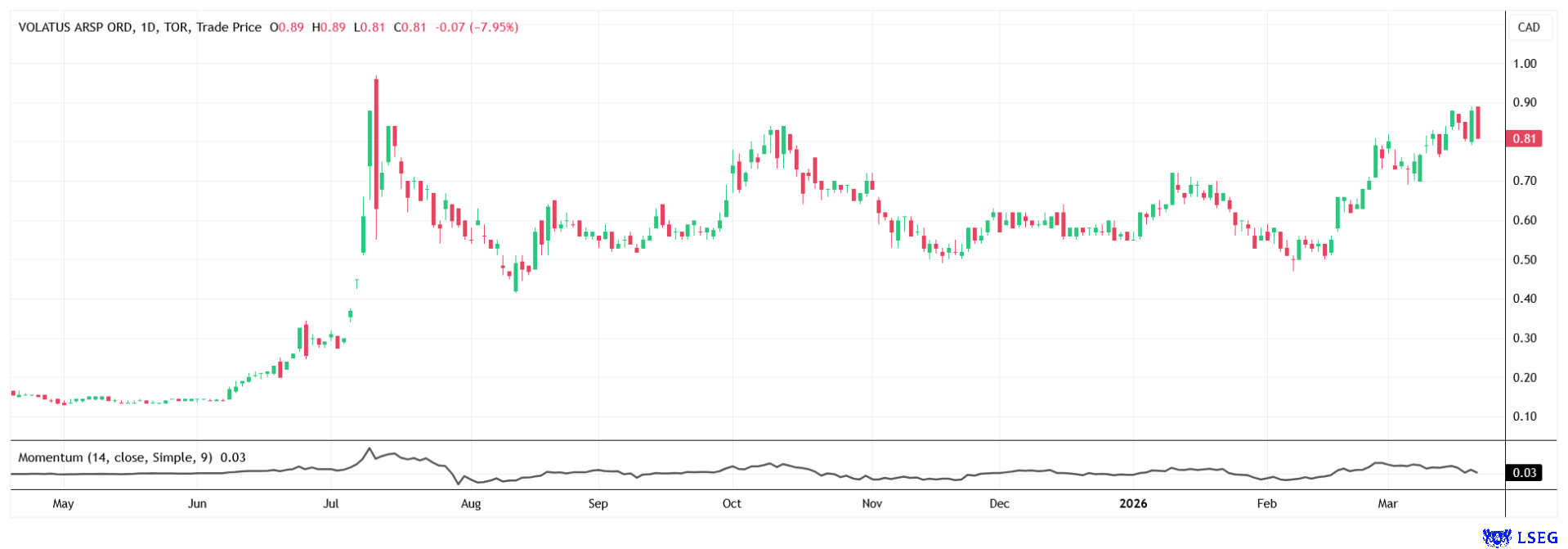
In summary, Volatus Aerospace appears well-positioned for its next phase of growth. The TSX uplisting on March 20, 2026, marks a structural milestone, improving visibility and access to institutional capital. With the full integration of Synergy Aviation and the targeted development of platforms such as Condor XL, the company is building a scalable platform across both civilian and defense applications. Volatus has the potential to deliver what the world needs most right now: security and advanced technology. The company presents itself as a solid yet still innovative partner. Even if growth is unlikely to be linear, the foundation on which Volatus is built appears exceptionally robust. Investors seeking exposure to the future of aviation and global security will find it difficult to ignore this Canadian frontrunner. Volatus Aerospace should at least be on the watchlist - if the stock breaks above its previous high, further upside momentum could follow.
Conflict of interest
Pursuant to §85 of the German Securities Trading Act (WpHG), we point out that Apaton Finance GmbH as well as partners, authors or employees of Apaton Finance GmbH (hereinafter referred to as "Relevant Persons") currently hold or hold shares or other financial instruments of the aforementioned companies and speculate on their price developments. In this respect, they intend to sell or acquire shares or other financial instruments of the companies (hereinafter each referred to as a "Transaction"). Transactions may thereby influence the respective price of the shares or other financial instruments of the Company.
In this respect, there is a concrete conflict of interest in the reporting on the companies.
In addition, Apaton Finance GmbH is active in the context of the preparation and publication of the reporting in paid contractual relationships.
For this reason, there is also a concrete conflict of interest.
The above information on existing conflicts of interest applies to all types and forms of publication used by Apaton Finance GmbH for publications on companies.
Risk notice
Apaton Finance GmbH offers editors, agencies and companies the opportunity to publish commentaries, interviews, summaries, news and the like on news.financial. These contents are exclusively for the information of the readers and do not represent any call to action or recommendations, neither explicitly nor implicitly they are to be understood as an assurance of possible price developments. The contents do not replace individual expert investment advice and do not constitute an offer to sell the discussed share(s) or other financial instruments, nor an invitation to buy or sell such.
The content is expressly not a financial analysis, but a journalistic or advertising text. Readers or users who make investment decisions or carry out transactions on the basis of the information provided here do so entirely at their own risk. No contractual relationship is established between Apaton Finance GmbH and its readers or the users of its offers, as our information only refers to the company and not to the investment decision of the reader or user.
The acquisition of financial instruments involves high risks, which can lead to the total loss of the invested capital. The information published by Apaton Finance GmbH and its authors is based on careful research. Nevertheless, no liability is assumed for financial losses or a content-related guarantee for the topicality, correctness, appropriateness and completeness of the content provided here. Please also note our Terms of use.