June 16th, 2026 | 07:25 CEST
USA–Iran: The Strait of Hormuz is Opening Up! A Sector Buy Signal for Bayer, MustGrow, BASF and K+S!
Created and published on behalf of MustGrow Biologics Corp.
Some things are ultimately not surprising. The "agreement" between the USA–Israel and Iran resembles shadow boxing. One step forward, one step back—that is how the movements at the trading desk appear. The stock markets are reacting accordingly. At the start of the week, optimism about a near-term end to the hostilities is once again dominating. Oil prices are correcting most sharply, down nearly 5%, with Brent now quoted at only USD 82.50 per barrel. This is a positive signal for chemical- and transport-oriented industries in the food sector, with BASF and Bayer showing corresponding strength. Large volumes of goods must be transported globally, and shipping routes carry significant operational importance. As part of efforts to ensure long-term food security, more and more ideas are emerging that could mitigate the international energy crisis. MustGrow focuses on natural ingredients rather than chemicals, while K+S represents a typical example of the "old economy" in this sector. For investors, multiple opportunities for returns are available!
time to read: 6 minutes | Author: André Will-Laudien
ISIN: MUSTGROW BIOLOGICS CORP. | CA62822A1030 | TSXV: MGRO , OTCQB: MGROF , BAYER AG NA O.N. | DE000BAY0017 , BASF SE NA O.N. | DE000BASF111 , K+S AG NA O.N. | DE000KSAG888
Table of contents:
Author

André Will-Laudien
Born in Munich, he first studied economics and graduated in business administration at the Ludwig-Maximilians-University in 1995. As he was involved with the stock market at a very early stage, he now has more than 30 years of experience in the capital markets.
Tag cloud
Shares cloud
MustGrow: On Course for New Growth Markets with Good Soil Biology
Global agriculture faces a historic challenge. By 2050, the world population is expected to reach nearly 10 billion, while farmers face pressure from rising production costs, resource scarcity, and increasingly extreme weather. Agricultural technology companies that skillfully combine productivity and sustainability are therefore coming increasingly into focus. Among the innovative leaders in this trend is the Canadian company MustGrow Biologics, which develops and markets biological solutions for regenerative agriculture.
At the heart of its business model are products based on natural mustard-derived extracts, designed to improve soil fertility, strengthen plants, and reduce reliance on conventional fertilizers and chemicals. The flagship biofertility product, TerraSante™, supports soil microbial activity, promotes root growth, and increases resistance to drought stress and nutrient deficiencies. The portfolio is complemented by the pre-registered mustard-derived biocontrol product TerraMG™, a biological solution for controlling soil-borne diseases and pests. The company's positioning in the growing agricultural biologicals market appears attractive; according to industry estimates, the global market volume is projected to reach USD 35 billion by the early 2030s. Aware of the challenges associated with climate change, investors are currently looking specifically for such alternative solutions that also meet ESG goals.
IIF moderator Lyndsay Malchuk in conversation with COO Colin Bletsky about the future of biofertilizers and their advantages over conventional methods.
https://www.youtube.com/watch?v=QdRWwgygRbY
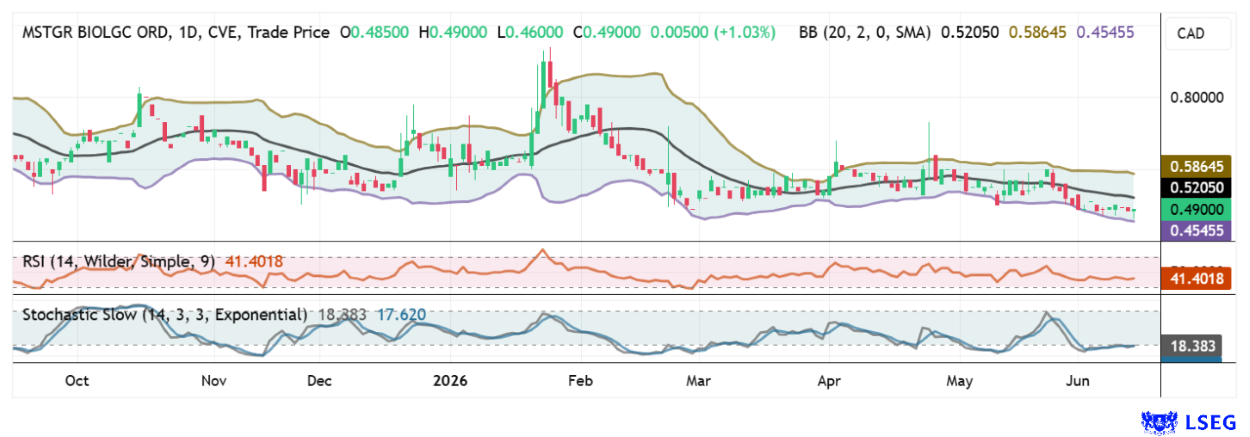
Operationally, MustGrow can report its first commercialization in Q1. Revenue of approximately CAD 0.1 million was generated from TerraSante™, whereas no revenue was recorded in the same period of the previous year. At the same time, the gross margin improved from 19.5% to a pleasing 23.6%, and current operating expenses were reduced from CAD 1.2 million to CAD 0.9 million. Due to high development costs, a net loss of CAD 1.3 million—reduced by just under 20%—remained on the books. Sequentially, there is reason to expect significant progress in the coming quarters, as the full-scale rollout has only just begun.
Expansion in the United States remains a key growth driver. Thanks to new approvals in Texas, Utah, and Montana, TerraSante™ is now registered and commercially available in 10 US states. Texas, in particular, provides access to major agricultural markets, with production volumes worth billions for crops such as potatoes, melons, citrus fruits, and pecans. In the latest quarterly report, CEO Corey Giasson highlights capacity expansions at contract manufacturers and temporary production interruptions; however, in the long term, the transition to continuous production lines is expected to enable significantly higher output volumes.
At the same time, MustGrow has an extensive portfolio of approximately 108 granted and pending patents, as well as international marketing partnerships, including with Bayer in Europe, the Middle East, and Africa. A solid foundation! With a market capitalization of just under CAD 31 million, the company remains in an early stage of development. Subject to the completion of a CAD 2 million LIFE private placement, the company could now initiate new growth initiatives in the US. A strong megatrend is benefiting the sector and the very well-positioned MustGrow. Extremely exciting!
Bayer and BASF: Significant Developments in Agricultural Technology
Companies such as Bayer and BASF are also among the key players providing solutions to the aforementioned challenges through innovations across the agricultural value chain. In its CropScience division, the Bayer Group focuses on developing high-performance seed varieties, modern crop protection solutions, and digital applications. The aim is to help farmers stabilize yields while optimizing resource use. Heat- and drought-tolerant crops are in particularly high demand, as they can strengthen food security amid increasingly extreme weather. The importance of such technologies is growing, as around 10% of the global population is still affected by food insecurity and billions of people cannot be adequately supplied with essential nutrients!
The industry is on edge, as climate change leaves little time for action. This is also mobilizing the chemical giant BASF, which has been placing greater emphasis on the ecological dimension of agriculture for several years. The company aims to establish productivity and biodiversity not as opposites, but as complementary factors. Through measures such as perennial flower strips, structurally rich agricultural landscapes, and practical biodiversity programs, BASF is providing concrete support to farmers in preserving habitats for insects and other important species. This approach is gaining relevance, as more than half of Germany's land area is used for agriculture, and the agricultural landscape thus plays a decisive role in the condition of many ecosystems.
From an investor's perspective, the entire sector combines two long-term megatrends: food security and sustainability. The Food and Agriculture Organization of the United Nations forecasts that global agricultural production must increase by about 50% by 2050 to meet the needs of the growing population.
This opens up attractive growth opportunities for Bayer and BASF, as both companies have extensive research budgets, global distribution networks, and technological platforms. On the LSEG platform, Bayer offers an average target price of around EUR 49.30, with over 35% upside potential, while BASF can hope for a price increase of about 10% over the next 12 months in the same context. Our conclusion: cyclical stocks, good dividends, and solid future prospects. The 2026 P/E ratios of 8.5 for Bayer and 16.6 for BASF are cyclically in the lower end of the valuation range over a 3-year horizon. Interesting in the medium term!
K+S: A Convertible Bond at a Lower Level Now
As if the May downgrades had not already put enough pressure on the share price, the German fertilizer and salt group K+S is now also announcing a financing move. The company successfully placed the planned convertible bond on the capital market at the end of last week. It increased the issue size from the original EUR 300 million to EUR 320 million due to strong demand. The debt instrument, maturing in 2031, carries a coupon of just 0.625% per year and is aimed exclusively at institutional investors. The initial conversion price was set at EUR 17.93, representing a 35% premium over the share's reference price and was described by analysts as a success. The increased confidence appears to stem from the easing of tensions in the Middle East. K+S intends to use the proceeds primarily to finance the acquisition of Qemetica's salt business, create additional financial flexibility, and optimize its capital structure. From the company's perspective, the transaction offers significant financing advantages, as the company can save interest costs in the mid-double-digit million-euro range over the entire term compared to a traditional bond. And the new stock subscription rights, priced at just under EUR 18, have little impact on the share price of EUR 13.50. Well-financed and a 30% discount to the yearly high are putting K+S in a good mood!
The stock markets remain volatile. What was hot yesterday is by no means guaranteed to be so tomorrow. Last week, SpaceX was the driving force; now the market is focusing on falling energy prices, which is having a corresponding impact on industrial stocks. This is breathing new life into stocks like Bayer, BASF, and K+S. The Canadian biological solutions provider MustGrow could also benefit significantly, as many positive factors are now converging here!
Conflict of interest
Pursuant to §85 of the German Securities Trading Act (WpHG), we point out that Apaton Finance GmbH as well as partners, authors or employees of Apaton Finance GmbH (hereinafter referred to as "Relevant Persons") currently hold or hold shares or other financial instruments of the aforementioned companies and speculate on their price developments. In this respect, they intend to sell or acquire shares or other financial instruments of the companies (hereinafter each referred to as a "Transaction"). Transactions may thereby influence the respective price of the shares or other financial instruments of the Company.
In this respect, there is a concrete conflict of interest in the reporting on the companies.
In addition, Apaton Finance GmbH is active in the context of the preparation and publication of the reporting in paid contractual relationships.
For this reason, there is also a concrete conflict of interest.
The above information on existing conflicts of interest applies to all types and forms of publication used by Apaton Finance GmbH for publications on companies.
Risk notice
Apaton Finance GmbH offers editors, agencies and companies the opportunity to publish commentaries, interviews, summaries, news and the like on news.financial. These contents are exclusively for the information of the readers and do not represent any call to action or recommendations, neither explicitly nor implicitly they are to be understood as an assurance of possible price developments. The contents do not replace individual expert investment advice and do not constitute an offer to sell the discussed share(s) or other financial instruments, nor an invitation to buy or sell such.
The content is expressly not a financial analysis, but a journalistic or advertising text. Readers or users who make investment decisions or carry out transactions on the basis of the information provided here do so entirely at their own risk. No contractual relationship is established between Apaton Finance GmbH and its readers or the users of its offers, as our information only refers to the company and not to the investment decision of the reader or user.
The acquisition of financial instruments involves high risks, which can lead to the total loss of the invested capital. The information published by Apaton Finance GmbH and its authors is based on careful research. Nevertheless, no liability is assumed for financial losses or a content-related guarantee for the topicality, correctness, appropriateness and completeness of the content provided here. Please also note our Terms of use.