December 12th, 2025 | 07:15 CET
US banks declare a golden age: JPMorgan, Goldman Sachs, Kobo Resources and the maximum leverage
Wall Street's gold price forecasts for 2026 are unusually clear. Both JPMorgan and Goldman Sachs have raised their price targets significantly and see the precious metal on the verge of a historic breakout. But while the big banks primarily manage their business through volume and hedging, the market offers additional opportunities for speculative investors. Small explorers like Kobo Resources could become particularly interesting precisely because the big institutional players have not yet invested here.
time to read: 3 minutes | Author: Nico Popp
ISIN: JPMORGAN CHASE DL 1 | US46625H1005 , GOLDMAN SACHS GRP INC. | US38141G1040 , KOBO RESOURCES INC | CA49990B1040
Table of contents:
Author

Nico Popp
At home in Southern Germany, the passionate stock exchange expert has been accompanying the capital markets for about twenty years. With a soft spot for smaller companies, he is constantly on the lookout for exciting investment stories.
Tag cloud
Shares cloud
The business model of the banks: Winners in every scenario
When the heavyweights of the financial world agree, investors should pay close attention. A rare consensus is currently emerging on Wall Street, as the analyst teams of the leading US banks have significantly revised their gold forecasts for 2026 upwards. The message is clear: **a structural supply deficit is coinciding with a geopolitical environment that is forcing central banks around the world to shift their dollar reserves into gold. JPMorgan sees the precious metal in a long-term supercycle and forecasts an average gold price of over USD 5,000 from the fourth quarter of 2026 onwards. Goldman Sachs is singing from the same hymn sheet, forecasting a continuation of the rally well into 2026, reaching USD 4,900. The drivers are no longer just interest rate cuts, but massive physical demand from Asia and strategic buying pressure of central banks.
How JPMorgan and Goldman Sachs are profiting from the gold rally
It is important for private investors to understand that institutions such as JPMorgan and Goldman Sachs are not simply betting on rising prices. Their business model is far more complex and robust. These banks primarily act as market makers, meaning they provide liquidity to the market and earn money from the difference between the buying and selling prices, known as spreads. In a bull market, where trading volume and volatility are rising, these spreads often widen, causing trading departments' profits to soar.
In addition, banks benefit from storage business and structured financial products. As custodians of huge physical gold reserves for ETFs and institutional clients, they generate ongoing fee income that rises with the value of gold. At the same time, they sell mining companies complex hedging instruments that producers use to protect themselves against price fluctuations. So the bank often wins twice: it earns from the physical rally through its own holdings and at the same time from the hedging needs of industry. Banks are therefore pursuing a business with a built-in safety net.
Kobo Resources: The speculative bet flying under the radar
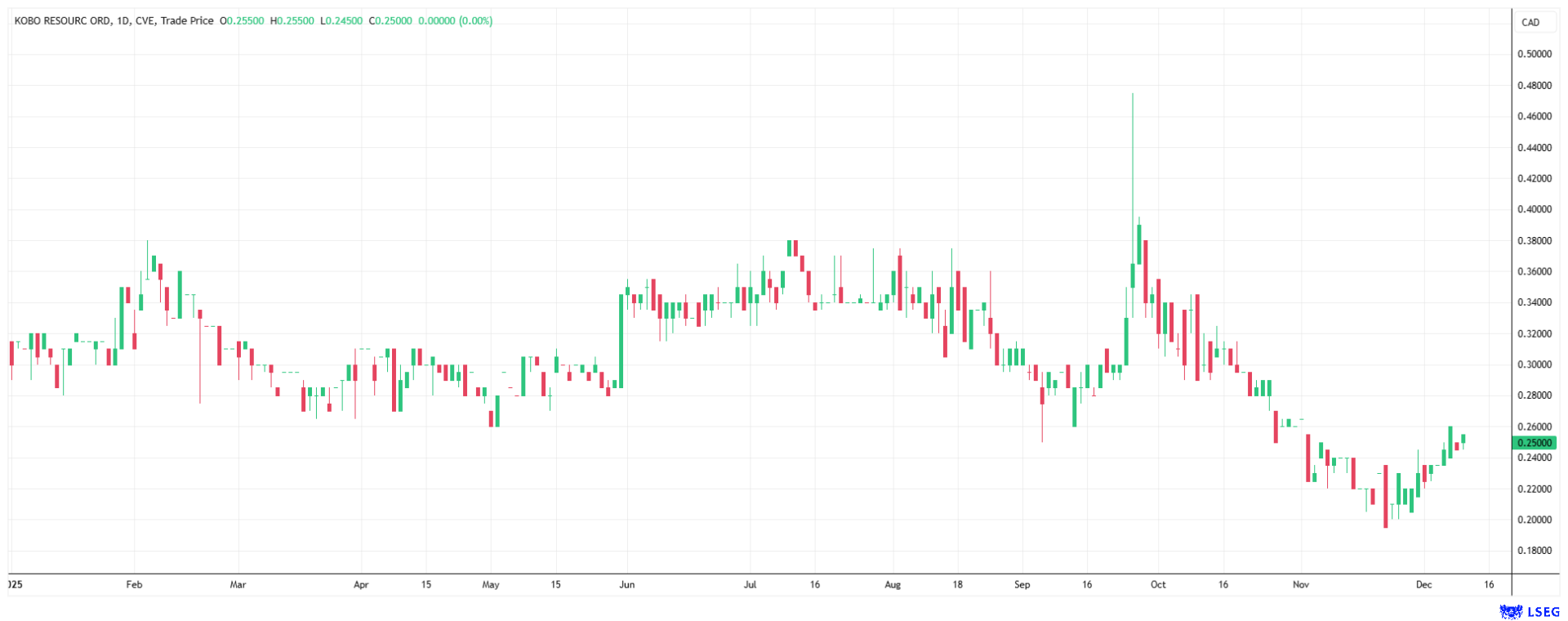
While large banks cover the broad market, a niche largely ignored by Wall Street is opening up for risk-taking investors. Here, the focus is on junior miners and exploration companies that maximize leverage on the gold price. A prominent example of this category is Kobo Resources. The Company operates in Côte d'Ivoire and focuses entirely on developing new deposits rather than operating existing mines.
Côte d'Ivoire has become one of the most attractive gold regions in West Africa in recent years, and Kobo Resources owns 100% of the Kossou Gold Project there. Unlike many competitors, who only have options on land, Kobo has complete control over its properties. Management is aggressively pursuing exploration, and drill results to date indicate high-grade deposits close to surface. This is crucial for the profitability of a potential future mine, as surface gold is significantly cheaper to extract than deep deposits.
Kobo Resources and the advantage of private investors
This is precisely where the strategic opportunity for investors lies. Due to their compliance rules and low market capitalization, large institutions such as JPMorgan or Goldman Sachs are often not allowed to invest in small stocks such as Kobo Resources. They have to wait until a project has reached a specific size or a resource estimate is available that meets institutional standards. Kobo Resources is currently working on this validation through further drilling programs and geological models, thereby creating value.
During this window of opportunity, private investors have an information advantage and can use it to their benefit. If the US banks' forecasts prove accurate and the price of gold reaches new heights in 2026, experience shows that capital will flow through the sector in a cascade: first, the large producers will rise, then investors will seek higher-yielding alternatives among the explorers. Stocks such as Kobo Resources then often serve as a speculative addition to portfolios. If successful, meaning if the resources are confirmed or the Company is acquired by a major player, they offer a multiple of the performance of the physical gold price. However, investors purchase this potential at an increased risk should the exploration fail. However, with Kobo Resources already reporting impressive drilling results this year, including 2.5 g/t Au over 10 m, and having convinced professional investors in the fall, the Company appears to be well positioned for 2026.
Watch YouTube videoConflict of interest
Pursuant to §85 of the German Securities Trading Act (WpHG), we point out that Apaton Finance GmbH as well as partners, authors or employees of Apaton Finance GmbH (hereinafter referred to as "Relevant Persons") may hold shares or other financial instruments of the aforementioned companies in the future or may bet on rising or falling prices and thus a conflict of interest may arise in the future. The Relevant Persons reserve the right to buy or sell shares or other financial instruments of the Company at any time (hereinafter each a "Transaction"). Transactions may, under certain circumstances, influence the respective price of the shares or other financial instruments of the Company.
In addition, Apaton Finance GmbH is active in the context of the preparation and publication of the reporting in paid contractual relationships.
For this reason, there is a concrete conflict of interest.
The above information on existing conflicts of interest applies to all types and forms of publication used by Apaton Finance GmbH for publications on companies.
Risk notice
Apaton Finance GmbH offers editors, agencies and companies the opportunity to publish commentaries, interviews, summaries, news and the like on news.financial. These contents are exclusively for the information of the readers and do not represent any call to action or recommendations, neither explicitly nor implicitly they are to be understood as an assurance of possible price developments. The contents do not replace individual expert investment advice and do not constitute an offer to sell the discussed share(s) or other financial instruments, nor an invitation to buy or sell such.
The content is expressly not a financial analysis, but a journalistic or advertising text. Readers or users who make investment decisions or carry out transactions on the basis of the information provided here do so entirely at their own risk. No contractual relationship is established between Apaton Finance GmbH and its readers or the users of its offers, as our information only refers to the company and not to the investment decision of the reader or user.
The acquisition of financial instruments involves high risks, which can lead to the total loss of the invested capital. The information published by Apaton Finance GmbH and its authors is based on careful research. Nevertheless, no liability is assumed for financial losses or a content-related guarantee for the topicality, correctness, appropriateness and completeness of the content provided here. Please also note our Terms of use.