July 21st, 2026 | 07:00 CEST
Ukraine – Iran – NATO: The Battle in the Skies Gives Wings to RTX and Lockheed; Rheinmetall and Volatus Aerospace on the Rise!
As long as geopolitical conflicts continue, defence stocks have it easy. That is because they automatically come into focus when new government programs are launched to boost defence capabilities. In July, it was the NATO conference in Ankara. Government officials in attendance surrounded Donald Trump, as the US is the leader in air defence—and this is precisely where both NATO and Ukraine are falling short. When it comes to drones, however, the former Soviet state has made great strides. An entire drone industry was built from the ground up in no time at all. And for several weeks now, they have been piercing through Russia's defensive perimeter and penetrating deep into its energy processing facilities. Ukraine has already taken a quarter of Russia's oil refining capacity out of commission. The West views this progress as a welcome easing of tensions, but is stepping up its investments even further. Chancellor Merz, for example, is ordering the highly sought-after Tomahawk missiles from the US and is even participating in the latest French nuclear exercise. Just as politicians are, investors should also be in the starting blocks to ride the new wave of investment.
time to read: 6 minutes | Author: André Will-Laudien
ISIN: VOLATUS AEROSPACE INC | CA92865M1023 | TSXV: FLT , OTCQB: TAKOF , RHEINMETALL AG | DE0007030009 , LOCKHEED MARTIN DL 1 | US5398301094 , RTX CORPORATION | US75513E1010
Table of contents:
Author

André Will-Laudien
Born in Munich, he first studied economics and graduated in business administration at the Ludwig-Maximilians-University in 1995. As he was involved with the stock market at a very early stage, he now has more than 30 years of experience in the capital markets.
Tag cloud
Shares cloud
RTX and Lockheed: The European Investment Wave Is Rolling
All eyes are once again on the defence sector! The general threat situation in Europe is prompting governments to take major steps. In particular, the high volume of orders for EU air defence is bringing an unprecedented wave of major contracts to the US defence giants RTX Corporation and Lockheed Martin. Numerous NATO countries are completely overhauling their military infrastructure in record time. The US corporation RTX, better known by its subsidiary Raytheon, is benefiting massively from the enormous demand for the Patriot air defence system, which forms the backbone of European missile defence. Lockheed Martin is also reporting a full order book due to EU-wide procurement of F-35 stealth jets, which serve as both nuclear and conventional deterrents.
Added to this are orders for Tomahawk cruise missiles, which are considered sold out, to strengthen long-range precision strike capabilities. Since RTX manufactures these advanced cruise missiles, the company secures long-term revenue through production and maintenance. Due to high demand, production is being ramped up to 1,000 units per year. Lockheed Martin benefits indirectly through the integration of these weapons systems into joint defence networks and delivery platforms. Moreover, the decades-long service and modernization contracts guarantee both companies stable, predictable cash flows for generations to come. However, this novel defence cooperation between the EU and the US also cements Europe's technological dependence on the American defence industry—a fact that should not be overlooked amid all the euphoria.
The estimates for the two defence contractors on the LSEG platform are highlighted in gold. Since 2023, RTX has increased its revenue by 25% to approximately USD 88 billion; by the end of 2027, it is expected to rise to USD 101 billion. The bottom line is a profit of around USD 10.5 billion, which, at a share price of USD 197, translates to a P/E ratio of 25.3. After consolidating to USD 145 in April, the stock is now back at USD 191, just 5% below its all-time high. Things are a bit more moderate at Lockheed. After USD 75 billion in revenue in 2025, revenue is expected to reach USD 83 billion by 2027. The stock is trading at a 2027 P/E ratio of 15.9. With a 2026 price-to-sales (P/S) ratio between 1.5 and 2.5, the shares are not overvalued, as ongoing conflicts could drive further growth.
Volatus Aerospace: The Infrastructure of Modern Security Architectures
The global security landscape is changing not only defence strategies but also capital flows. With rising investments in drones, artificial intelligence, and autonomous systems, a multi-billion-dollar market of the future is emerging. According to Fortune Business Insights, the global market for unmanned aerial systems is expected to grow from approximately USD 47 billion in 2026 to about USD 160 billion by 2034, representing an annual growth rate of 16.4%. In addition to military applications, demand is also rising in critical infrastructure sectors such as energy supply, data centers, pipelines, ports, and airports. Here, Volatus Aerospace is making a name for itself as an integrated provider of autonomous systems, aerial reconnaissance, and AI-based software. The company combines drone technology, sensor systems, training solutions, and software into a scalable platform. At the core are the modular autonomy architecture, V-Cortex, for air, ground, and water vehicles, as well as the cloud-based counter-UAS platform, SKYDRA, which supports the transition to higher-margin software and service revenues.
The industrial base is growing at a truly noticeable rate. In Mirabel, Canada, Volatus has commissioned a production and integration center spanning approximately 53,000 square feet, which could generate up to CAD 250 million in revenue at full capacity. The location is gaining strategic importance now that the Canadian government is establishing a new Uncrewed Systems Defence Innovation Secure Hub there and has initially invested CAD 29 million. The goal is to develop autonomous defence systems more quickly and test them under realistic conditions—an investment environment from which Volatus is likely to benefit directly. There is also significant regulatory activity underway. With the planned "Maple List," Canada aims to create a national certification platform for drones, modelled after the US Blue List, and to facilitate domestic manufacturers' access to military procurement programs. From July 20 to 24, Volatus will be exhibiting at the Farnborough International Airshow in the UK, one of the world's most important aviation and defence trade shows. This will allow the company, which is still relatively small by industry standards, to enhance its international visibility among government agencies, NATO partners, and industry customers.
Operationally, the defence business is now emerging as the key growth driver. Qualification for the second phase of the US Drone Dominance Program, with a total volume of approximately USD 1.1 billion, as well as the collaboration with the UCan Brave Tech Center to integrate battle-tested Ukrainian technologies into Western defence systems, underscore the company's strategic positioning. Following the CAD 34.5 million capital increase, Volatus has fresh financial resources to expand its necessary production and technology platforms. At the same time, management estimates the project pipeline at approximately CAD 500 million. With a current market capitalization of just CAD 370 million, analysts estimate the fair value of the stock, currently trading at around CAD 0.51, to be CAD 1.07 on average, with the highest price targets reaching CAD 1.25. If the company succeeds in converting its extensive pipeline into orders and capitalizing on rising defence spending in North America, Volatus Aerospace continues to have significant potential for revaluation from an analytical perspective.
CFO Abhinav Singhvi outlined the company's strategy at the recent 19th International Investment Forum.
Rheinmetall: The correction to the correction is underway
The time is ripe for a redefinition of the trading range! Despite all the negative press since March and the recent loss of the naval contract to TKMS, Rheinmetall remains structurally well-positioned, as its core growth story is clearly anchored in land-based systems, ammunition, and digitalization—and not primarily at sea. The recently announced EUR 100 million call-off under the D-LBO program is merely a small component within a significantly larger, long-term framework agreement, from which Rheinmetall will generate a total of more than EUR 1.4 billion through IT system integration and vehicle integration. This secures the Group recurring business over the coming years in hardware, software, integration, and services related to the digital networking of Bundeswehr vehicles and command posts.
The shift in the frigate contract to TKMS is strategically painful primarily because it eliminates an important opportunity to establish a strong position in the naval segment and requires a correction of the expectations previously factored into the price regarding the NVL engagement. In terms of the share price, this move led to a significant setback to around EUR 900 and increased volatility. Still, it reflects a reassessment of the naval potential rather than a weakening of the core business. Politically and militarily, the focus of the current rearmament effort remains on army platforms, ammunition, and networked command capabilities, where Rheinmetall retains a key role. Although 21 out of 24 analysts on the LSEG platform have revised their price targets downward, they are maintaining a "Buy" rating. The mixed 12-month price target of EUR 1,695, down from EUR 2,225 in February, is now much more realistic.
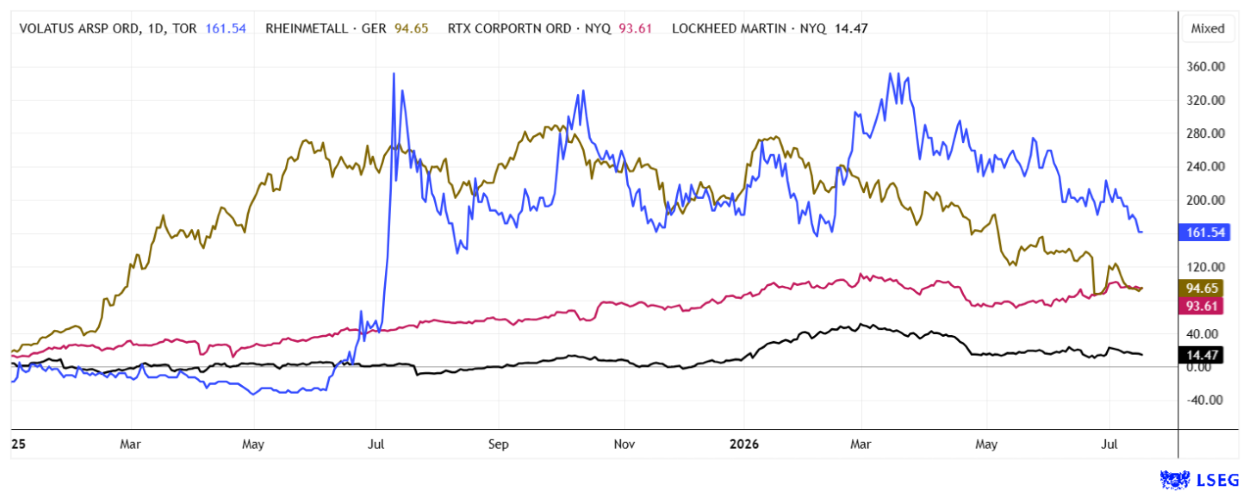
The environment for dividend stocks is becoming increasingly selective. While high-tech and chip stocks are currently losing some steam, renewed attacks by Iran on Western allies are driving further price surges in defence stocks. While Rheinmetall and RTX continue to consolidate, Volatus Aerospace and Lockheed Martin are once again attracting new investor interest at their recent correction levels.
Conflict of interest
Pursuant to §85 of the German Securities Trading Act (WpHG), we point out that Apaton Finance GmbH as well as partners, authors or employees of Apaton Finance GmbH (hereinafter referred to as "Relevant Persons") currently hold or hold shares or other financial instruments of the aforementioned companies and speculate on their price developments. In this respect, they intend to sell or acquire shares or other financial instruments of the companies (hereinafter each referred to as a "Transaction"). Transactions may thereby influence the respective price of the shares or other financial instruments of the Company.
In this respect, there is a concrete conflict of interest in the reporting on the companies.
In addition, Apaton Finance GmbH is active in the context of the preparation and publication of the reporting in paid contractual relationships.
For this reason, there is also a concrete conflict of interest.
The above information on existing conflicts of interest applies to all types and forms of publication used by Apaton Finance GmbH for publications on companies.
Risk notice
Apaton Finance GmbH offers editors, agencies and companies the opportunity to publish commentaries, interviews, summaries, news and the like on news.financial. These contents are exclusively for the information of the readers and do not represent any call to action or recommendations, neither explicitly nor implicitly they are to be understood as an assurance of possible price developments. The contents do not replace individual expert investment advice and do not constitute an offer to sell the discussed share(s) or other financial instruments, nor an invitation to buy or sell such.
The content is expressly not a financial analysis, but a journalistic or advertising text. Readers or users who make investment decisions or carry out transactions on the basis of the information provided here do so entirely at their own risk. No contractual relationship is established between Apaton Finance GmbH and its readers or the users of its offers, as our information only refers to the company and not to the investment decision of the reader or user.
The acquisition of financial instruments involves high risks, which can lead to the total loss of the invested capital. The information published by Apaton Finance GmbH and its authors is based on careful research. Nevertheless, no liability is assumed for financial losses or a content-related guarantee for the topicality, correctness, appropriateness and completeness of the content provided here. Please also note our Terms of use.