May 26th, 2026 | 06:55 CEST
Completely Underrated: How Investors Can Benefit from the Megatrend of Autonomous Flight Systems with Volatus Aerospace
Unmanned Aerial Systems (UAS) have established themselves as a megatrend. Their importance and range of applications are steadily increasing. Already indispensable in the military, they are gradually transforming industries such as logistics, delivery services, agriculture, industrial inspection, and media. In particular, players like Volatus Aerospace are well-positioned. Their success formula consists of several elements: strong integration with NATO-related clients and an intelligent ecosystem with increasingly scalable business operations, which gives the stock a clear position as a market favourite.
time to read: 5 minutes | Author: Carsten Mainitz
ISIN: VOLATUS AEROSPACE INC | CA92865M1023 | TSXV: FLT , OTCQB: TAKOF
Table of contents:
Author

Carsten Mainitz
The native Rhineland-Palatinate has been a passionate market participant for more than 25 years. After studying business administration in Mannheim, he worked as a journalist, in equity sales and many years in equity research.
Tag cloud
Shares cloud
Megatrend
The technological maturity and, consequently, the rapid growth of unmanned aerial systems are based on advances in batteries, sensor technology, artificial intelligence, computer vision, and communication. This evolution has made drones more powerful and, at the same time, more affordable. The war in Ukraine impressively demonstrates how much inexpensive drones can transform traditional military technology, from reconnaissance to precision strikes.
Outside the military, drones are now essential tools for numerous industries and applications. Agriculture, search and rescue, disaster response, critical infrastructure monitoring, logistics, transportation, and media play the largest roles. According to Grand View Research, the UAS market was worth approximately USD 20 billion last year and is projected to more than double in just a few years. Geographically, North America holds the largest share, though commercial applications predominate globally.
However, experts predict a rapid upswing in the military sector. The driving forces are, in particular, the significant increase in government investments in UAS around the globe and the formation of strategic partnerships with the private sector.
The US Sets the Pace
The US government, in particular, is driving the industry forward.
With the Drone Dominance Program (DDP), the US Department of Defence has launched an initiative aimed at establishing the US as the world's leading player in unmanned aerial systems.
At its core, the DDP's goal is to massively scale up the production of small, low-cost drones and integrate them into every combat unit. The goal is to produce over 300,000 drones by 2028. The US is thus building up a strategic stockpile of ready-to-deploy systems. Approximately USD 1 billion has been allocated for this purpose.
In total, only 48 companies have qualified to participate in the program, including Volatus Aerospace. If the Canadians were to be selected, the share price would take off. The market is currently underestimating this massive potential. Likewise, the impact of Canada's Defence Industrial Strategy is being underestimated. The country plans to invest around 70% of its more than CAD 80 billion budget into the domestic defence industry. With the ongoing expansion of its manufacturing and system integration capabilities in Québec, Volatus Aerospace is also ideally positioned to benefit massively from these favourable conditions.
The Formula for Success
Volatus Aerospace positions itself as an integrated provider of a comprehensive aerial and data ecosystem. This clearly sets the company apart from pure drone manufacturers. In recent years, the Canadians have successfully integrated a considerable number of companies, thereby fully capitalizing on opportunities in this growth market. In the commercial sector, the Canadians offer, among other things, aerial services to energy suppliers and infrastructure operators, including the monitoring of pipelines, power lines, and offshore wind farms.
In the defence sector, Volatus is winning an increasing number of NATO contracts. Most recently, the company announced multi-million-dollar contracts for training drone pilots for military and security-related missions. Together with Sentinel R&D, the company is also working on the development of a Canadian interceptor drone system.
To support future growth in the military and procurement sectors, the company has assembled an international advisory team with NATO and defence expertise. This team is led by the well-known retired Canadian Lieutenant General Andrew Leslie and was recently joined by retired US Air Force Major General Peter "Pete" Fesler.
Technologically, the company marked a milestone this spring with the launch of its cloud-based platform for drone defence planning and simulation. The SaaS platform SKYDRA generates recurring revenue with margins of 80%-85%. This is likely to positively impact the Canadian company's overall profitability in the coming quarters. In addition, Volatus is advancing the development of its AI-based autonomy platform, V-Cortex, and its heavy-lift drone systems.
Gain deeper insights into the company's strategy. The video features CEO Glen Lynch in his latest interview with IIF host Lyndsay Malchuk.
Significant First-Quarter Developments are only Partially Reflected in the Figures
The recently published first-quarter figures only partially reflect the company's strategic and operational successes and are negatively impacted by project delays and high investments. Consequently, the slight decline in revenue from CAD 5.7 million to CAD 5.6 million in the first three months of the current fiscal year should not be overinterpreted. What matters is that, thanks to improved efficiency and cost reductions, the gross margin increased from 32% to a new high of 35%. In the medium term, management is aiming for a stable margin range of 35 to 40%.
The Canadian company is still in the red. However, with rising order intake and a greater emphasis on scalable business, this picture will change fundamentally and permanently in the coming quarters. With a cash balance of nearly CAD 32 million, the company remains comfortably positioned for its planned growth.
"We continue to see strong momentum across our defence, training, and infrastructure business segments, supported by Canada's defence industry strategy, growing opportunities within NATO, and the continued commercialization of our proprietary platforms and software technologies. Therefore, management remains confident that the company will achieve significant growth through fiscal year 2026," CEO Glen Lynch summarized the situation.
Share Price and Valuation
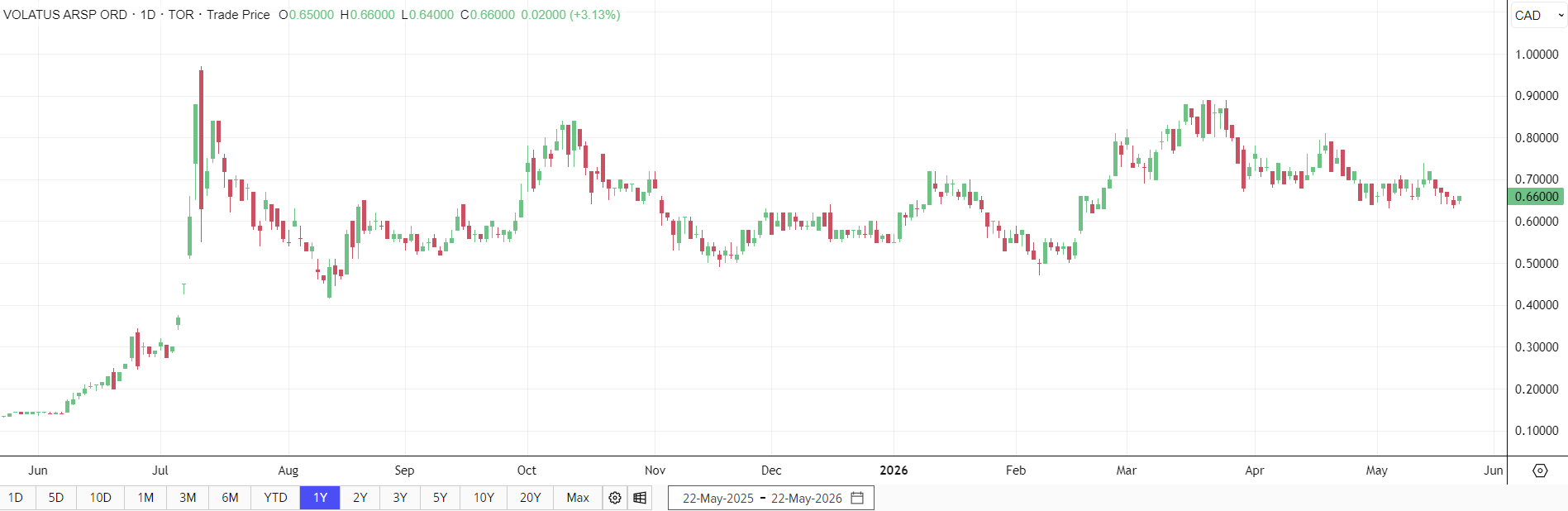
Since the beginning of the year, the share has been trading within a broad range between approximately CAD 0.50 and CAD 0.90. Currently, the share price stands at CAD 0.66, roughly in the middle of this range. Analysts unanimously recommend the shares as a "Buy" and cite price targets of up to CAD 1.25. The current market capitalization is CAD 450 million, reflecting a moderate valuation level compared to competitors.
Conclusion
Volatus is strategically well-positioned with its ecosystem. The first-quarter figures barely reflect the company's true potential, as its scalable, high-margin business has only just begun and has been weighed down by project delays and high investments. However, this will change dramatically in the coming quarters. Forward-thinking investors are reading between the lines and seizing the opportunity now. Analysts believe the stock has upside potential of up to CAD 1.25. Should the company secure contracts under US or Canadian defence programs, strong price momentum is expected.
Conflict of interest
Pursuant to §85 of the German Securities Trading Act (WpHG), we point out that Apaton Finance GmbH as well as partners, authors or employees of Apaton Finance GmbH (hereinafter referred to as "Relevant Persons") may hold shares or other financial instruments of the aforementioned companies in the future or may bet on rising or falling prices and thus a conflict of interest may arise in the future. The Relevant Persons reserve the right to buy or sell shares or other financial instruments of the Company at any time (hereinafter each a "Transaction"). Transactions may, under certain circumstances, influence the respective price of the shares or other financial instruments of the Company.
In addition, Apaton Finance GmbH is active in the context of the preparation and publication of the reporting in paid contractual relationships.
For this reason, there is a concrete conflict of interest.
The above information on existing conflicts of interest applies to all types and forms of publication used by Apaton Finance GmbH for publications on companies.
Risk notice
Apaton Finance GmbH offers editors, agencies and companies the opportunity to publish commentaries, interviews, summaries, news and the like on news.financial. These contents are exclusively for the information of the readers and do not represent any call to action or recommendations, neither explicitly nor implicitly they are to be understood as an assurance of possible price developments. The contents do not replace individual expert investment advice and do not constitute an offer to sell the discussed share(s) or other financial instruments, nor an invitation to buy or sell such.
The content is expressly not a financial analysis, but a journalistic or advertising text. Readers or users who make investment decisions or carry out transactions on the basis of the information provided here do so entirely at their own risk. No contractual relationship is established between Apaton Finance GmbH and its readers or the users of its offers, as our information only refers to the company and not to the investment decision of the reader or user.
The acquisition of financial instruments involves high risks, which can lead to the total loss of the invested capital. The information published by Apaton Finance GmbH and its authors is based on careful research. Nevertheless, no liability is assumed for financial losses or a content-related guarantee for the topicality, correctness, appropriateness and completeness of the content provided here. Please also note our Terms of use.