November 13th, 2026 | 05:25 CET
Things are heating up: Defence sell-off, antimony gains! Rheinmetall, Renk, NSJ Antimony and Hensoldt in Focus
Created and Published on Behalf of NSJ Antimony Corp.
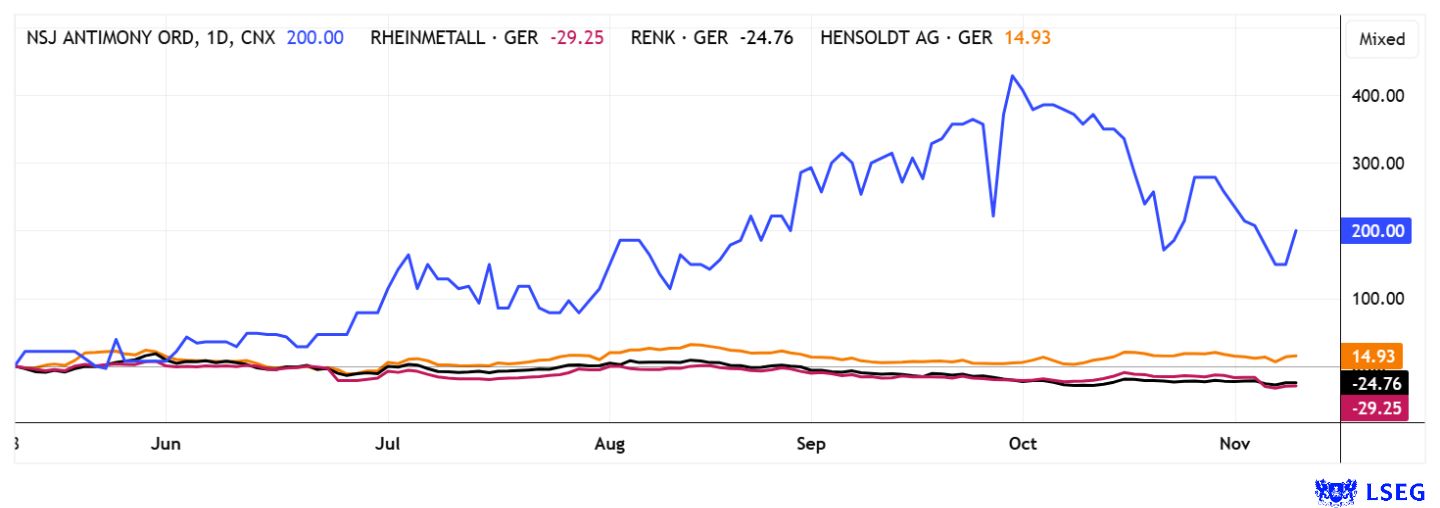
Diplomatic initiatives could bring an end to hostilities in Ukraine in the coming weeks. This has recently put noticeable pressure on the share prices of traditional defence stocks. Following the years-long rally in defence stocks, many investors are now systematically taking profits, as they price in a normalisation of acute demand for ammunition and equipment, at least in the short term, in the event of a possible ceasefire. Yet political strategists agree: even lasting peace would no longer reverse the long-term turning point in security policy, but would instead reveal the strategic importance of upstream supply chains. Here, critical metals are once again coming into focus on financial markets, as modern defence systems and the global expansion of energy and AI infrastructure are simply not feasible without these raw materials. In particular, the often underestimated metalloid antimony is emerging as the ultimate bottleneck, as it is indispensable for hardening ammunition, night-vision devices and highly specialised semiconductors. We present a colourful potpourri of trends – but also an excellent opportunity for risk-aware investors to capitalise on fresh momentum.
time to read: 5 minutes | Author: André Will-Laudien
ISIN: NSJ Antimony Corp. | CA6293911039 , RHEINMETALL AG | DE0007030009 , RENK AG | DE000RENK730 , HENSOLDT AG INH | DE000HAG0005
Table of contents:
Author

André Will-Laudien
Born in Munich, he first studied economics and graduated in business administration at the Ludwig-Maximilians-University in 1995. As he was involved with the stock market at a very early stage, he now has more than 30 years of experience in the capital markets.
Tag cloud
Shares cloud
Rheinmetall and Renk – Ceasefire hopes and profit-taking
Rheinmetall below EUR 800! It resembles a tragedy for latecomers: those who missed the chance to get out in time are now looking at deep portfolio losses. The current diplomatic negotiations over an end to the war in Ukraine are causing significant unease on the trading floor and weighing heavily on the share prices of the domestic defence industry. Even bulging order books currently offer no reliable protection against sharp share price losses. German industry leader Rheinmetall has experienced turbulent days recently and yesterday slumped to a new 52-week low of around EUR 770. Alongside the widespread nervousness over possible peace settlements came a self-inflicted shock in early November: the group's management had to revise its revenue targets downwards for the second time within a quarter. The revenue forecast for the current year was cut to approximately EUR 13.2 billion, while the targeted operating margin was reduced slightly to 18.5%. Although the Düsseldorf-based group has a substantial order backlog of EUR 78 billion, investors are increasingly losing patience as these contracts are translating into recognised revenue only slowly. Major investment banks such as Bank of America and JPMorgan reacted promptly, withdrawing their Buy recommendations. The average target price on the LSEG Refinitiv data platform has also fallen from EUR 1,925 in January to EUR 1,358 now. Apparently, even die-hard optimists among analysts are struggling to adjust their expectations to the new reality. From a technical perspective, there is still room for further falls!
Speculation about a ceasefire and a general shift of capital away from the defence sector have also left their mark on propulsion specialist Renk. Following yesterday's sharp pullback, a new year-low of EUR 32.84 lit up the trading screen. The downward trend is therefore continuing despite positive company news. Even a strong increase in order intake in early November had no effect in the negative overall market environment. Just like Rheinmetall, Renk has also come under increased scrutiny from professional short sellers, who have significantly expanded their short positions across the sector. Although most analysts consider the shares too cheaply valued on fundamentals and see an average target of around EUR 56.50, caution currently prevails on the stock market. With an estimated price-to-earnings (P/E) ratio of 16.6 for 2027, the shares are not a real bargain either.
Hensoldt – Better than the sector would suggest
Sensor technology provider Hensoldt has proved more resilient than its direct competitors in recent weeks, but has been unable to escape the sector's general pressure entirely. In early November, reports of IT problems at the central warehouse briefly caused unease before convincing nine-month figures turned things around again. The company increased its new orders by 77% to more than EUR 3.5 billion, raised its annual targets and reported a record order backlog of just under EUR 10.4 billion. At the Capital Markets Day on November 10, the management board also reaffirmed its ambitious long-term targets: annual revenue is set to climb to EUR 6 billion by 2030 and even to EUR 10 billion by 2035. Nevertheless, market participants point critically to free cash flow, which remains negative after three quarters, and the risk that major projects could be delayed. Many investment firms are maintaining a Neutral Hold recommendation despite raised price targets, as the shares already command a demanding valuation at a 2026 price-to-sales (P/S) ratio of 3.5 and a P/E ratio of 42.8. At a current share price of EUR 79, the shares are still EUR 13 away from the average LSEG Refinitiv price target of around EUR 92. Given the stable share price performance, further developments here remain extremely interesting.
NSJ Antimony – Entering the analysis phase with fresh drill data
With China dominating global antimony mining and processing and having recently imposed strict export controls, the West faces the threat of a dramatic supply shortage. This is because established industrialised nations must build up strategic reserves regardless of the war's current course and finance their own mining projects outside Asian monopolies. Enormous demand for antimony is meeting historically tight supply, driving prices to ever-higher records. Investors are increasingly recognising that true power in the 21st century lies not solely in finished weapons systems, but in control over the necessary elemental materials.
Canadian antimony specialist NSJ Antimony has reached an important milestone at its project in New Brunswick: the first drilling phase is complete, and attention is now turning to the assay results. The exploration area is located about 15 km from the historic Lake George mine, which at times accounted for up to 4% of global antimony supply between 1970 and 1992. Of geological interest is the fact that both sites are characterised by comparable Silurian interbedded greywacke and argillite. NSJ has significantly expanded its project area through additional claims; the total project area is now stated as around 72 km², including direct and indirect interests in claims. Three pronounced antimony soil anomalies had already provided initial indications of a mineralised system, which has now been systematically tested through drilling for the first time. To this end, the company completed 11 drill holes totalling 3,469 m of NQ core drilling, with drill hole locations selected based on soil geochemistry and geophysical IP surveys.
The first operational test has thus been passed, but the crucial question of the grade, thickness and continuity of any potential mineralisation remains unanswered for now. The drill cores are currently being logged in detail, prepared and sent in sections to Activation Laboratories for analysis, meaning that the forthcoming laboratory results could become the real share price driver. In parallel, NSJ has strengthened its financial flexibility and completed a flow-through financing of just under CAD 900,000 at the end of October, issuing 1,363,636 shares at CAD 0.66 each. The fresh capital is expressly earmarked for the further exploration and development of Antimony 2.0. The significant price jump compared with the September financing at CAD 0.30 is noteworthy.
The sector is also receiving political support through the strategic expansion of Western processing capacity, as US Antimony Corporation is expanding its smelter in Montana to more than 300 tonnes per month and benefiting from a government contract worth up to USD 245 million to replenish strategic antimony reserves. This makes it clear that Western raw material security depends not only on new deposits, but equally on functioning processing and supply chains. This provides an ideal environment for NSJ to execute every stage of the process successfully. With a market capitalisation of just CAD 17.5 million, investors can get involved early. Highly exciting!
Conclusion
What a crazy world. For months, the stock market has been speculating about potential earnings growth in the defence sector. Analysts' price targets could hardly be set high enough to match the enormous expectations. But, as always, things turn out differently from what the crowd expects. Defence stocks are plunging amid renewed peace talks, while companies in the critical metals sector, such as NSJ Antimony, are soaring. "That's Life", as Frank Sinatra would say.
Conflict of interest
Pursuant to §85 of the German Securities Trading Act (WpHG), we point out that Apaton Finance GmbH as well as partners, authors or employees of Apaton Finance GmbH (hereinafter referred to as "Relevant Persons") currently hold or hold shares or other financial instruments of the aforementioned companies and speculate on their price developments. In this respect, they intend to sell or acquire shares or other financial instruments of the companies (hereinafter each referred to as a "Transaction"). Transactions may thereby influence the respective price of the shares or other financial instruments of the Company.
In this respect, there is a concrete conflict of interest in the reporting on the companies.
In addition, Apaton Finance GmbH is active in the context of the preparation and publication of the reporting in paid contractual relationships.
For this reason, there is also a concrete conflict of interest.
The above information on existing conflicts of interest applies to all types and forms of publication used by Apaton Finance GmbH for publications on companies.
Risk notice
Apaton Finance GmbH offers editors, agencies and companies the opportunity to publish commentaries, interviews, summaries, news and the like on news.financial. These contents are exclusively for the information of the readers and do not represent any call to action or recommendations, neither explicitly nor implicitly they are to be understood as an assurance of possible price developments. The contents do not replace individual expert investment advice and do not constitute an offer to sell the discussed share(s) or other financial instruments, nor an invitation to buy or sell such.
The content is expressly not a financial analysis, but a journalistic or advertising text. Readers or users who make investment decisions or carry out transactions on the basis of the information provided here do so entirely at their own risk. No contractual relationship is established between Apaton Finance GmbH and its readers or the users of its offers, as our information only refers to the company and not to the investment decision of the reader or user.
The acquisition of financial instruments involves high risks, which can lead to the total loss of the invested capital. The information published by Apaton Finance GmbH and its authors is based on careful research. Nevertheless, no liability is assumed for financial losses or a content-related guarantee for the topicality, correctness, appropriateness and completeness of the content provided here. Please also note our Terms of use.