January 30th, 2026 | 07:25 CET
The hunt for the cancer pill from BioNTech & Co.: Why Eli Lilly's billion-dollar bet is a wake-up call for Vidac Pharma
It is one of the oldest rules in the biotech sector: when the big pharmaceutical companies can no longer grow on their own, they open their coffers. The latest billion-dollar deal between US giant Eli Lilly and Dresden-based startup Seamless Therapeutics is more than just a headline – it is a wake-up call for the entire industry. Eli Lilly, now one of the most valuable companies in the world, is desperately seeking innovations to secure its pipeline beyond its booming weight-loss injections. This hunger for new mechanisms of action inevitably focuses attention on small, specialized companies researching revolutionary approaches. In this environment, Vidac Pharma is becoming the focus of strategic investors. The Company is working on an approach that is as elegant as it is radical: it aims to starve cancer rather than poison it by manipulating its metabolism. While Eli Lilly and BioNTech are spreading their billions across a wide range of areas, Vidac is delivering precisely the kind of specialized "deep science" that is often lacking in the pipelines of the big players.
time to read: 3 minutes | Author: Nico Popp
ISIN: BIONTECH SE SPON. ADRS 1 | US09075V1026 , ELI LILLY | US5324571083 , VIDAC PHARMA HOLDING PLC | GB00BM9XQ619
Table of contents:
Author

Nico Popp
At home in Southern Germany, the passionate stock exchange expert has been accompanying the capital markets for about twenty years. With a soft spot for smaller companies, he is constantly on the lookout for exciting investment stories.
Tag cloud
Shares cloud
Vidac Pharma: Attacking the Warburg effect
To understand why Vidac Pharma could be so attractive to companies like Eli Lilly or BioNTech, one must look deep into cell biology. Most cancer drugs attack the cell's DNA or use the immune system. Vidac takes a different approach and targets the so-called Warburg effect. Cancer cells have a fundamentally different metabolism than healthy cells. They burn sugar in turbo mode, even when there is enough oxygen available. Vidac has developed molecules that switch off this cancer turbo.
At the heart of the pipeline is the drug candidate VDA-1275. As current data show, this molecule not only acts directly against tumor cells, but also triggers an immunological chain reaction. In preclinical studies, the combination of VDA-1275 with established chemotherapies led to a synergistic effect that significantly increased survival rates. Particularly exciting: Vidac recently obtained a patent in the US that protects this mechanism of action well into the 2030s. This gives the Company a monopoly on an entirely new therapeutic target.
Connectivity: Who needs Vidac?
The question now is: Who are the potential partners? With its entry into Seamless Therapeutics in Dresden, Eli Lilly has shown that it is willing to take early-stage risks if the technological platform is right. The Dresden-based startup's technology targets hearing loss, but could also be used in other areas. As Lilly is expanding massively into oncology and seeking diversification beyond diabetes, Vidac's metabolic approach would be a perfect complement that does not compete internally with existing products.
However, a partnership with BioNTech could be even more obvious. With its billions in profits from the COVID era, the Mainz-based company is currently transforming itself into a global cancer specialist. BioNTech focuses heavily on immunotherapies such as CAR-T or mRNA, but these therapies often fail due to the hostile environment in the tumor, known as the tumor microenvironment. This is precisely where Vidac could open doors: by normalizing the tumor's metabolism, VDA-1275 makes cancer cells vulnerable to the immune system again. This synergy would be extremely elegant from a scientific perspective and highly attractive from a commercial standpoint.
The validation factor
A decisive argument for investors is the external validation that Vidac has already received. The analysis firm Sphene Capital recently renewed its "Buy" recommendation after Vidac received approval for a Phase 2 study in Germany. The fact that a small biotech company has cleared the strict hurdles set by the German regulatory authorities is considered a seal of quality in the industry.
In addition, clinical data from Vidac's ointment for actinic keratosis (a precursor to skin cancer) show that the platform works in humans and is safe. This "proof of concept" significantly reduces the technological risk, as it proves that interfering with cell metabolism has no toxic side effects on healthy organs.
Vidac shares as a speculative addition
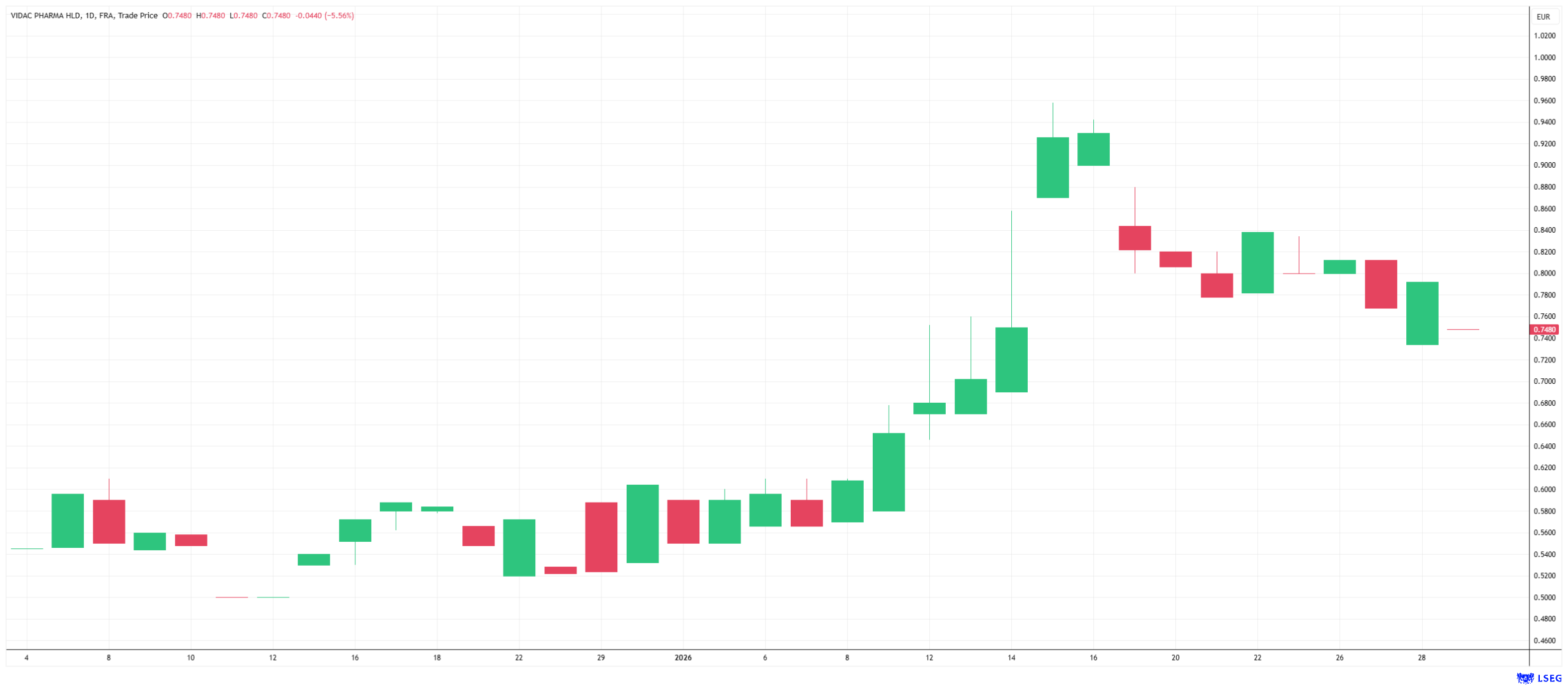
For investors, the situation at Vidac Pharma is extremely exciting: its market capitalization is extremely low compared to the billion-dollar valuations of potential partners such as BioNTech or Eli Lilly. The market currently appears to be primarily pricing in the dermatological projects, but largely ignoring the blockbuster potential of systemic cancer drugs.
Of course, as a company in clinical development, Vidac Pharma is not for conservative investors, as the risk of setbacks in studies is always present in the biotech sector. However, for speculative investors, the stock offers a rare opportunity: entry into a validated technology platform shortly before the major Phase 2 efficacy data is available. If this data is positive, Vidac is likely to quickly become the focus of large corporations looking for precisely such innovative puzzle pieces for their pipelines. With its well-founded technology that is compatible with other approaches, Vidac is predestined to become the next junior partner of the pharmaceutical giants, generating headlines and share price gains.
Watch YouTube videoConflict of interest
Pursuant to §85 of the German Securities Trading Act (WpHG), we point out that Apaton Finance GmbH as well as partners, authors or employees of Apaton Finance GmbH (hereinafter referred to as "Relevant Persons") may hold shares or other financial instruments of the aforementioned companies in the future or may bet on rising or falling prices and thus a conflict of interest may arise in the future. The Relevant Persons reserve the right to buy or sell shares or other financial instruments of the Company at any time (hereinafter each a "Transaction"). Transactions may, under certain circumstances, influence the respective price of the shares or other financial instruments of the Company.
In addition, Apaton Finance GmbH is active in the context of the preparation and publication of the reporting in paid contractual relationships.
For this reason, there is a concrete conflict of interest.
The above information on existing conflicts of interest applies to all types and forms of publication used by Apaton Finance GmbH for publications on companies.
Risk notice
Apaton Finance GmbH offers editors, agencies and companies the opportunity to publish commentaries, interviews, summaries, news and the like on news.financial. These contents are exclusively for the information of the readers and do not represent any call to action or recommendations, neither explicitly nor implicitly they are to be understood as an assurance of possible price developments. The contents do not replace individual expert investment advice and do not constitute an offer to sell the discussed share(s) or other financial instruments, nor an invitation to buy or sell such.
The content is expressly not a financial analysis, but a journalistic or advertising text. Readers or users who make investment decisions or carry out transactions on the basis of the information provided here do so entirely at their own risk. No contractual relationship is established between Apaton Finance GmbH and its readers or the users of its offers, as our information only refers to the company and not to the investment decision of the reader or user.
The acquisition of financial instruments involves high risks, which can lead to the total loss of the invested capital. The information published by Apaton Finance GmbH and its authors is based on careful research. Nevertheless, no liability is assumed for financial losses or a content-related guarantee for the topicality, correctness, appropriateness and completeness of the content provided here. Please also note our Terms of use.