March 6th, 2026 | 07:00 CET
The drone sky stormers from Canada: Volatus Aerospace conquers the skies – protection and defense against drone attacks!
Drones are already widely used today, but in the coming years, they are expected to become an integral part of modern infrastructure and industrial operations. For example, they can inspect kilometers of pipelines in the Arctic, secure the airspace above critical power plants, and support rescue workers in vital missions. Volatus Aerospace operates in this exciting environment between high-tech engineering and operational missions, but not only there. The Canadian company has quickly evolved from a hidden gem to a serious global player in the aerospace industry. With a clear vision and an impressive portfolio of projects, Volatus is demonstrating that the future of drone aviation has long since begun. We take a look behind the scenes at the company that is currently revolutionizing parts of the industry and also massively consolidating its own position through strategic acquisitions and technological innovations.
time to read: 6 minutes | Author: Mario Hose
ISIN: VOLATUS AEROSPACE INC | CA92865M1023 | TSXV: FLT , OTCQB: TAKOF
Table of contents:
Author

Mario Hose
Born and raised in Hannover, Lower Saxony follows social and economic developments around the globe. As a passionate entrepreneur and columnist he explains and compares the most diverse business models as well as markets for interested stock traders.
Tag cloud
Shares cloud
A drone pioneer with vision
When talking about Volatus Aerospace, it is important not to simply label the company as a drone manufacturer. Volatus is much more than that: it is a comprehensive provider of integrated aviation solutions that bridges the gap between manned and unmanned flight. Part of its success lies in its impressive network of around 1,200 certified contract pilots spanning North America. These professionals ensure that Volatus can offer coast-to-coast services that go far beyond the norm. From precision imaging and inspection for the energy sector to monitoring large infrastructure projects in construction, the team covers a spectrum that is rarely found in its entirety.
Particularly interesting is the company's approach of supplementing or even replacing conventional aircraft and helicopters where it makes ecological and economic sense. In areas such as forestry, environmental protection, or complex surveys of landfills and gravel pits, they rely on highly efficient drone systems. The subsidiary Volatus Aviation also ensures that classic aviation segments are served. This gives the group a special flexibility. It is a combination of the thirst for research within the company and operational experience on the ground that makes Volatus successful.
Below is the presentation from Volatus CEO Glen Lynch at the recent 18th IIF
Sensational news – Complete control over Synergy Aviation
A recent bombshell in the company's history was the announcement on March 4, 2026, that it would acquire the remaining shares in Synergy Aviation. Volatus already held a majority stake of 58.47%, but now management is aiming for 100%. This step is much more than a formality, as full integration will allow Volatus to consolidate its business aircraft operations under a single, strong brand. For investors, this means clarity and efficiency, as minority interests will be eliminated. This will streamline corporate governance and allow funds to be used in a much more targeted manner.
The acquisition is expected to be completed around March 15, 2026, and will be financed by the issuance of approximately 2.59 million common shares. CEO Glen Lynch rightly emphasized that this strategic move strengthens the company's ability to seamlessly integrate manned and unmanned capabilities.
It is precisely this consolidation that allows Volatus to focus on the really big projects. One example of this is the expansion of its operational base in Tulsa, Oklahoma. Volatus plans to start operations there this month, specifically to support the US oil and gas sector. The individual components are gradually meshing together, allowing the expansion to progress.
Technological pioneer
Now, to the current situation, which could become increasingly important due to the war in Iran. Iran recently announced that it would also carry out attacks on nuclear facilities in Israel. Those who want to survive in modern aviation must be at the forefront of technology. Volatus understands this and sent a clear signal with the launch of SKYDRA™ at the beginning of March this year. SKYDRA™ is the company's first Software-as-a-Service platform specifically designed for drone defense planning and simulation. In the current climate, where unmanned systems pose a threat and danger of being used to attack critical infrastructure, the need for solutions to protect against this will be enormous. Experts estimate that the market for drone defense will grow to over USD 20 billion in the next four years. With SKYDRA™, Volatus not only has a technological edge, but its business model also gives it the opportunity to generate recurring software revenue. This secures and helps to reestablish the group's financial stability.
However, these innovations also require new personnel. With the appointment of Krish Srinivasan as Chief Technology Officer last month, Volatus has brought on board an expert who has already managed multinational aviation programs worth many millions of euros. His task will be to further advance the autonomous capabilities of the systems and take production in Mirabel, Quebec, to the next level. Recent successes in the defense sector show that this confidence in the technology is also shared by official bodies.
Important: In December, Volatus secured a CAD 9 million contract from a NATO partner, followed by further training contracts for drone pilots in early February. These collaborations underscore that Volatus has become an indispensable partner for national and international security.
Stock market segment change, figures and chart analysis
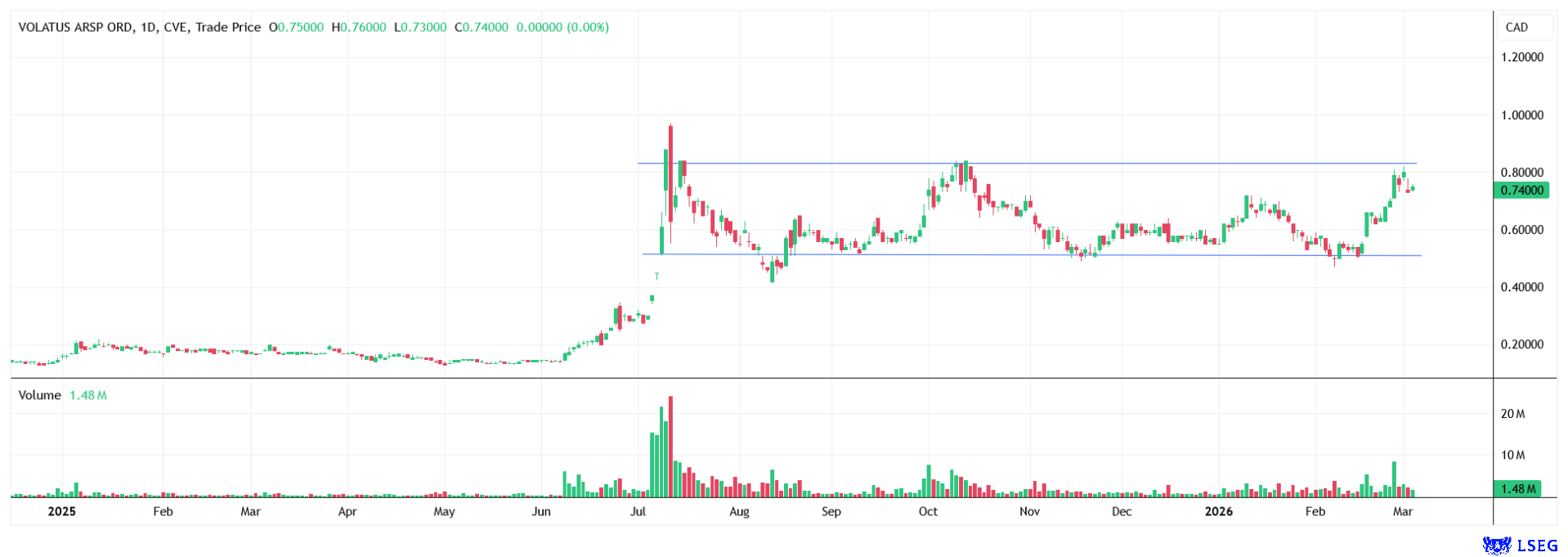
A look at the latest figures reveals a lot about Volatus' current momentum. In the third quarter of 2025, the drone specialist already managed to increase its revenue massively to CAD 10.61 million, compared to CAD 6.62 million in the same period last year. This jump in growth shows that the management's strategy appears to be paying off. At the same time, the company managed to limit its loss per share to CAD -0.01. Even though a loss of around CAD -0.033 is still expected for 2025 as a whole, the figures are increasingly pointing in the right direction. This potential is also clearly recognized on the stock market. The share price has recently risen to around CAD 0.740, with significant resistance in the CAD 0.82-0.83 range. If the share price manages to break above this level, it is likely to rise to around CAD 1.10. New order announcements or other good news from the company could lead to such a breakout.
However, the most significant vote of confidence from the financial world is the conditional approval for the switch to the Toronto Stock Exchange (TSX). The promotion from the venture segment to the main exchange is a huge accolade for any company. It increases visibility among institutional investors worldwide and facilitates access to fresh capital. CEO Glen Lynch rightly sees this as a milestone that reflects the maturity of the entire platform. In order to optimize the capital structure for this move, the company is also planning a reverse stock split, which will be decided at the next annual general meeting. Everything appears well thought out and geared toward long-term growth.
Conclusion: A strong overall concept for the future
Looking at the big picture, it is clear that Volatus Aerospace is in an excellent position. The company is likely to benefit greatly from Canada's new defense industry strategy, which aims to build sovereign domestic capabilities. With its planned investment in the Mirabel site, Volatus is creating the necessary infrastructure to meet the growing demand for autonomous technology "Made in Canada." The combination of experienced management, a very large network of pilots, and state-of-the-art software makes the group, and thus also Volatus shares, one of the most exciting names and stocks in the drone sector.
In summary, Volatus Aerospace is not only doing its homework, but also doing a lot more right. The complete takeover of Synergy Aviation provides stability, while innovations such as SKYDRA™ are likely to open up new markets. The upcoming move to the TSX marks the transition from an ambitious up-and-comer to an established industry player, which is then also likely to attract more attention from investors. Even if the break-even point has not yet been fully reached, the growth rates in sales and the strategic positioning are extremely positive. Geopolitical hotspots, but also the infrastructural requirements of future development, are likely to cause a boom in drones, drone software, and drone pilots. Those interested in the future of autonomous aviation will find it hard to ignore this dedicated team from Canada. Volatus Aerospace is a highly exciting stock and may be on the verge of reaching new heights.
Conflict of interest
Pursuant to §85 of the German Securities Trading Act (WpHG), we point out that Apaton Finance GmbH as well as partners, authors or employees of Apaton Finance GmbH (hereinafter referred to as "Relevant Persons") currently hold or hold shares or other financial instruments of the aforementioned companies and speculate on their price developments. In this respect, they intend to sell or acquire shares or other financial instruments of the companies (hereinafter each referred to as a "Transaction"). Transactions may thereby influence the respective price of the shares or other financial instruments of the Company.
In this respect, there is a concrete conflict of interest in the reporting on the companies.
In addition, Apaton Finance GmbH is active in the context of the preparation and publication of the reporting in paid contractual relationships.
For this reason, there is also a concrete conflict of interest.
The above information on existing conflicts of interest applies to all types and forms of publication used by Apaton Finance GmbH for publications on companies.
Risk notice
Apaton Finance GmbH offers editors, agencies and companies the opportunity to publish commentaries, interviews, summaries, news and the like on news.financial. These contents are exclusively for the information of the readers and do not represent any call to action or recommendations, neither explicitly nor implicitly they are to be understood as an assurance of possible price developments. The contents do not replace individual expert investment advice and do not constitute an offer to sell the discussed share(s) or other financial instruments, nor an invitation to buy or sell such.
The content is expressly not a financial analysis, but a journalistic or advertising text. Readers or users who make investment decisions or carry out transactions on the basis of the information provided here do so entirely at their own risk. No contractual relationship is established between Apaton Finance GmbH and its readers or the users of its offers, as our information only refers to the company and not to the investment decision of the reader or user.
The acquisition of financial instruments involves high risks, which can lead to the total loss of the invested capital. The information published by Apaton Finance GmbH and its authors is based on careful research. Nevertheless, no liability is assumed for financial losses or a content-related guarantee for the topicality, correctness, appropriateness and completeness of the content provided here. Please also note our Terms of use.