April 16th, 2026 | 07:10 CEST
The Crisis as a Wake-up Call: dynaCERT, Hapag-Lloyd, and Brookfield at the Forefront of Decarbonization
The state of the global economy, caught between wars and an energy price shock, is forcing industry and the logistics sector to take immediate action. As energy prices rise, stricter climate protection regulations are also demanding a shift away from fossil fuels. In this market environment, major shipping companies like Hapag-Lloyd are seeking solutions that take effect immediately to reduce their fleets' fuel consumption without lengthy retrofits. In the aviation sector, too, discussions are already underway about canceling flights or using only modern aircraft with lower fuel consumption. While the economy struggles with these conditions, well-capitalized financial market players like Brookfield Asset Management are investing heavily in the industry's transformation. As a developer of a bridging technology, dynaCERT offers an immediately available retrofit solution for diesel engines with its innovative HydraGEN approach, which directly reduces fuel consumption and improves the emissions balance. Since this business model is perfectly suited to the current times, it is worth taking a detailed look at the industry and the company.
time to read: 3 minutes | Author: Nico Popp
ISIN: DYNACERT INC | CA26780A1084 | TSX: DYA , OTCQB: DYFSF , HAPAG-LLOYD AG NA O.N. | DE000HLAG475 , BROOKFIELD ASSET MAN.A LV | CA1125851040
Table of contents:
Author

Nico Popp
At home in Southern Germany, the passionate stock exchange expert has been accompanying the capital markets for about twenty years. With a soft spot for smaller companies, he is constantly on the lookout for exciting investment stories.
Tag cloud
Shares cloud
Hapag-Lloyd: High Costs Force Swift Action
As one of the largest shipping companies, Hapag-Lloyd is under enormous pressure to adapt its fleet of around 300 container ships to the requirements of the EU Emissions Trading System. The group closed the 2025 fiscal year with an EBITDA of USD 3.6 billion, representing a decline of over 28% compared to the previous year. According to CEO Rolf Habben Jansen, this development is due, among other things, to weekly additional costs of USD 40 to USD 50 million resulting from rerouting ships around the Cape of Good Hope. To reduce emissions, the shipping company is investing in new ship propellers and hull coatings and has already managed to reduce fuel consumption by 5% during partial-load operation through engine tuning on ships such as the Basle Express. Given expected prices for EU emission allowances averaging EUR 104 per ton in 2026, every additional ton of fuel saved becomes a significant competitive advantage. Until new ships with alternative propulsion systems arrive in 2028 and 2029, bridge technologies for existing engines are becoming increasingly relevant for the Group. dynaCERT's technology also works on ships.
Brookfield Asset Management: Capital for the Transition
As a financial architect of the energy transition, Brookfield Asset Management manages assets of over USD 1.1 trillion and has a strong focus on decarbonization. The group makes targeted investments in carbon-intensive sectors to transform them. Capital flows into sustainable infrastructure projects through the Global Transition Fund II, which was closed in 2025 with USD 20 billion. According to its investment criteria, Brookfield seeks initiatives that deliver immediately measurable and verifiable emissions reductions. By creating certified CO2 savings, new technologies such as those from dynaCERT could play a key role within Brookfield's infrastructure portfolio and thus attract much-needed institutional capital.
dynaCERT Bridges the Gap to Clean Logistics
Here, dynaCERT positions itself as a solution provider. The company's proprietary HydraGEN technology uses distilled water to produce hydrogen and oxygen on demand and feeds them into the air intake system of diesel engines. Independent tests confirm that this system reduces fuel consumption by up to 19.2% and cuts nitrogen oxide emissions by up to 88%. Under the leadership of CEO Kevin Unrath, who recently took office, the company is now accelerating its commercial expansion. In the port sector, dynaCERT has already equipped cranes in Rochefort, France, and is currently expanding into Vietnam through service agreements. The energy price shock is particularly severe in Southeast Asia: in addition to working from home, driving bans are also being discussed there. The company is also achieving success in the mining sector in South America and in the Canadian province of Quebec, where, according to company statistics, a single large dump truck equipped with HydraGEN could save over 530,000 metric tonnes of CO2 equivalent annually. Using the integrated HydraLytica telematics system, dynaCERT tracks these savings in real time, enabling the generation of valuable Verra CO2 certificates, which secure an additional revenue stream for customers.
The Crisis as a Catalyst for dynaCERT Investors
For investors, dynaCERT offers an attractive opportunity in the current landscape. The company can leverage high energy prices and CO2 taxes as a perfect sales catalyst, as the HydraGEN systems now pay for themselves quickly in high-usage areas such as ports or mines. Analysts are correspondingly optimistic about the potential and have set an average consensus price target of CAD 0.75 for the dynaCERT share, paired with a strong "Buy" recommendation. Since corporations like Hapag-Lloyd rely on immediate savings and investors such as Brookfield are increasingly allocating capital to verifiable climate projects, dynaCERT is strategically positioned for success.
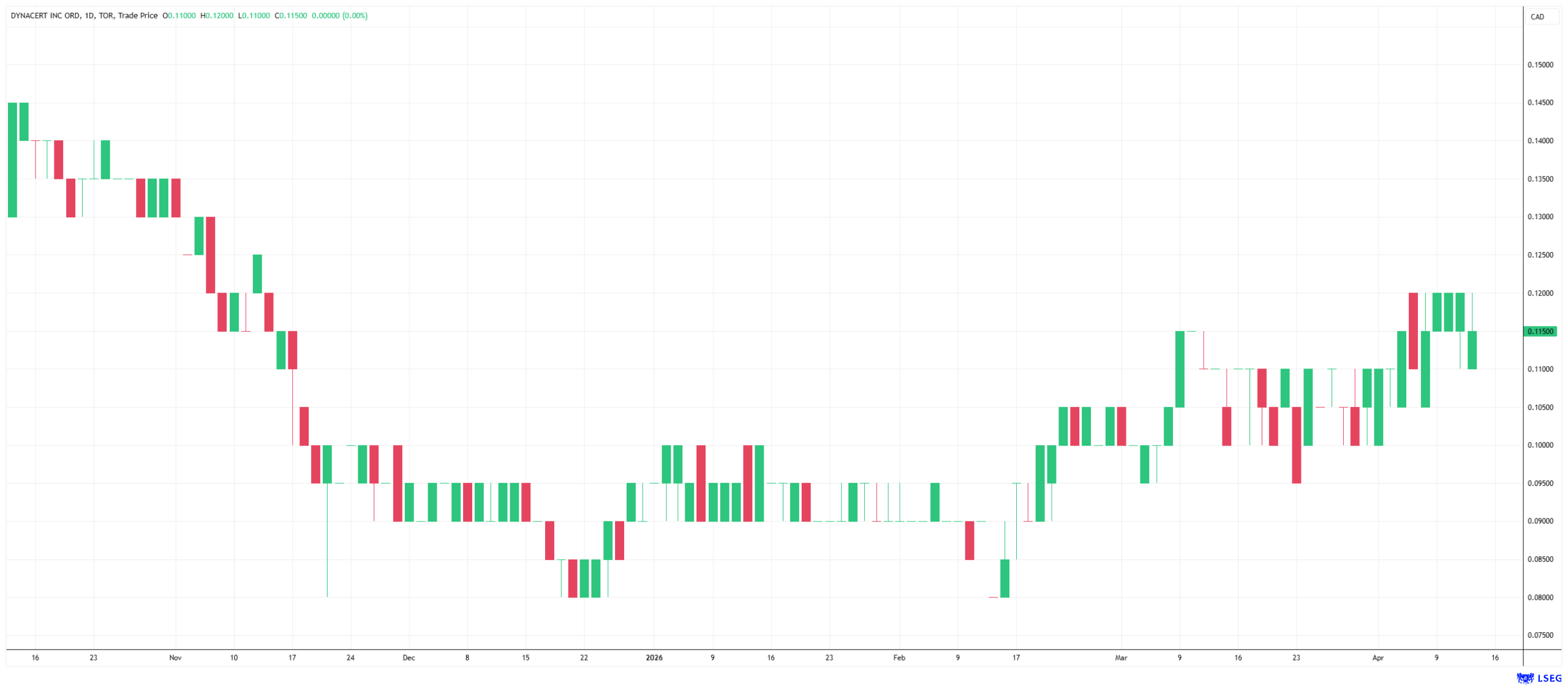
After the company has achieved a series of notable successes in recent quarters, the key now is to capitalize on the current energy crisis and generate significant new business. The starting point looks promising as the stock continues to trade near its lows. Speculative retail investors should keep a close eye on dynaCERT. If the company succeeds in securing significant orders, the stock is likely to regain momentum.
Watch YouTube videoConflict of interest
Pursuant to §85 of the German Securities Trading Act (WpHG), we point out that Apaton Finance GmbH as well as partners, authors or employees of Apaton Finance GmbH (hereinafter referred to as "Relevant Persons") may hold shares or other financial instruments of the aforementioned companies in the future or may bet on rising or falling prices and thus a conflict of interest may arise in the future. The Relevant Persons reserve the right to buy or sell shares or other financial instruments of the Company at any time (hereinafter each a "Transaction"). Transactions may, under certain circumstances, influence the respective price of the shares or other financial instruments of the Company.
In addition, Apaton Finance GmbH is active in the context of the preparation and publication of the reporting in paid contractual relationships.
For this reason, there is a concrete conflict of interest.
The above information on existing conflicts of interest applies to all types and forms of publication used by Apaton Finance GmbH for publications on companies.
Risk notice
Apaton Finance GmbH offers editors, agencies and companies the opportunity to publish commentaries, interviews, summaries, news and the like on news.financial. These contents are exclusively for the information of the readers and do not represent any call to action or recommendations, neither explicitly nor implicitly they are to be understood as an assurance of possible price developments. The contents do not replace individual expert investment advice and do not constitute an offer to sell the discussed share(s) or other financial instruments, nor an invitation to buy or sell such.
The content is expressly not a financial analysis, but a journalistic or advertising text. Readers or users who make investment decisions or carry out transactions on the basis of the information provided here do so entirely at their own risk. No contractual relationship is established between Apaton Finance GmbH and its readers or the users of its offers, as our information only refers to the company and not to the investment decision of the reader or user.
The acquisition of financial instruments involves high risks, which can lead to the total loss of the invested capital. The information published by Apaton Finance GmbH and its authors is based on careful research. Nevertheless, no liability is assumed for financial losses or a content-related guarantee for the topicality, correctness, appropriateness and completeness of the content provided here. Please also note our Terms of use.