May 7th, 2026 | 08:10 CEST
The AI Revolution Is Unstoppable: How First Hydrogen, Tesla, and NVIDIA Are Ushering in the Robot Era
The global economy is facing many major shifts. One of these disruptions is largely driven by advances in AI and robotics. What were considered isolated trends in software intelligence, clean energy, and mechanical automation just a few years ago are now merging into visions capable of transforming entire industries and our daily lives. Visionary investments in autonomous systems are the new battleground for the global tech elite, while in more conservative economic regions like Germany, the combination of humanoid robots and autonomous mobility is often still dismissed as a futuristic pipe dream. Yet leading technology companies are inexorably laying the groundwork for this new era, in which multifunctional, AI-equipped robots are pushing the boundaries of what is currently imaginable. We highlight two of these visionaries, Tesla and NVIDIA, and explain why First Hydrogen has discovered an exciting niche in the shadow of these giants.
time to read: 3 minutes | Author: Nico Popp
ISIN: First Hydrogen Corp. | CA32057N1042 | TSXV: FHYD , TESLA INC. DL -_001 | US88160R1014 , NVIDIA CORP. DL-_001 | US67066G1040
Table of contents:
Author

Nico Popp
At home in Southern Germany, the passionate stock exchange expert has been accompanying the capital markets for about twenty years. With a soft spot for smaller companies, he is constantly on the lookout for exciting investment stories.
Tag cloud
Shares cloud
Tesla and the Metamorphosis into an Autonomous Robotics Platform
For Tesla investors, this year's developments provide the clearest evidence yet that the company is finally transforming from a pure automaker into a platform for artificial intelligence (AI) and robotics. Tech visionary Elon Musk increasingly emphasizes that the company's true value lies not in the number of vehicles delivered, but in the autonomous potential of its proprietary network and computing power. The company is currently preparing for mass production of the Optimus Generation 3 humanoid robot, scheduled to begin at the Fremont plant in the summer of 2026.
Technically speaking, Optimus is a breakthrough in applied robotics. It uses the highly advanced Autopilot software stack to perceive its environment, has 22 degrees of freedom in its hands, and features state-of-the-art tactile sensors. Tesla plans to roll out these humanoid robots on a large scale, with the initial focus on having them perform simple, repetitive tasks in its own car factories. To finance this ambitious transformation, Tesla has tripled its annual capital expenditures to over USD 25 billion, underscoring its absolute focus on building AI training centers and ramping up Optimus production. One thing seems clear: Elon Musk is once again going all in on robots.
NVIDIA provides the nervous system
No robotics revolution is conceivable without the corresponding computing power in the background. This is precisely where NVIDIA holds absolute dominance. The company no longer just supplies high-performance chips but a fully integrated ecosystem of hardware, software, and pre-trained AI models. At the heart of this strategy is Project GR00T, a universal base model for humanoid robots that enables machines to learn human movements through pure observation and perform complex tasks in unstructured environments.
In addition, with Isaac Lab 3.0, NVIDIA provides a simulation environment where robot agents can be trained using digital twins before they are physically deployed in a real factory. NVIDIA reported a 69% increase in revenue to USD 44.06 billion in the first quarter of fiscal year 2026, with the Data Center segment remaining the undisputed growth driver. Leading robotics and industrial companies worldwide are already integrating NVIDIA's libraries as standard, underscoring the company's outstanding market position.
First Hydrogen: Specialized Ground Robotics for Extreme Conditions
While US tech giants are primarily targeting humanoid systems for the mass market, First Hydrogen, an innovative company previously known mainly for hydrogen commercial vehicles, is strategically seizing opportunities in a high-return niche. Through an exclusive global licensing agreement for a patented mobile robot platform, the company is entering the unmanned ground vehicle (UGV) market. The planned robotic system features a highly efficient hybrid propulsion system combining hydrogen fuel cells, batteries, and solar energy.
Compared to purely battery-electric systems, this approach is expected to offer significantly longer operational times and a minimal thermal signature, thereby minimizing detectability in the infrared spectrum. With its innovative hybrid leg-wheel architecture, which utilizes eight articulated legs with integrated wheels, the robot is designed to roll on roads while simultaneously climbing stably over rough terrain. With its new system, First Hydrogen is targeting demanding markets ranging from last-mile logistics and the inspection of remote solar parks to operations in hazardous regions.
First Hydrogen Stock: Geopolitical Catalysts Ahead
The outlook for First Hydrogen's new business segment is promising, as unmanned ground systems are experiencing high demand amid the defence boom. The war in Ukraine has long since evolved into a kind of "open-air laboratory" for modern warfare, in which robots play a key role. The Ukrainian armed forces' remarkable successes with ground robots, which have already forced enemy positions to surrender without human intervention, are also fueling excitement in the capital markets. The Ukrainian government plans to contract for around 25,000 ground robot systems in the first half of 2026 alone—this is a major pull effect from which highly developed, long-endurance systems are likely to benefit directly.
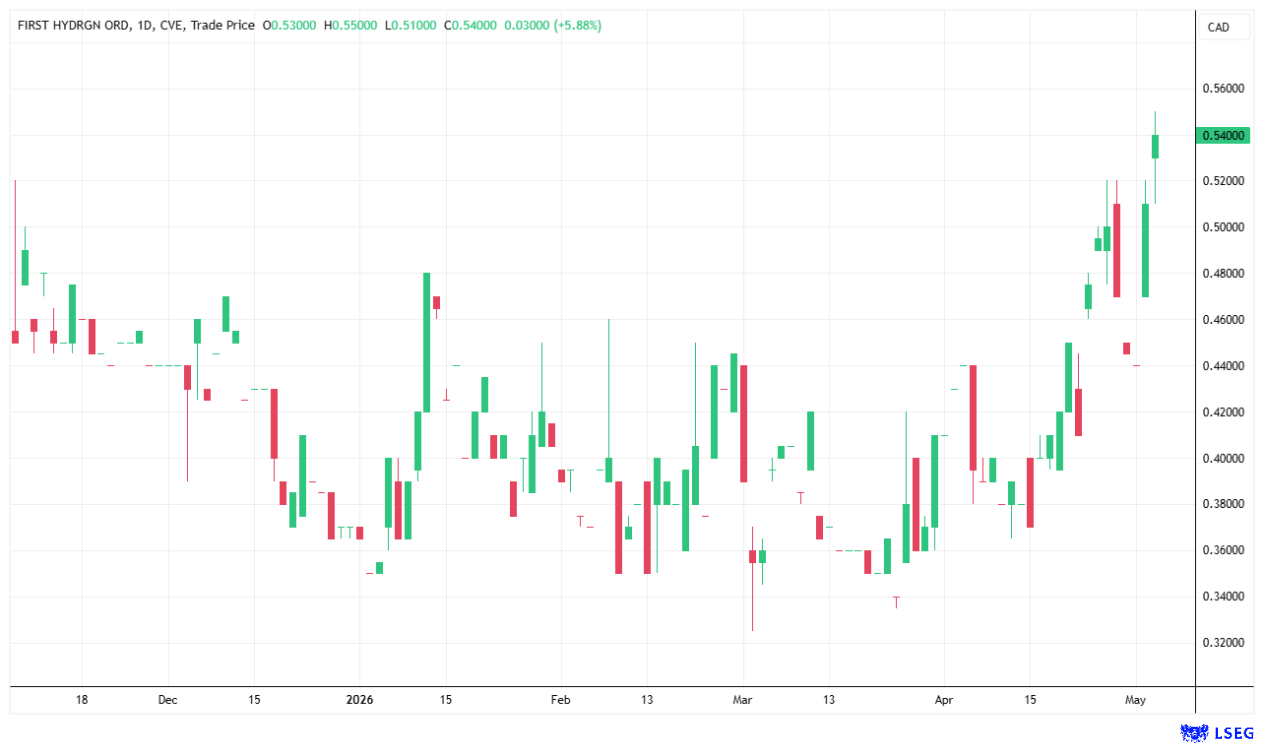
For investors, First Hydrogen stock offers an interesting starting point after a long consolidation phase. Technical analysis currently indicates that the share is bottoming out. Since the innovative robotics and UGV segment is barely priced into the current stock price and the company is still primarily perceived as a traditional hydrogen stock, speculative investors may see opportunities in the stock. If First Hydrogen's new robotics division gains operational momentum, the stock could have upside.
Conflict of interest
Pursuant to §85 of the German Securities Trading Act (WpHG), we point out that Apaton Finance GmbH as well as partners, authors or employees of Apaton Finance GmbH (hereinafter referred to as "Relevant Persons") may hold shares or other financial instruments of the aforementioned companies in the future or may bet on rising or falling prices and thus a conflict of interest may arise in the future. The Relevant Persons reserve the right to buy or sell shares or other financial instruments of the Company at any time (hereinafter each a "Transaction"). Transactions may, under certain circumstances, influence the respective price of the shares or other financial instruments of the Company.
In addition, Apaton Finance GmbH is active in the context of the preparation and publication of the reporting in paid contractual relationships.
For this reason, there is a concrete conflict of interest.
The above information on existing conflicts of interest applies to all types and forms of publication used by Apaton Finance GmbH for publications on companies.
Risk notice
Apaton Finance GmbH offers editors, agencies and companies the opportunity to publish commentaries, interviews, summaries, news and the like on news.financial. These contents are exclusively for the information of the readers and do not represent any call to action or recommendations, neither explicitly nor implicitly they are to be understood as an assurance of possible price developments. The contents do not replace individual expert investment advice and do not constitute an offer to sell the discussed share(s) or other financial instruments, nor an invitation to buy or sell such.
The content is expressly not a financial analysis, but a journalistic or advertising text. Readers or users who make investment decisions or carry out transactions on the basis of the information provided here do so entirely at their own risk. No contractual relationship is established between Apaton Finance GmbH and its readers or the users of its offers, as our information only refers to the company and not to the investment decision of the reader or user.
The acquisition of financial instruments involves high risks, which can lead to the total loss of the invested capital. The information published by Apaton Finance GmbH and its authors is based on careful research. Nevertheless, no liability is assumed for financial losses or a content-related guarantee for the topicality, correctness, appropriateness and completeness of the content provided here. Please also note our Terms of use.