August 12th, 2026 | 07:00 CEST
Stocks for Life? How Netflix, BMW and Aspermont Build Customer Loyalty and Recurring Revenue
Recurring revenue is the ultimate goal. In practice, this is often achieved with basic consumer goods like toothpaste or with strong brands. People who have been buying Nike running shoes for years are more likely to remain loyal to the brand. Providers like Netflix take the concept of recurring revenue to the extreme—here, the subscription automatically renews for another month. If you do not cancel, you keep paying. BMW would also love to have such loyal customers. But the competition never sleeps. We take a closer look at three companies that would love to keep their customers for life.
time to read: 3 minutes | Author: Nico Popp
ISIN: ASPERMONT LTD. | AU000000ASP3 | ASX: ASP , NETFLIX INC. DL-_001 | US64110L1061 , BAY.MOTOREN WERKE AG ST | DE0005190003
Table of contents:
Author

Nico Popp
At home in Southern Germany, the passionate stock exchange expert has been accompanying the capital markets for about twenty years. With a soft spot for smaller companies, he is constantly on the lookout for exciting investment stories.
Tag cloud
Shares cloud
Netflix: Advertising and Iron Discipline
The US streaming provider Netflix sees money coming in every month—a constant stream of new series and movies makes Netflix attractive to many people. In fiscal year 2025, total revenue climbed 16.0% to USD 45.2 billion, while net income rose by a good quarter to USD 11.0 billion. The company increased its operating margin from 26.7% in 2024 to 29.5% in 2025 and even expanded it to a whopping 32.3% in the first quarter of 2026. The driver behind this development is Netflix's advertising division, whose revenue more than doubled to over USD 1.5 billion in 2025 and is expected to reach the USD 3.0 billion mark this year. At the same time, management is demonstrating skill in negotiations amid the whirlwind of takeovers. After breaking off negotiations to acquire Warner Bros. in February 2026, Netflix pocketed a pre-tax premium of USD 2.8 billion. This significantly boosted free cash flow once again and has provided even more leeway for further M&A activities.
BMW: Setbacks in the Chinese Market
A very different picture emerges for the Munich-based premium automaker BMW, which must navigate the balancing act between internal combustion engines and electric vehicles. Although deliveries rose slightly in 2025 to just over 2.46 million vehicles, consolidated revenue plummeted by 6.3% to EUR 133.45 billion. At the same time, the operating margin in the automotive segment shrank to 5.3% in fiscal year 2025 and plummeted to a meagre 2.3% in the second quarter of 2026. Above all, the dramatic decline in demand in China, where sales slumped by 12.5%, is taking a heavy toll on the Bavarian automaker. Support for the Chinese dealer network, along with increased import tariffs, reduced operating profit per vehicle sold by approximately EUR 700. To stem the decline in margins, the Board of Management implemented a cost-cutting program that had already reduced fixed costs by EUR 2.5 billion in 2025. Hopes now rest entirely on the modular vehicle architecture of the so-called "New Class," which is expected to lower production costs in the coming years and get margins back on track. Still, BMW can only dream of customer loyalty on the level of Netflix.
Aspermont: Systematically Transforming Its Digital Media Business in the Commodities Sector
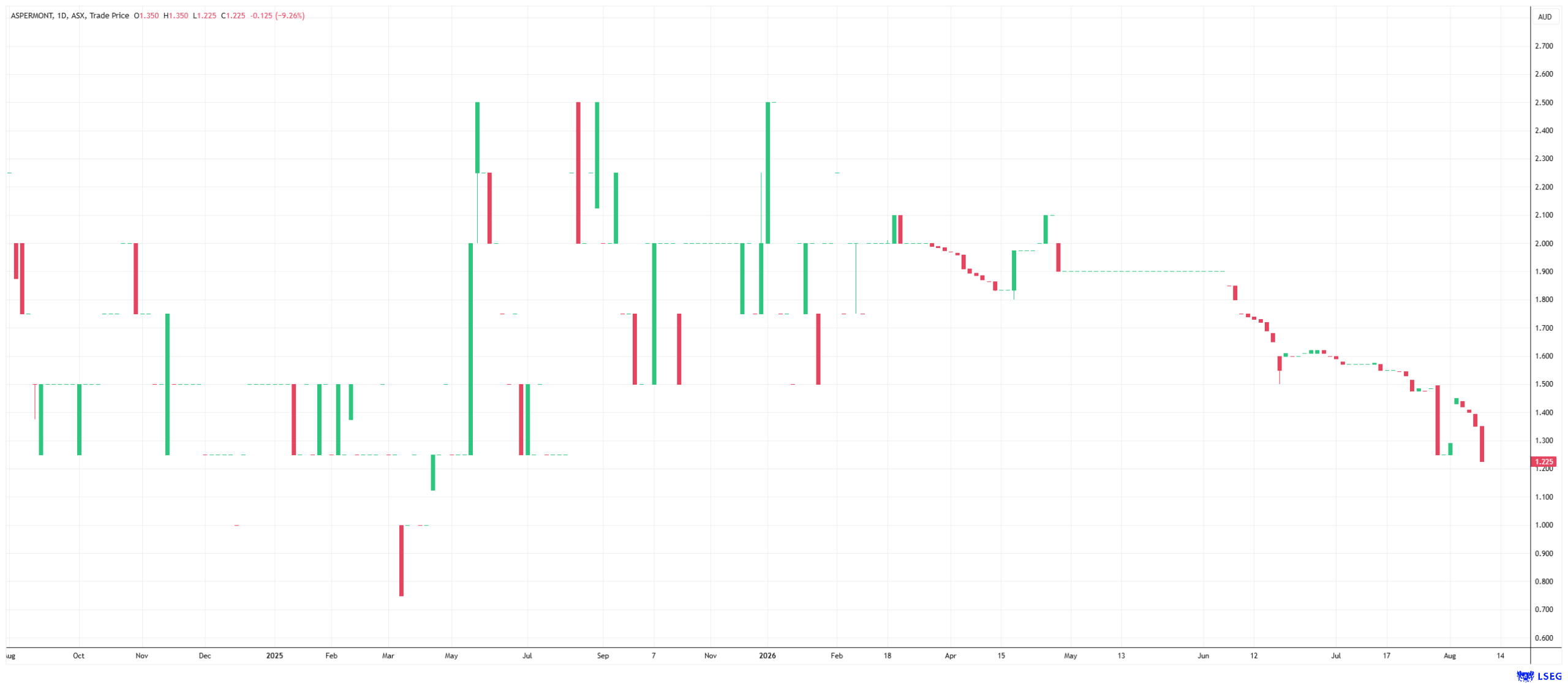
Beyond car enthusiasts and streaming junkies, the Australian media company Aspermont provides businesses with valuable information. The long-established media company is transforming its information services for the commodities, energy, and agriculture sectors from traditional print products to a purely digital subscription system. This deliberate move away from old revenue streams is clearly reflected in total revenue, which fell from AUD 19.25 million in 2023 to AUD 15.41 million most recently in fiscal year 2025. While this may not seem particularly positive at first glance, it makes sense. Pure subscription revenue climbed to AUD 10.16 million for the full year 2025 and now accounts for 66% of total consolidated revenue. With well-known trade publications such as the Mining Journal and the Energy News Bulletin, the company reaches a global readership of more than 3.8 million registered users. Despite a reported net loss of AUD 2.20 million for the year, the company recently achieved an operational turnaround in cash flow, which returned to positive territory at AUD 0.20 million.
Aspermont: A Streamlined Balance Sheet and Insider Purchases Build Confidence
The Australian company's balance sheet remains surprisingly robust despite its digital transformation: long-term liabilities of just AUD 0.07 million are offset by cash and cash equivalents of AUD 2.95 million. Both CEO Alex Kent and COO Ajit Patel have reaffirmed their confidence in the company's strategy and increased their holdings of company shares in recent quarters. To further drive the international growth of the digital platforms, Michael Brown assumed the chairmanship of the board of directors in early 2026. Operationally, management has set a goal of generating consistently positive operating cash flows in the second half of fiscal year 2027. In this way, the niche provider is gradually building a high-margin platform model that is increasingly decoupled from the cyclical fluctuations of traditional advertising markets. If this "Netflix effect" takes full hold, the stock could once again become an attractive investment.
For years, Aspermont was considered an undervalued penny stock traded primarily in Germany by only the most hardened investors—the share price's many decimal places deterred investors. As of this year, Aspermont is no longer a penny stock thanks to a reverse stock split. This gives the market more opportunities to reflect Aspermont's gradual progress. As increasingly more industrial companies, as well as family offices and other firms, are increasingly reliant on expert information about commodities, Aspermont's transformation could prove to be perfectly timed. The stock is a candidate for the watchlist and has long since become more than just a speculative play.
Watch YouTube videoConflict of interest
Pursuant to §85 of the German Securities Trading Act (WpHG), we point out that Apaton Finance GmbH as well as partners, authors or employees of Apaton Finance GmbH (hereinafter referred to as "Relevant Persons") currently hold or hold shares or other financial instruments of the aforementioned companies and speculate on their price developments. In this respect, they intend to sell or acquire shares or other financial instruments of the companies (hereinafter each referred to as a "Transaction"). Transactions may thereby influence the respective price of the shares or other financial instruments of the Company.
In this respect, there is a concrete conflict of interest in the reporting on the companies.
In addition, Apaton Finance GmbH is active in the context of the preparation and publication of the reporting in paid contractual relationships.
For this reason, there is also a concrete conflict of interest.
The above information on existing conflicts of interest applies to all types and forms of publication used by Apaton Finance GmbH for publications on companies.
Risk notice
Apaton Finance GmbH offers editors, agencies and companies the opportunity to publish commentaries, interviews, summaries, news and the like on news.financial. These contents are exclusively for the information of the readers and do not represent any call to action or recommendations, neither explicitly nor implicitly they are to be understood as an assurance of possible price developments. The contents do not replace individual expert investment advice and do not constitute an offer to sell the discussed share(s) or other financial instruments, nor an invitation to buy or sell such.
The content is expressly not a financial analysis, but a journalistic or advertising text. Readers or users who make investment decisions or carry out transactions on the basis of the information provided here do so entirely at their own risk. No contractual relationship is established between Apaton Finance GmbH and its readers or the users of its offers, as our information only refers to the company and not to the investment decision of the reader or user.
The acquisition of financial instruments involves high risks, which can lead to the total loss of the invested capital. The information published by Apaton Finance GmbH and its authors is based on careful research. Nevertheless, no liability is assumed for financial losses or a content-related guarantee for the topicality, correctness, appropriateness and completeness of the content provided here. Please also note our Terms of use.