August 15th, 2024 | 07:45 CEST
Starbucks, First Hydrogen, Amazon - Which industry has the greatest growth potential?
The markets are on the move. Large companies such as Starbucks are facing new challenges as the system catering business stagnates. A rigorous CEO replacement is now intended to bring both the team and shareholders back to the core of the coffee roasting company: Entrepreneurial spirit, customer friendliness, and innovation. Brian Niccol, who has already set other system catering businesses on the road to success, has been appointed to the helm with these key words. All hopes are now pinned on him. In the booming hydrogen market, the Canadian company First Hydrogen has an entirely different set of challenges. With a focus on the logistics sector, the team is concentrating on developing a delivery van that companies like Amazon & Co can use. Initial tests under real-life conditions bode well: the First Hydrogen vehicle can cover a whopping 630 km on a single tank of hydrogen. Like Starbucks, Amazon is experiencing a slowdown in growth. New competitors, particularly from China, are appearing on the e-commerce scene. However, the Seattle-based company has a growth strategy that uses AI. Where is the greatest growth potential for investors?
time to read: 6 minutes
|
Author:
Juliane Zielonka
ISIN:
First Hydrogen Corp. | CA32057N1042 , STARBUCKS CORP. | US8552441094 , AMAZON.COM INC. DL-_01 | US0231351067
Table of contents:
Author

Juliane Zielonka
Born in Bielefeld, she studied German, English and psychology. The emergence of the Internet in the early '90s led her from university to training in graphic design and marketing communications. After years of agency work in corporate branding, she switched to publishing and learned her editorial craft at Hubert Burda Media.
Tag cloud
Shares cloud
Abrupt change of leadership at Starbucks: Brian Niccol takes the helm
The US coffee chain Starbucks is undergoing a rigorous change in its leadership. Laxman Narasimhan, who was appointed CEO just over a year ago, is stepping down from his post with immediate effect. His successor will be Brian Niccol, the former head of the fast-food chain Chipotle Mexican Grill. The coffee company reported declining sales in the last two financial quarters, both in the critical US home market and the global competition.
The questionable performance caught the attention of activist investors like Elliott Investment Management and Starboard Value, who, according to reports from Wall Street Journal have reportedly acquired stakes in the Company and are pushing for the CEO's removal.
Long-time former CEO Howard Schultz also got involved in the discussion. In a LinkedIn post from May, he criticized that the Company had "fallen out of favour" and called for a stronger focus on the customer experience in US stores. "There are no quick fixes. But the way forward should be what has led the Company to financial success over decades: Inspire your employees, exceed customer expectations, and let culture and servant leadership guide you," he writes in the professional network. Schultz, with over 37 years of experience at Starbucks and a founding member, gives his full backing to new CEO Brian Niccol.
The Starbucks Board of Directors believes Niccol is the right person to navigate the Company through this challenging time, based on his successful leadership experience at Chipotle, Pizza Hut, and Taco Bell. Until Niccol officially takes office on September 9, Chief Financial Officer Rachel Ruggeri will serve as interim CEO.
The financial markets reacted very positively to the news this week. Starbucks' share price rose by 19% at times on Tuesday. In contrast, Chipotle's shares fell by more than 10%, illustrating how valuable the new Niccol appointment is for the coffee and cake retailer. The restaurant chain sector in the US was estimated to be worth around USD 228.4 billion in 2023 - an increase of 5.2% compared to the previous year's figure of USD 216.5 billion.
First Hydrogen's delivery vehicle impresses with strong performance in the booming hydrogen market
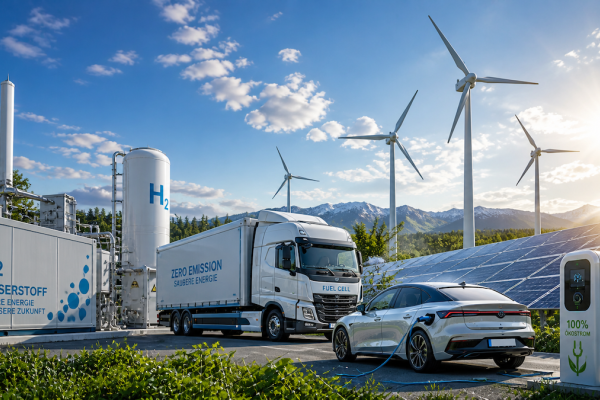
The hydrogen economy is seen as a key element in the energy transition and climate protection. Scientists and entrepreneurs see great potential in green hydrogen for various industrial applications. Cooperation between politics, industry, and research is needed to establish a sustainable hydrogen economy. This is precisely where the Company First Hydrogen, which specializes in zero-emission delivery vehicles and the production and distribution of green hydrogen, is positioned. The Company, based in Vancouver, Montreal, and London, has developed and built two hydrogen-powered light commercial vehicles (FCEVs) already approved for road use in the UK. In tests, their vehicles have achieved a range of over 630 km on a single tank of hydrogen. The tests took place under real-life conditions.
In addition, First Hydrogen is planning to build a 35 MW plant for the production of green hydrogen and a vehicle assembly plant in Shawinigan, Quebec. For investors, this means a company that produces its own energy and can also excel in logistics. Whether delivery services for supermarket orders or deliveries from Amazon, Hermes, DHL, etc., the efficient use of their technology knows few bounds. First Hydrogen is targeting the booming logistics market, which is facing the challenge of meeting emissions targets. The Company's strategy is based on the use of existing technologies and a proven chassis, resulting in cost savings and market advantages.
With its agile business model and independence from specific suppliers or technologies, First Hydrogen retains control over component selection. This allows the Company to respond flexibly to market changes and use the best available parts from preferred global suppliers.
The global market for green hydrogen will continue to grow according to Strategic Market Research. From USD 1.45 billion in 2021, it is expected to rise to USD 75.72 billion by 2030, corresponding to an annual growth rate of 55.1%. Europe currently dominates the market with a share of over 57% - just one more reason to take a closer look at First Hydrogen.
Amazon shares fall after disappointing forecast and rising AI spending
E-commerce giant Amazon is struggling to grow. On the one hand, it is disappointing analysts with a weaker-than-expected sales forecast for the current quarter, while on the other, it is set to invest more in artificial intelligence and cloud computing infrastructure.
E-commerce giant Amazon recorded a sales growth of 10% to USD 148 billion in the second quarter of 2024. Cloud service AWS once again proved to be a growth driver with a 19% increase in revenue to USD 26.3 billion. AWS' market share in the cloud segment rose to 32%, while competitor Microsoft fell slightly to 23%. Google Cloud was able to increase its share to 12%.
Despite the strong cloud business, which continues to account for the majority of revenue, there is a slowdown in the e-commerce segment. Growth in online retail amounted to just 8% year-on-year. Competition from China, such as Shein and Temu, is challenging the e-commerce giant. In response, Amazon is planning to open a discount store in China.
Amazon expects sales of between USD 154 and 158.5 billion for the third quarter. This Company forecast is below the expectations of Wall Street analysts. However, the planned investments in AI and cloud infrastructure should promote further growth in this segment. In terms of broad-based growth, the Seattle-based company is now increasingly trying its hand in the sports and entertainment sector with new streaming rights and in-house productions.
Starbucks is struggling with falling sales and shareholder pressure, which has led to an abrupt change in leadership, reinforced by activist investors. New CEO Niccol has deep experience in successfully transforming food service businesses. His focus on corporate culture, innovation, and digital technologies could be just what Starbucks needs to consolidate its position as a leading coffee chain and open up new growth opportunities. First Hydrogen combines the development of hydrogen-powered commercial vehicles with plans to produce green hydrogen, representing a holistic business approach. The successful testing of its vehicles and the planned investments in production facilities show the potential for significant growth. In a market forecast to grow by 55.1% annually until 2030, First Hydrogen could play a key role in transforming the transportation sector and the energy industry. The Company's focus on the logistics market and its flexible supplier strategy position it well for future opportunities in green technology. According to forecasts, the global e-commerce market is expected to reach a volume of USD 4.65 trillion by 2024. A compound annual growth rate (CAGR) of 8.5% is anticipated for the period from 2024 to 2028. Despite a slowdown in overall growth, Amazon remains innovative and is investing heavily in forward-looking areas such as AI and cloud infrastructure. In the face of increasing competition, particularly from China, the Company is expanding its profitable cloud business and AI. The hydrogen sector, in which First Hydrogen operates, appears to have the greatest growth potential of the three companies presented. In addition, hydrogen technology addresses critical future issues such as emissions reduction, further emphasizing its long-term growth potential.
Conflict of interest
Pursuant to §85 of the German Securities Trading Act (WpHG), we point out that Apaton Finance GmbH as well as partners, authors or employees of Apaton Finance GmbH (hereinafter referred to as "Relevant Persons") may hold shares or other financial instruments of the aforementioned companies in the future or may bet on rising or falling prices and thus a conflict of interest may arise in the future. The Relevant Persons reserve the right to buy or sell shares or other financial instruments of the Company at any time (hereinafter each a "Transaction"). Transactions may, under certain circumstances, influence the respective price of the shares or other financial instruments of the Company.
In addition, Apaton Finance GmbH is active in the context of the preparation and publication of the reporting in paid contractual relationships.
For this reason, there is a concrete conflict of interest.
The above information on existing conflicts of interest applies to all types and forms of publication used by Apaton Finance GmbH for publications on companies.
Risk notice
Apaton Finance GmbH offers editors, agencies and companies the opportunity to publish commentaries, interviews, summaries, news and the like on news.financial. These contents are exclusively for the information of the readers and do not represent any call to action or recommendations, neither explicitly nor implicitly they are to be understood as an assurance of possible price developments. The contents do not replace individual expert investment advice and do not constitute an offer to sell the discussed share(s) or other financial instruments, nor an invitation to buy or sell such.
The content is expressly not a financial analysis, but a journalistic or advertising text. Readers or users who make investment decisions or carry out transactions on the basis of the information provided here do so entirely at their own risk. No contractual relationship is established between Apaton Finance GmbH and its readers or the users of its offers, as our information only refers to the company and not to the investment decision of the reader or user.
The acquisition of financial instruments involves high risks, which can lead to the total loss of the invested capital. The information published by Apaton Finance GmbH and its authors is based on careful research. Nevertheless, no liability is assumed for financial losses or a content-related guarantee for the topicality, correctness, appropriateness and completeness of the content provided here. Please also note our Terms of use.