November 5th, 2026 | 05:29 CET
Standard Uranium, Uranium Energy and Cameco: Uranium price breaks records, but producers' shares fall
The global market for nuclear fuels is currently looking extremely robust. According to business magazine Forbes, the price for long-term supply contracts reached a record USD 96 per pound at the end of October, while the spot price stood at USD 89.95. According to industry analysts, this prolonged cycle is being fuelled by a chronic supply deficit of around 10,000 tonnes per year and sharply rising electricity demand driven by the expansion of data centres for artificial intelligence. In addition, primary supply is tightening because Kazatomprom, Kazakhstan's state-owned producer, is deliberately curtailing its production in 2026 by around 10% compared with approved volumes – according to the company, market conditions do not warrant operating at full capacity. Despite the positive backdrop for the uranium price, mining operators' shares are currently undergoing a deep correction.
time to read: 4 minutes | Author: Nico Popp
ISIN: Standard Uranium Ltd | CA85422Q8487 , Uranium Energy Corp | US9168961038 , CAMECO CORP. | CA13321L1085
Table of contents:
Author

Nico Popp
At home in Southern Germany, the passionate stock exchange expert has been accompanying the capital markets for about twenty years. With a soft spot for smaller companies, he is constantly on the lookout for exciting investment stories.
Tag cloud
Shares cloud
Cameco struggles with operational issues and legacy supply contracts
Industry leader Cameco has lost around 25% of its share price since the start of the year and fell to a 52-week low in late October after announcing disappointing quarterly results. According to Cameco, the Canadian group achieved a realised selling price of just USD 65.78 per pound in the third quarter, highlighting the discrepancy between the physical commodity market and corporate profits. The main reason for this weak performance was a scheduled extended maintenance shutdown at the Key Lake processing plant in northern Saskatchewan, which reduced third-quarter production by 20% to 3.5 million pounds. To fulfil its supply contracts, Cameco also purchased 1.8 million pounds of uranium on the market in the third quarter. Operating cash flow fell by 98% to just CAD 3 million. Compounding matters, Cameco's historically evolved contract portfolio passes on rising market prices only with a delay and, in some cases, subject to caps. Analysts became more cautious: Truist cut its price target from USD 130 to USD 125 (Buy) as early as October 22, before the results, while Barclays cut its target from USD 95 to USD 89 (Equal Weight) on November 2.
Uranium Energy is betting entirely on the market price
US company Uranium Energy is taking a fundamentally different approach. By consistently avoiding contractual price caps, the group offers institutional investors direct leverage to the rising spot market. The company is pressing ahead with the expansion of its in-situ leaching facilities in North America, benefiting from the US government's strategic imperative to build a domestic supply chain following the ban on Russian uranium imports. In Wyoming and Texas, the company now has permitted production capacity of around 12 million pounds per year, with production at the Burke Hollow project in southern Texas set to begin in spring 2026, marking a major operational milestone. To secure its position as a diversified player, management is advancing its expansion into conventional hard-rock mining in Canada's Athabasca Basin through the Roughrider project, which has 27.8 million pounds of indicated resources. To finance these growth plans, the company relies on liquid assets of around USD 753 million (as at July 31, 2026), which also include physical uranium inventories revalued on the balance sheet.
Standard Uranium measures extreme radiation levels at Corvo
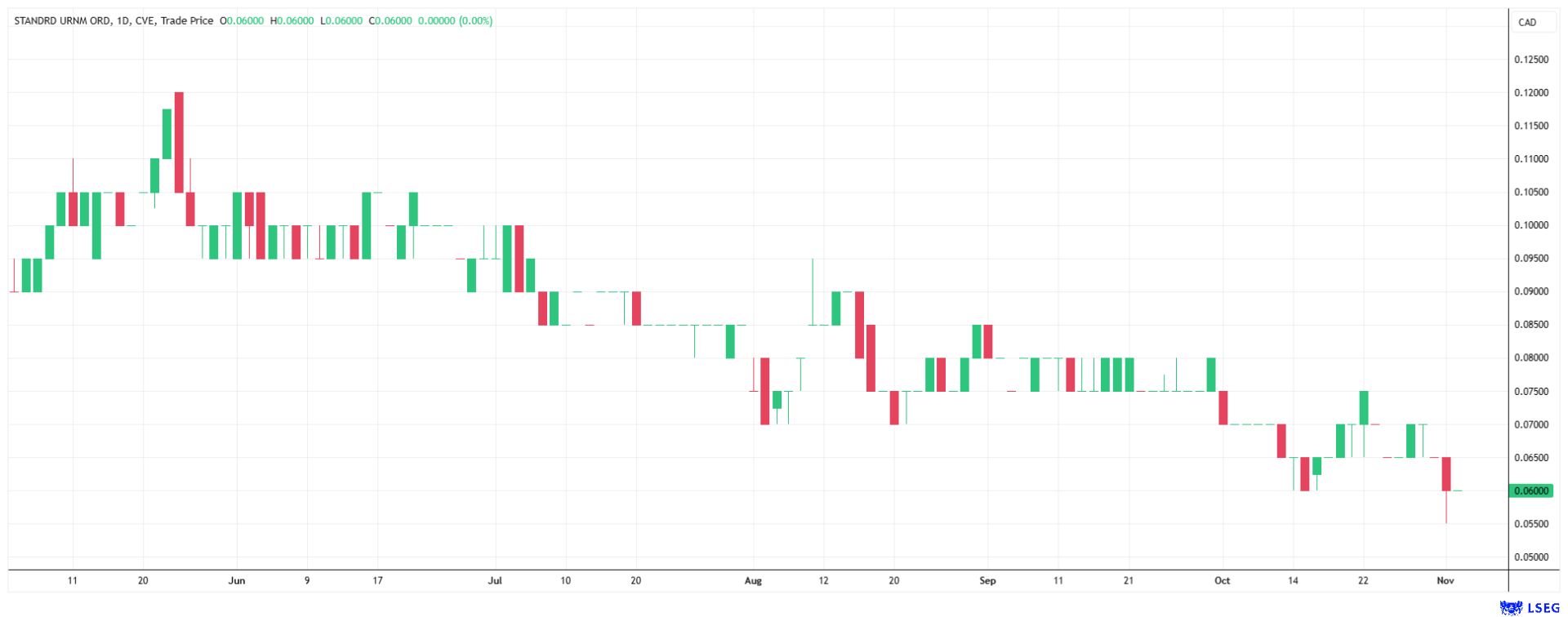
At the speculative end of the market, explorer Standard Uranium is attracting attention. As the company's geologists reported in late October, radiation levels of up to 48,000 counts per second (cps) were measured with a handheld scintillometer during surface work. The discoveries were made at the Corvo project, which occupies a highly favourable geological location only around 60 km east of Cameco's world-class McArthur River mine and holds promise for basement-hosted uranium deposits. Exploration is supported by joint venture partner Aventis Energy, which pays for the work and, in return, can acquire up to 75% of the project over a three-year period. The company itself emphasises that scintillometer readings are not directly related to uranium grades – nine rock samples are therefore with the Saskatchewan Research Council for chemical analysis.
Only the laboratory results can rule out the possibility that this is merely radioactive disequilibrium caused by decay products such as bismuth. If the laboratory data confirm high uranium grades, Corvo will become exciting: near-surface targets in the basement rock, within reach of the region's major mines, could then also attract the interest of larger producers. To explore its projects in Saskatchewan, Standard Uranium also announced financing of up to CAD 1 million in early November. It increased it to up to CAD 2 million just one day later, driven by strong demand. Up to 25 million so-called flow-through units will be issued at CAD 0.08 each, offering tax benefits to investors in Canada; closing remains subject to approval by the TSX Venture Exchange.
Conclusion and outlook
According to market observers, the gap between uranium's actual scarcity and the low valuations of established mine operators suggests a long-term paradigm shift. A notable indicator of financial investors' current reluctance is the Sprott Physical Uranium Trust, which traded significantly below its net asset value in late October. For the equity market to realign with the physical uranium market in future, major producers such as Cameco must deliver smoothly on the operational front from early 2027 onwards. While Uranium Energy benefits directly from every price increase through its unhedged strategy, the fundamental revaluation of explorers such as Standard Uranium depends entirely on reliable laboratory certificates. As long as actual chemical evidence of uranium at Corvo remains outstanding, Standard Uranium's shares remain a highly speculative investment for risk-tolerant investors despite the spectacular scintillometer readings.
Conflict of interest
Pursuant to §85 of the German Securities Trading Act (WpHG), we point out that Apaton Finance GmbH as well as partners, authors or employees of Apaton Finance GmbH (hereinafter referred to as "Relevant Persons") may hold shares or other financial instruments of the aforementioned companies in the future or may bet on rising or falling prices and thus a conflict of interest may arise in the future. The Relevant Persons reserve the right to buy or sell shares or other financial instruments of the Company at any time (hereinafter each a "Transaction"). Transactions may, under certain circumstances, influence the respective price of the shares or other financial instruments of the Company.
In addition, Apaton Finance GmbH is active in the context of the preparation and publication of the reporting in paid contractual relationships.
For this reason, there is a concrete conflict of interest.
The above information on existing conflicts of interest applies to all types and forms of publication used by Apaton Finance GmbH for publications on companies.
Risk notice
Apaton Finance GmbH offers editors, agencies and companies the opportunity to publish commentaries, interviews, summaries, news and the like on news.financial. These contents are exclusively for the information of the readers and do not represent any call to action or recommendations, neither explicitly nor implicitly they are to be understood as an assurance of possible price developments. The contents do not replace individual expert investment advice and do not constitute an offer to sell the discussed share(s) or other financial instruments, nor an invitation to buy or sell such.
The content is expressly not a financial analysis, but a journalistic or advertising text. Readers or users who make investment decisions or carry out transactions on the basis of the information provided here do so entirely at their own risk. No contractual relationship is established between Apaton Finance GmbH and its readers or the users of its offers, as our information only refers to the company and not to the investment decision of the reader or user.
The acquisition of financial instruments involves high risks, which can lead to the total loss of the invested capital. The information published by Apaton Finance GmbH and its authors is based on careful research. Nevertheless, no liability is assumed for financial losses or a content-related guarantee for the topicality, correctness, appropriateness and completeness of the content provided here. Please also note our Terms of use.