October 28th, 2026 | 05:45 CET
Split in the Tungsten Market: How Almonty, MP Materials and Rheinmetall Are Responding
The tungsten market is currently splitting into two distinct segments. While Chinese ammonium paratungstate (APT) prices are falling significantly, according to the Shanghai Metals Market, Western tungsten prices remain largely stable. Meanwhile, Washington's regulatory procurement requirements are forcing Western industrial companies to realign their supply chains. From 2027, new US legislation will prohibit the Department of Defense from using tungsten sourced from geopolitically sensitive countries such as China, Russia, Iran and North Korea. This legislation decouples Western prices from the Asian market and puts secure supply sources in sharper focus.
time to read: 3 minutes | Author: Nico Popp
ISIN: Almonty Industries Inc | CA0203987072 , MP MATERIALS CORP | US5533681012 , RHEINMETALL AG | DE0007030009
Table of contents:
Author

Nico Popp
At home in Southern Germany, the passionate stock exchange expert has been accompanying the capital markets for about twenty years. With a soft spot for smaller companies, he is constantly on the lookout for exciting investment stories.
Tag cloud
Shares cloud
MP Materials: Government guarantees for security of supply
The US Department of Defense is increasingly securing strategic raw materials through direct intervention in pricing. As the example of rare earth producer MP Materials shows, the government guarantees a minimum price of USD 110/kg for strategically important neodymium-praseodymium. If the market price falls below this level, Washington compensates for the difference. This price floor model could serve as a blueprint for other critical metals such as tungsten, where Western production costs exceed Chinese market prices. In September, the US Department of Defense also pledged USD 450 million to The Elmet Group to secure downstream tungsten processing. These direct market interventions show how governments intend to close the gap between Western cost structures and Asian supply. However, such interventions are fraught with pitfalls and can become a cost trap for governments.
Rheinmetall: The hunger for tungsten and rising costs
Europe's leading defence group Rheinmetall is critically dependent on tungsten heavy alloys for its armour-piercing ammunition. The group is currently increasing production and plans to manufacture around 1.5 million artillery shells annually by 2030. This capacity expansion coincides with a period of significantly higher ammunition prices. While a standardised 155-mm artillery shell cost around EUR 2,000 before 2022, NATO says European armies paid up to EUR 8,000 at peak times. Because few alternatives exist to kinetic-energy projectiles, depleted uranium is not an option in most NATO countries; defence suppliers are likely to pass on price premiums for conflict-free tungsten to public budgets.
Almonty Industries: Commercial start of the Sangdong mine
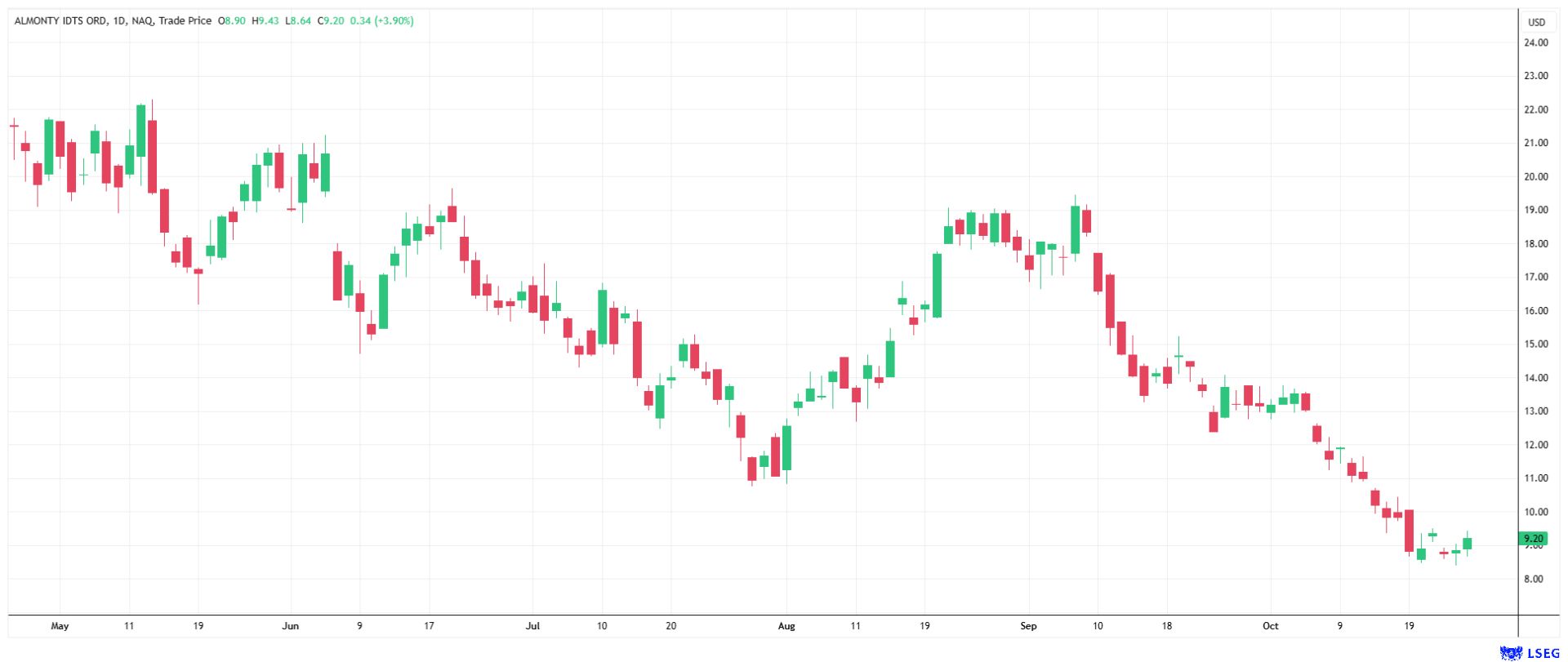
Against this regulatory backdrop, Almonty Industries, which relocated its corporate headquarters to Dillon, Montana several months ago, is positioning itself as a key player in securing Western tungsten supplies. The mining company reported in late September that its Sangdong mine in South Korea had transitioned to commercial operations, confirming this milestone in mid-October. After more than 30 years of inactivity, the mine began shipping tungsten concentrate for the first time, while Almonty continues advancing the second phase of expansion, targeted for completion by 2027. According to the company, the deposit contains 8.6 million tonnes of probable ore reserves grading 0.42% tungsten oxide. The material produced aligns with forthcoming US Department of Defense requirements restricting the use of tungsten mined or processed in countries such as China, Russia, Iran and North Korea. With the ramp-up of the first production phase, Almonty is supplying the very material whose origin US defence contractors will have to document comprehensively from 2027 onward. The company also benefits from end-to-end supply chain traceability, an advantage as customers must demonstrate the origin of their tungsten.
Almonty Industries: Long-term contracts and financial security
The strategic importance of South Korean production is reflected in extensive offtake agreements. In July, Almonty extended an existing contract with Global Tungsten & Powders, a subsidiary of Austria's Plansee Group, to a term of 21 years. This corresponds to a contracted annual revenue at July's APT pricing of approximately USD 490 million, with a minimum volume of 210,000 MTU annually, following the ramp-up. Offtaker GTP is based in the US state of Pennsylvania and processes tungsten concentrate into powder. This creates a supply chain outside the countries excluded by US origin rules. Construction was financed in part through a senior project loan of USD 75.1 million from Germany's KfW IPEX-Bank. A share buyback programme of up to USD 300 million launched in August signals management's confidence in future cash flow.
The new market reality: Strategic premium for conflict-free tungsten
The new US procurement rules are clearly splitting the global tungsten market into two spheres: while prices for Asian intermediate products are coming under pressure, a strategic premium is emerging for conflict-free material. With the start of operations in South Korea, Almonty Industries is supplying precisely the raw material that defence groups such as Rheinmetall urgently need. As the subsidies for MP Materials show, the US government is prepared to guarantee security of supply. Because commercial ramp-up of mining projects is always subject to geological and operational risks, and because upcoming expansion phases require substantial capital, Almonty shares remain an investment closely tied to successful scaling in South Korea. However, the prerequisites are far better at the company founded by tungsten expert Lewis Black than elsewhere: Almonty has operated tungsten mines successfully for years and has already brought Sangdong into production. Its competitors have yet to do the same.
Conflict of interest
Pursuant to §85 of the German Securities Trading Act (WpHG), we point out that Apaton Finance GmbH as well as partners, authors or employees of Apaton Finance GmbH (hereinafter referred to as "Relevant Persons") currently hold or hold shares or other financial instruments of the aforementioned companies and speculate on their price developments. In this respect, they intend to sell or acquire shares or other financial instruments of the companies (hereinafter each referred to as a "Transaction"). Transactions may thereby influence the respective price of the shares or other financial instruments of the Company.
In this respect, there is a concrete conflict of interest in the reporting on the companies.
In addition, Apaton Finance GmbH is active in the context of the preparation and publication of the reporting in paid contractual relationships.
For this reason, there is also a concrete conflict of interest.
The above information on existing conflicts of interest applies to all types and forms of publication used by Apaton Finance GmbH for publications on companies.
Risk notice
Apaton Finance GmbH offers editors, agencies and companies the opportunity to publish commentaries, interviews, summaries, news and the like on news.financial. These contents are exclusively for the information of the readers and do not represent any call to action or recommendations, neither explicitly nor implicitly they are to be understood as an assurance of possible price developments. The contents do not replace individual expert investment advice and do not constitute an offer to sell the discussed share(s) or other financial instruments, nor an invitation to buy or sell such.
The content is expressly not a financial analysis, but a journalistic or advertising text. Readers or users who make investment decisions or carry out transactions on the basis of the information provided here do so entirely at their own risk. No contractual relationship is established between Apaton Finance GmbH and its readers or the users of its offers, as our information only refers to the company and not to the investment decision of the reader or user.
The acquisition of financial instruments involves high risks, which can lead to the total loss of the invested capital. The information published by Apaton Finance GmbH and its authors is based on careful research. Nevertheless, no liability is assumed for financial losses or a content-related guarantee for the topicality, correctness, appropriateness and completeness of the content provided here. Please also note our Terms of use.