July 30th, 2026 | 09:30 CEST
SpaceX's Environmental Mess, Occidental Petroleum's Battle Against Windmills, and Zefiro Methane's Billion-Dollar Opportunity
When SpaceX's rockets soar toward orbit, the public gazes spellbound at the evening sky. The fact that rocket launches release enormous amounts of greenhouse gases is only noted critically in passing. Yet even SpaceX is doing everything it can to reduce its environmental footprint. There is still plenty of potential for savings right here on Earth. Plugging abandoned and orphaned wells from the oil and gas industry is one such opportunity. If these avoided emissions are systematically tracked and converted into carbon credits, this would build a bridge between the traditional oil and gas industry and the space sector. We shed light on this development and show where investors can look for opportunities.
time to read: 4 minutes | Author: Nico Popp
ISIN: ZEFIRO METHANE CORP | CA98926D1069 | NEO: ZEFI , OCCIDENTAL PET. DL-_20 | US6745991058 , SPACE EXPLORATION TECHNOLOGIES CORP | US84615Q1031 | NASDAQ: SPCX
Table of contents:
Author

Nico Popp
At home in Southern Germany, the passionate stock exchange expert has been accompanying the capital markets for about twenty years. With a soft spot for smaller companies, he is constantly on the lookout for exciting investment stories.
Tag cloud
Shares cloud
SpaceX Under Fire: Fuel Emissions and Soot Particles in the Stratosphere
For years, the US space company SpaceX has relied on a combination of highly refined kerosene and liquid oxygen for its Falcon 9 launch vehicle, which results in significant environmental impacts. Based on current combustion analyses, a single Falcon 9 launch emits between several hundred and several thousand metric tons of CO₂, depending on the calculation method, while at the same time fine black carbon is deposited directly into protective layers of the atmosphere. These soot particles have a warming effect in the stratosphere that is 500 times greater than that of a comparable mass of carbon dioxide at ground level. But the worst part is: they remain there for years. To significantly reduce soot emissions and gain additional technical advantages, the company switched to liquid methane for the Starship system. Taking into account all secondary effects, such as water vapor injections and radiative forcing, environmental ecologists estimate the carbon footprint of a single Starship launch at up to 76,000 metric tons of carbon dioxide equivalent. While kinetic alternatives like Green Launch's light-gas cannons offer emission-free launches from the ground, they remain limited to minisatellites due to extreme acceleration forces. They cannot be used to launch humans into orbit. Space travel will remain a dirty business for the foreseeable future. That is reason enough to focus on potential savings here on Earth.
Occidental Petroleum: Direct CO₂ Capture Is Expensive
The US energy company Occidental Petroleum is doing everything it can to reduce its emissions. Through its specialized subsidiary 1PointFive, the energy giant is relying on so-called direct air capture technology. The large-scale STRATOS project, built in Texas's Permian Basin, is designed to filter up to 500,000 metric tons of CO₂ directly from the ambient air each year and permanently store it in deep rock formations. However, this technical approach requires enormous amounts of investment capital and also consumes energy to extract the highly diluted gas from the atmosphere. In contrast, directly preventing localized methane leaks at the Earth's surface is many times more efficient. Since methane contributes to global warming about 80 to 90 times more than CO₂ over a two-decade period, plugging a single leak has an enormous impact on global climate protection.
Zefiro Methane Taps into a Billion-Dollar Market and Protects the Climate
This is precisely where the cleantech company Zefiro Methane comes in. Scientific surveys by the US Environmental Protection Agency and research from McGill University estimate that the total number of unplugged, abandoned and orphaned wells in the US is in the millions. A study by Columbia University estimates the cost of remediating just 500,000 of these climate-damaging wells at USD 12 to USD 24 billion, while the global market for complete decommissioning is valued at up to USD 600 billion. In August 2025, Zefiro Methane achieved a global breakthrough in commercialization, plugging wellbores while simultaneously generating emissions credits for the greenhouse gas saved in the process. The methodology, developed in collaboration with McGill researcher Dr. Mary Kang, enables verified methane reductions to be converted directly into environmental credits. For the project in Custer County, engineers from the subsidiary Plants & Goodwin plugged the deep well, removed approximately 1,500 m of damaged pipe, and demonstrated a verified reduction of 92,956 metric tons of CO₂ equivalent. The certificate package went directly to the commodities trader Mercuria Energy America. Global corporations are also increasingly seeking such credits on the market.
Strong Margins in the US, Rising Regulatory Pressure in Europe
In addition to decommissioning using heavy equipment, Zefiro Methane is also expanding its measurement business. As part of a major government contract for the West Virginia Department of Environmental Protection, the company measured methane levels at 849 abandoned wells in the rugged terrain of the Appalachian Mountains. This measurement work offers Zefiro Methane margins that are roughly twice those in its traditional remediation business, since capital expenditure remains low, with no need for heavy cementing vehicles.
Zefiro is receiving additional momentum from the new EU Methane Regulation. This regulation imposes strict obligations on international supply chains. Starting in 2027, equivalence requirements will apply to imported gases, followed by binding methane intensity limits beginning in August 2030. Research by the Öko-Institut shows that European gas imports emitted approximately 155 million metric tons of CO₂-equivalent methane in 2023 and 2024. US LNG exporters are thus forced to reduce emissions to avoid penalties. At the same time, the EU is requiring operators to compile comprehensive inventories of contaminated sites by August 2026—which could also lead to remediation plans in the North German Basin, where oil production peaked as early as 1968. Although EU legislation could still be watered down, as has happened in various areas in recent months, the trend is nevertheless toward reducing emissions along supply chains.
Opportunity for Investors: Zefiro Attracts Analyst Attention
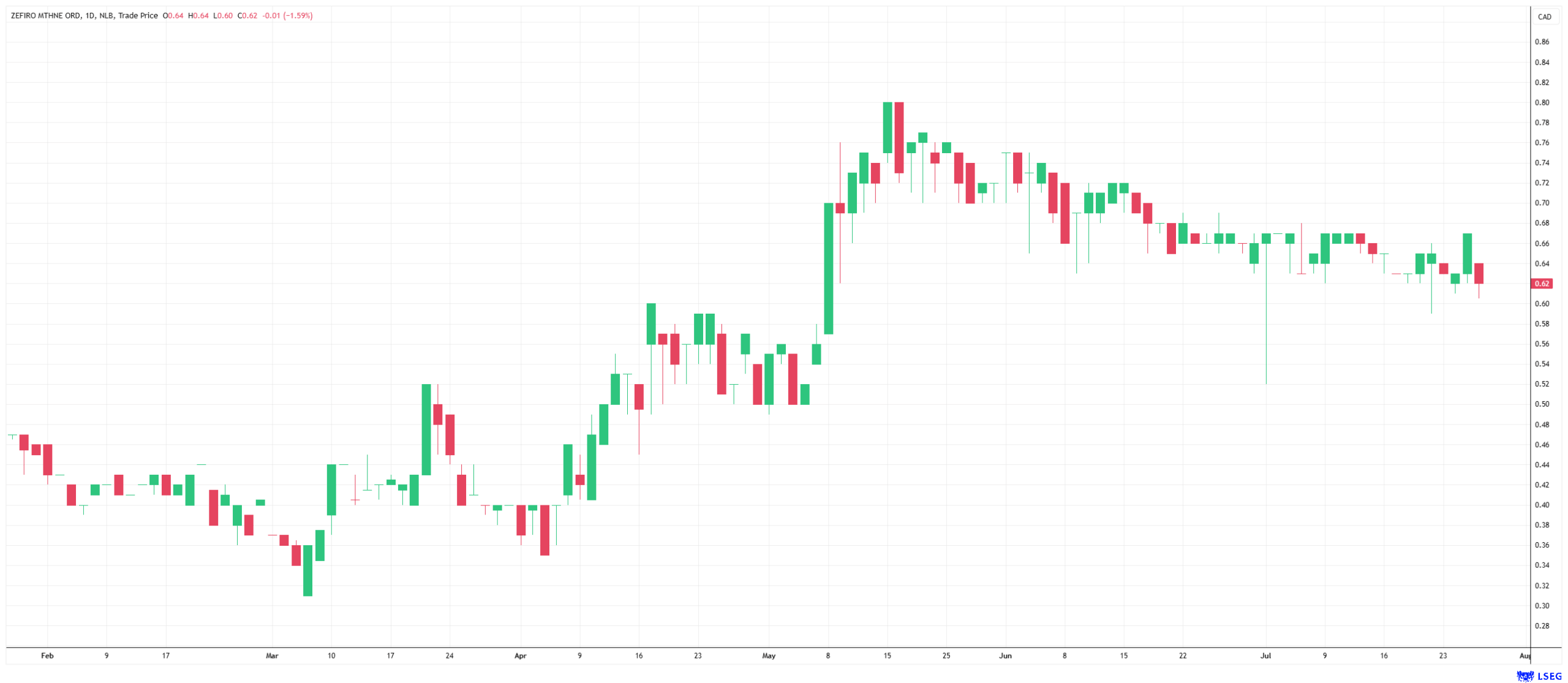
Analysts at GBC recently issued a "Buy" recommendation for Zefiro Methane shares and have set an initial price target of USD 1.50 (equivalent to CAD 2.12). The experts point to the billion-dollar potential in the remediation of abandoned wellbores, as well as the significantly expanded fleet capacity across 13 US states, as key drivers of operational growth. However, the enormous market potential, estimated at USD 280 billion, is also offset by risks stemming from potential operational uncertainties. The persistently high demand for remediation from energy companies should, however, provide Zefiro with strong business opportunities in the coming years—while companies like Occidental Petroleum and SpaceX are forced to invest, Zefiro can look forward to growing demand for its services.
Watch YouTube videoConflict of interest
Pursuant to §85 of the German Securities Trading Act (WpHG), we point out that Apaton Finance GmbH as well as partners, authors or employees of Apaton Finance GmbH (hereinafter referred to as "Relevant Persons") may hold shares or other financial instruments of the aforementioned companies in the future or may bet on rising or falling prices and thus a conflict of interest may arise in the future. The Relevant Persons reserve the right to buy or sell shares or other financial instruments of the Company at any time (hereinafter each a "Transaction"). Transactions may, under certain circumstances, influence the respective price of the shares or other financial instruments of the Company.
In addition, Apaton Finance GmbH is active in the context of the preparation and publication of the reporting in paid contractual relationships.
For this reason, there is a concrete conflict of interest.
The above information on existing conflicts of interest applies to all types and forms of publication used by Apaton Finance GmbH for publications on companies.
Risk notice
Apaton Finance GmbH offers editors, agencies and companies the opportunity to publish commentaries, interviews, summaries, news and the like on news.financial. These contents are exclusively for the information of the readers and do not represent any call to action or recommendations, neither explicitly nor implicitly they are to be understood as an assurance of possible price developments. The contents do not replace individual expert investment advice and do not constitute an offer to sell the discussed share(s) or other financial instruments, nor an invitation to buy or sell such.
The content is expressly not a financial analysis, but a journalistic or advertising text. Readers or users who make investment decisions or carry out transactions on the basis of the information provided here do so entirely at their own risk. No contractual relationship is established between Apaton Finance GmbH and its readers or the users of its offers, as our information only refers to the company and not to the investment decision of the reader or user.
The acquisition of financial instruments involves high risks, which can lead to the total loss of the invested capital. The information published by Apaton Finance GmbH and its authors is based on careful research. Nevertheless, no liability is assumed for financial losses or a content-related guarantee for the topicality, correctness, appropriateness and completeness of the content provided here. Please also note our Terms of use.