June 29th, 2026 | 06:45 CEST
Soaring Stock Prices, a Billion-Dollar Ruling, and the Green Transition: The Big Return Showdown Between Lufthansa, Bayer, and A.H.T. Syngas
Sometimes, a single court ruling is enough to fundamentally alter the outlook for a listed company. Bayer demonstrated this vividly this week. Meanwhile, Lufthansa is climbing to new annual highs, supported by falling oil prices and a surprisingly stable credit rating. Then there is A.H.T. Syngas, a small but ambitious provider of biomass power plants that has either just emerged from a consolidation phase, or may be approaching the end of one. Three very different companies, three distinct stages of development—yet all three are worth a closer look at this moment. If you want to understand where opportunities may lie and where caution is warranted, read on.
time to read: 6 minutes | Author: Matthias Schomber
ISIN: A.H.T. SYNGAS TECH. EO 1 | NL0010872388 , BAYER AG NA O.N. | DE000BAY0017 , LUFTHANSA AG VNA O.N. | DE0008232125
Table of contents:
Author

Matthias Schomber
Raised in Giessen, Hesse, Matthias Schomber discovered his passion for the financial markets as early as the 1990s—at a time when stock trading was still largely the domain of true, die-hard traders. After completing his banking apprenticeship, he worked for a private bank there and witnessed the rise and fall of the Neuer Markt firsthand on the trading floor of the Frankfurt Stock Exchange, drawing lessons from the experience that continue to shape his thinking as a trader, author, and trading system developer to this day.
Tag cloud
Shares cloud
Lufthansa: On the Rise Thanks to Oil, Credit Rating, and Cargo
Lufthansa is benefiting primarily from external circumstances and making the most of them. The falling oil price, following the initial easing of tensions between Iran and the US, has provided a tailwind for the aviation sector as a whole, and Lufthansa is capitalizing on it. At the end of last week, the share reached a new multi-week high just under EUR 10 before pulling back slightly, closing at around EUR 9.73-9.75. Year-to-date, it is up by over 30%.
A key factor in this recovery came this week from the rating agency Fitch, which affirmed Lufthansa's credit rating at "BBB-," keeping it in the investment-grade range, with a stable outlook. Fitch praised the company's strong position as Europe's largest airline group in terms of fleet size and revenue, noting that the cargo and maintenance divisions mitigate its cyclical dependence on the passenger business. The stock responded with a further rise.
It is precisely this cargo division that is currently delivering tangible results. In Frankfurt, the first construction phase of a new high-bay warehouse went into operation. It stands 42 m tall and features 3,000 storage slots across 13 floors. The project, named "LCCevo," costs around EUR 600 million, and the group expects it to yield productivity gains of up to 30%. Completion is scheduled for 2030. In addition, the Bundestag has cleared the way for biometric facial recognition at airports. This is a procedure that Lufthansa is already testing in Frankfurt, primarily for travelers to the US. The data collected must be deleted three hours after departure.
However, the mood is not entirely unclouded. Lufthansa had to deny a media report this week alleging that up to 40 aircraft were being grounded due to a kerosene shortage; in fact, the issue involves bottlenecks in the Asian fuel supply as well as war-related additional costs of around EUR 1.5 billion. According to published reports, BlackRock has also recently reduced its voting stake from 4.32% to 4.04%, and analysts at Bernstein Research initiated coverage of Lufthansa with a "Market Perform" rating and a price target of "only" EUR 7.90, well below the current level. The next real test will come on August 4 with the half-year report.
Lufthansa has performed well and could even break through the EUR 10 mark, though the RSI suggests caution. Therefore, a consolidation phase could be imminent before the share price continues its upward trajectory.
Bayer: The Sudden Billion-Euro Miracle
A completely different picture emerges for the Leverkusen-based chemical giant Bayer, which has shaken up the stock market world in recent days with a real bombshell. A completely unexpected and far-reaching court ruling from the US on the controversial issue of glyphosate caused the share price, which had been battered for a long time, to surge by nearly 20%. It seems as though the heavy legal burdens that have hung over the company like dark clouds since the massive Monsanto acquisition are finally losing their menace.
CEO Bill Anderson had already demonstrated strategic and diplomatic skill a year and a half ago when he traveled to Washington for Donald Trump's inauguration to smooth things over. This patriotic move could now pay off, as international markets are noticeably calming down. Market observers increasingly agree that there could still be significant upside for Bayer, as the fundamental undervaluation of its business segments appears substantial. However, the investment remains a high-risk proposition in both the short and medium term. The US justice system continues to act unpredictably, which is why investors must keep the latent risk of further potential lawsuits firmly in mind. The current share price gain, however, impressively demonstrates the upside potential.
However, it is not without its downsides. With an RSI of just over 80, the stock is considered overbought following the recent rally, and anyone buying now is primarily buying on momentum. That could work out well, but it might not. Net debt remains above EUR 30 billion, and significant funds are likely to continue flowing into ongoing legal disputes this year as well. In addition, the so-called "quiet period" begins on July 15 ahead of the half-year report on August 4. Until then, management will refrain from making new statements. Be sure to mark this date on your calendar. Add the stock to the watchlist; if the price weakens, it could be an interesting opportunity for a staggered entry.
A.H.T. Syngas: The Underrated Energy Pioneer on the Rise
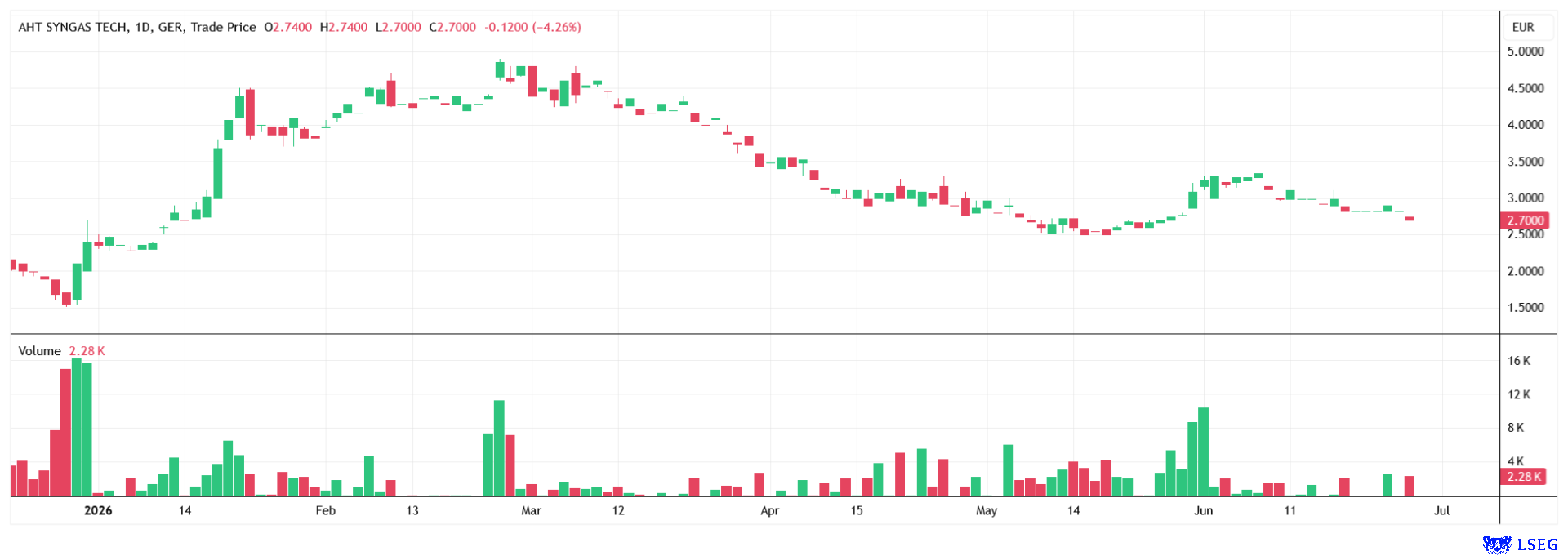
From a traditional DAX heavyweight, the path leads directly to an exciting growth story in the field of decentralized energy supply. A.H.T. Syngas Technology N.V., with operational headquarters in Bonn and Eindhoven, operates in the rapidly growing decarbonization market. The company's stock has already had an extremely impressive run in 2026. Following a sharp rise from approximately EUR 1.50 to nearly EUR 5.00, the share has entered an extended but healthy consolidation phase.
A stable bottom appears to have formed around the EUR 2.50 level. Shortly thereafter, the stock rose again significantly above the EUR 3.00 mark. The recent advance is now being digested, and the stock is currently trading at a "more attractive" level of around EUR 2.70. This could present a potential entry opportunity on a constructive upward trajectory, with an initial price target in the EUR 3.50-4.00 range.
The fundamental drivers behind this chart performance are partly rooted in recent company announcements. On March 19, 2026, the management team led by CEO Gero Ferges announced an exclusive partnership with the renowned Innotec Energy in neighbouring Poland. This well-connected partner company currently holds the rights to 17 promising projects and is handling all project development on-site as the general contractor. Both partners expect to secure concrete orders as early as this year, with a total value exceeding EUR10 million. This partnership could be a decisive step on the path from being a pure component supplier to becoming a comprehensive cleantech solutions provider.
This outlook is accompanied by a strengthening of the company's financial foundation. As previously reported in January, the company successfully placed a convertible bond, thereby securing its strategic flexibility for further expansion in the field of natural gas substitution.
A closer look at the company's technological structure underscores the enormous market potential. The mature biomass power plants operate using proven twin-fire reactor technology and deliver exactly what modern industry needs today more urgently than ever. The various model series of the A.H.T. Twin-fire technology impressively demonstrate this performance capability. The R 111 model, for example, delivers a hot-gas output for thermal use of up to 700 kilowatts, while the R 116 variant reaches up to 1,500 kilowatts. The most powerful system in this series, the R 123 model, provides up to 3,000 kilowatts.
With just 5,000 tonnes of waste wood chips, such a system generates 1,000 kilowatts of electrical energy and 1,500 kilowatts of thermal energy. In addition to high-quality syngas for industrial applications, the process also safely produces high-purity hydrogen, CO₂, and phosphorus. This could precisely address the urgent needs of mid-sized industrial companies and municipalities that require extremely high process heat of over 800°C and are seeking to rapidly move away from fossil fuels.
With the glyphosate ruling, Bayer has achieved a fundamental breakthrough, but the stock is already well valued following the rally, and the debt burden remains high. The RSI also urges caution. Lufthansa has recently benefited from a stable credit rating and a growing cargo division, but it is once again facing the familiar risk of rising oil prices amid a potential escalation in the Strait of Hormuz, and it will also be judged by its half-year results in August. As for A.H.T. Syngas, following the sharp rise and subsequent correction, the share is currently trading at around EUR 2.70. With the partnership in Poland and a solid order outlook, the fundamentals do not look bad. In the current phase, one could see an opportunity to buy, with an eye toward a possible recovery toward EUR 3.50 to 4.00.
Conflict of interest
Pursuant to §85 of the German Securities Trading Act (WpHG), we point out that Apaton Finance GmbH as well as partners, authors or employees of Apaton Finance GmbH (hereinafter referred to as "Relevant Persons") may hold shares or other financial instruments of the aforementioned companies in the future or may bet on rising or falling prices and thus a conflict of interest may arise in the future. The Relevant Persons reserve the right to buy or sell shares or other financial instruments of the Company at any time (hereinafter each a "Transaction"). Transactions may, under certain circumstances, influence the respective price of the shares or other financial instruments of the Company.
In addition, Apaton Finance GmbH is active in the context of the preparation and publication of the reporting in paid contractual relationships.
For this reason, there is a concrete conflict of interest.
The above information on existing conflicts of interest applies to all types and forms of publication used by Apaton Finance GmbH for publications on companies.
Risk notice
Apaton Finance GmbH offers editors, agencies and companies the opportunity to publish commentaries, interviews, summaries, news and the like on news.financial. These contents are exclusively for the information of the readers and do not represent any call to action or recommendations, neither explicitly nor implicitly they are to be understood as an assurance of possible price developments. The contents do not replace individual expert investment advice and do not constitute an offer to sell the discussed share(s) or other financial instruments, nor an invitation to buy or sell such.
The content is expressly not a financial analysis, but a journalistic or advertising text. Readers or users who make investment decisions or carry out transactions on the basis of the information provided here do so entirely at their own risk. No contractual relationship is established between Apaton Finance GmbH and its readers or the users of its offers, as our information only refers to the company and not to the investment decision of the reader or user.
The acquisition of financial instruments involves high risks, which can lead to the total loss of the invested capital. The information published by Apaton Finance GmbH and its authors is based on careful research. Nevertheless, no liability is assumed for financial losses or a content-related guarantee for the topicality, correctness, appropriateness and completeness of the content provided here. Please also note our Terms of use.