February 3rd, 2026 | 11:30 CET
Sell-off or healthy correction? Quality stocks in focus: SAP, D-Wave, and Aspermont
Market activity has picked up noticeably in recent days. Upswing here, sharp pullback there! Volatility is back, driven by political statements and economic uncertainties. While the sudden 30% crash in silver is unsettling commodity investors, and SAP shares are undergoing a significant correction, many investors are fleeing to defensive sectors and tangible assets. Crypto markets remain in a downward spiral, and the perennial topic of AI is being viewed with increasing selectivity. Against this backdrop, Australian media and commodities specialist Aspermont is leveraging its long-established network and data assets to accelerate growth using AI. At the same time, it remains to be seen whether there is still hope for higher valuations after the sell-off at SAP and D-Wave. Time to get out the magnifying glass, Sherlock Holmes style.
time to read: 4 minutes | Author: André Will-Laudien
ISIN: SAP SE O.N. | DE0007164600 , D-WAVE QUANTUM INC | US26740W1099 , ASPERMONT LTD | AU000000ASP3
Table of contents:
Author

André Will-Laudien
Born in Munich, he first studied economics and graduated in business administration at the Ludwig-Maximilians-University in 1995. As he was involved with the stock market at a very early stage, he now has more than 30 years of experience in the capital markets.
Tag cloud
Shares cloud
SAP – Great figures, but disappointment in cloud growth
SAP's figures were widely discussed last week, and after a few seconds of shock, the sell-off price level of EUR 162 was soon history. The main argument for the disappointed analysts was the significantly lower order backlog in the cloud sector. There were few signs of a crash in the balance sheet, as revenues increased by 3% in Q4, while operating profit accelerated by as much as 27%. However, criticism focused on the slowing growth momentum in the cloud business, which had served as the basis for the revaluation of SAP shares between 2022 and 2025. At its peak, the Walldorf-based company was valued at as much as EUR 285 per share, implying a market capitalization of roughly EUR 320 billion. Investors are now keeping a close eye on the new ratings from analysts, with Berenberg and Deutsche Bank already throwing their new estimates into the ring. Although the Hamburg-based bank expects only EUR 250 after EUR 280 in 12 months, it is repeating its "Buy" rating. In Frankfurt, the "Buy" rating also remains in place, but here the experts now consider only EUR 220 to be plausible due to a deterioration in the outlook. Let's see what happens in the next few days. After all, the first two indications already create a mixed potential of 35%. The brave are stepping in or adding to their positions!
Aspermont Ltd. – From specialist publisher to data intelligence pioneer
Aspermont Ltd. has undergone a profound transformation in recent years. The journey took it from a publishing house with a long history to a data-driven technology provider that now delivers scalable digital solutions for global industries. The company leverages its extensive experience from more than two centuries of specialist publications to provide knowledge, market analysis, and big data services for the commodities, energy, and agriculture sectors. At the heart of its success is a unique data archive that has been transformed into a modern AI-based decision-making platform. With "Mining IQ," launched in 2025, Aspermont has created a tool that provides market players with precise insights into project developments, ESG risks, and investment flows. The AUD 550,000 six-month contract with Rio Tinto clearly demonstrates how highly the market rates the strategic value of this solution. The integration of historical data with current project data transforms industry analysis into a precise management tool. This business model not only increases margins but also the predictability of revenue through recurring subscriptions and licensing.
There is currently speculation in the capital market that the company could be preparing a 250:1 reverse split of its shares. Such a move would significantly change the visual impression of the share price and thus noticeably improve accessibility for professional investors. Many institutional investors avoid stocks in the cent range because they are considered difficult to trade and volatile. A higher share price could therefore attract new investor groups, improve liquidity, and reduce price fluctuations. The new share price after the split could be around AUD 2.00 in purely mathematical terms, with the market capitalization of approximately AUD 24 million remaining unchanged for the time being as a result of this technical measure.
However, the symbolic component of this measure is also extremely interesting. It would be a visible signal of the company's maturation process. This is because moving away from the penny image reinforces the claim to be perceived as an established information and technology provider, and at the same time strengthens the confidence of existing shareholders. The planned publication of the 2025 financial results should support this process and demonstrate for the first time the potential of the fully digitalized business model. For investors who are betting on the strategic shift from a publishing company to a data intelligence firm, an exceptionally exciting opportunity profile is opening up. After all, scaling can only be achieved with a few blockbuster orders, similar to the one from Rio Tinto. Extremely exciting!
IIF moderator Lyndsay Malchuk spoke to company founder and CEO Alex Kent about the company's future prospects.
D-Wave – Betting on the breakthrough of the next generation of computers
Quantum computing specialist D-Wave Quantum has fallen completely by the wayside. At the beginning of the new year, its share price was still around USD 33, but yesterday it was trading at just USD 21.50. D-Wave is considered a pioneer of a technology path that could fundamentally change the world of computing in terms of complex mathematics and combinatorics. The company is one of the few players that can deploy functioning systems not only in the laboratory, but also in real-world application scenarios. The basis for this is the proprietary quantum annealing technology, which is accessible via the company's own cloud platform "Leap." This technology already allows complex optimization tasks for industry, finance, and government clients to be tested in practice. Long term, this technology has enormous potential, especially for IT security and cryptography. Powerful quantum computers could one day crack existing encryption protocols with special algorithms, which would call entire security architectures into question. D-Wave's positioning between quantum physics, high-performance data processing, and blockchain technologies is interesting. All of these are technology sectors poised to flourish over the coming years. Whether that already justifies a 2026 price-to-sales ratio of 180 is, however, a philosophical question.
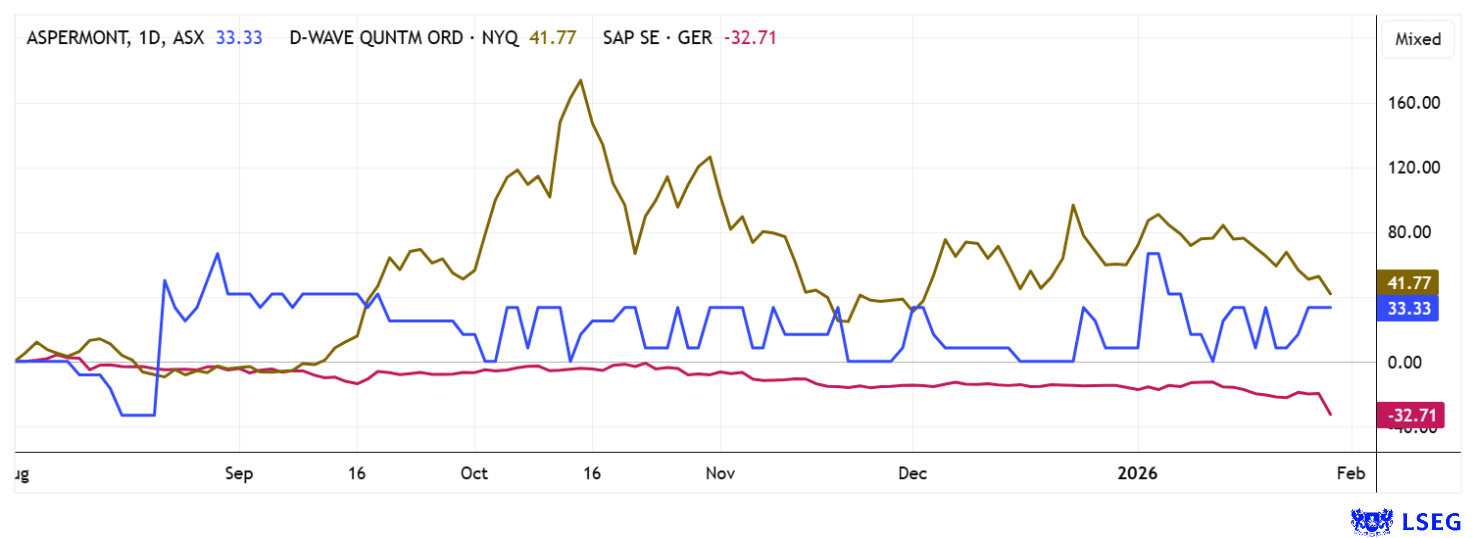
The stock markets are currently experiencing increased volatility, but sector trends and thematic investment stories are attracting attention. Aspermont currently appears to be perfectly positioned, while D-Wave Quantum's valuation remains clearly forward-looking despite the recent correction. Following the setbacks, SAP has a significantly improved risk/reward profile, as much of the negative news is already priced into the current share price.
Conflict of interest
Pursuant to §85 of the German Securities Trading Act (WpHG), we point out that Apaton Finance GmbH as well as partners, authors or employees of Apaton Finance GmbH (hereinafter referred to as "Relevant Persons") currently hold or hold shares or other financial instruments of the aforementioned companies and speculate on their price developments. In this respect, they intend to sell or acquire shares or other financial instruments of the companies (hereinafter each referred to as a "Transaction"). Transactions may thereby influence the respective price of the shares or other financial instruments of the Company.
In this respect, there is a concrete conflict of interest in the reporting on the companies.
In addition, Apaton Finance GmbH is active in the context of the preparation and publication of the reporting in paid contractual relationships.
For this reason, there is also a concrete conflict of interest.
The above information on existing conflicts of interest applies to all types and forms of publication used by Apaton Finance GmbH for publications on companies.
Risk notice
Apaton Finance GmbH offers editors, agencies and companies the opportunity to publish commentaries, interviews, summaries, news and the like on news.financial. These contents are exclusively for the information of the readers and do not represent any call to action or recommendations, neither explicitly nor implicitly they are to be understood as an assurance of possible price developments. The contents do not replace individual expert investment advice and do not constitute an offer to sell the discussed share(s) or other financial instruments, nor an invitation to buy or sell such.
The content is expressly not a financial analysis, but a journalistic or advertising text. Readers or users who make investment decisions or carry out transactions on the basis of the information provided here do so entirely at their own risk. No contractual relationship is established between Apaton Finance GmbH and its readers or the users of its offers, as our information only refers to the company and not to the investment decision of the reader or user.
The acquisition of financial instruments involves high risks, which can lead to the total loss of the invested capital. The information published by Apaton Finance GmbH and its authors is based on careful research. Nevertheless, no liability is assumed for financial losses or a content-related guarantee for the topicality, correctness, appropriateness and completeness of the content provided here. Please also note our Terms of use.