March 11th, 2026 | 07:10 CET
Scarcity drives prices – Market turbulence continues! Almonty, Shell, and BP are the winners in the current situation
Recent developments in the Middle East have put the commodity markets under considerable strain. Within a short period, the price of oil climbed to more than USD 115 per barrel, reaching a level not seen for several years. This movement is primarily driven by increasing risks to global energy trade following the further escalation of the situation in the Persian Gulf. Particular focus is on the Strait of Hormuz, one of the world's most important energy transport routes. Around 20% of internationally traded crude oil passes through this strait every day, meaning that any disruption immediately affects prices and supply expectations. Yesterday, US President Donald Trump issued a clear warning to Iran not to disrupt international trade routes. Within four hours, the price of oil plummeted by USD 30. Scarcity, yes – volatility, extreme! The same applies to tungsten prices, which have risen by a further 100% since the beginning of the year. We take a closer look.
time to read: 5 minutes | Author: André Will-Laudien
ISIN: ALMONTY INDUSTRIES INC. | CA0203987072 | TSX: AII , NASDAQ: ALM , ASX: AII , Shell PLC | GB00BP6MXD84 , BP PLC DL-_25 | GB0007980591
Table of contents:
Author

André Will-Laudien
Born in Munich, he first studied economics and graduated in business administration at the Ludwig-Maximilians-University in 1995. As he was involved with the stock market at a very early stage, he now has more than 30 years of experience in the capital markets.
Tag cloud
Shares cloud
Commodity prices out of control – Oil prices up USD 40 in just 24 hours
In addition to geopolitical tensions, the structural supply situation for several commodities is also exacerbating market nervousness. In the case of oil, the free production reserves of major producers are currently considered to be relatively limited, while at the same time, parts of global production are restricted by conflicts or technical problems. In addition, commercial oil stocks in several industrialized countries, including Europe, are below their long-term averages, which reduces the scope for cushioning short-term supply shortages. Understandably, the alarm bells are already ringing in Brussels, with fuel retailers anticipating a possible supply shortage and raising the price of diesel from EUR 1.60 to EUR 2.20 within a week. Although the constraints are primarily felt in industry, it is also to be expected that larger purchases in the private sector will take a back seat for the time being due to uncertain household budgets. This is a severe blow to economies that will have to fight hard for every tenth of a percentage point of growth in 2026. At present, there are many indications that the price excesses for energy commodities and strategic metals are likely to continue. Yesterday, there was some relief: Brent was trading at USD 88.50, down USD 30 from the previous day. Relief, yes – but no real sign of relaxation.
Shell and BP – The beneficiaries of the turmoil
The global oil market is currently under exceptional pressure as inventories shrink and key export routes remain blocked. Investment banks such as Goldman Sachs are even warning that a prolonged conflict could push prices above USD 100 in the short term, or even significantly higher in extreme cases. Due to the proximity to the current distortions, many research houses have not yet commented. Yesterday morning, there was a respite, but how long will the calm before the next storm last?
In this environment, integrated energy companies with a global presence and diversified revenue streams are benefiting the most. Shell plc currently reports free cash flow of over USD 30 billion per year and generates around 60% of its revenue outside the upstream oil business, including in liquefied natural gas trading. The share price is trading at EUR 36.30, just below the 25-year high reached in March. The current 2026 P/E ratio of 13.2 is particularly attractive, as short-term price gains cannot yet be fully priced in. The dividend yield of over 4% and further share buybacks are further supported by strong cash flow when crude oil prices are high.
BP plc also remains an energy favorite. The company produces around 2.5 million barrels of oil equivalent per day at a production cost of only USD 25/barrel, which keeps profit margins high even when prices are volatile. In addition, BP is investing heavily in renewable energy and infrastructure, a classic hedge against volatile energy markets. Of course, the British group continues to generate over 70% of its operating cash flow from traditional oil and gas projects. Analysts see higher profit potential in the short term if prices remain high, while the share price of around EUR 6.50 is still just under 40% below its all-time high of EUR 11 in 2000. BP is also at the lower end of its long-term valuation range with a 2026 P/E ratio of 14.3. The publication of the 2025 financial results on April 23 is likely to provide decisive momentum. Very exciting!
Almonty Industries – Still far too cheap under certain circumstances
Although tungsten prices are trending inexorably upward, Almonty shares have had to absorb a great deal of volatility in recent days. This is understandable, as early investors are sitting on huge profits despite the continuing good outlook, which they are keen to realize in uncertain times. The daily pattern is unmistakable: at the start of trading, sell orders are executed at lower prices; once this flow has been digested, long-term investors gather momentum and the share price surges to new highs. This has also been the case in recent days. At EUR 17.20 in Frankfurt, the share is only EUR 0.50 away from its all-time high, with strong trading volume
IIF presenter Lindsay Malchuk talks to expert Christopher Ecclestone about the current events surrounding the Strait of Hormuz and the possible impact on critical metals.
Current analyst estimates for Almonty are gradually reflecting the realities of the tense commodity markets. However, experts are unable to keep pace with the high momentum. While analyst reports three to four months ago set price targets between CAD 9.00 and CAD 13.50, the 100% increase in the tungsten price since the beginning of the year has led to new price targets in the range of CAD 27.35 and CAD 28.60 (GBC). Bank of America has initiated coverage with a target of USD 20, while Cantor Fitzgerald has raised its target to CAD 36.00. The story becomes plausible when looking at one key figure: GBC uses a long-term APT price assumption of USD 1,500 as the basis for its model and expects free cash flow of around CAD 400 million for 2027. However, the price is currently above USD 2,300 and could rise further. As a result, the currently calculated price-to-cash-flow ratio of 9 could quickly fall to around 5. The key factor for Almonty's valuation, therefore, remains the long-term price trajectory and the actual contract prices at which deliveries can be secured. The material is in short supply – those willing to pay upfront are likely to secure supply. Yesterday, Almonty closed at CAD 26.75 – leaving plenty of room and even more upside potential, even for new investors!
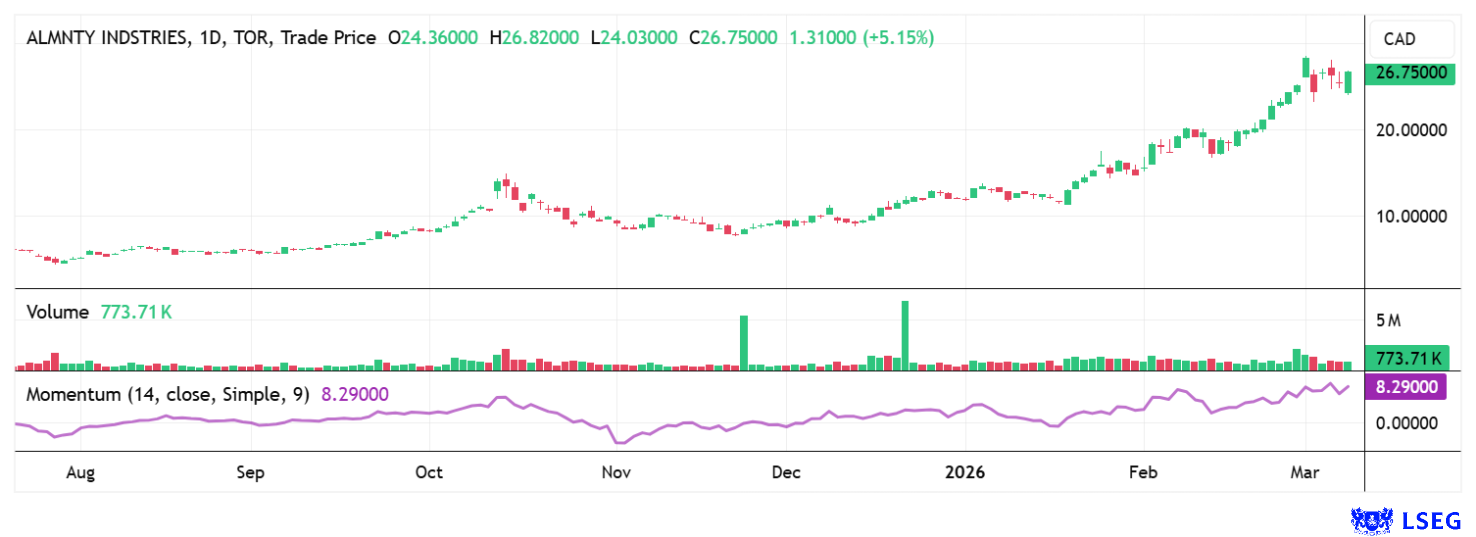
The international situation, with its numerous geopolitical conflicts, is not exactly conducive to stock market investment. However, when you look at the scarce resources in the energy market and critical metals, it becomes clear that those who do not invest here will miss out on medium-term opportunities for significantly higher valuations. This is because the commodity cycle – usually around seven years – only began to price in realities at the end of 2024. The rally is therefore likely to continue unabated.
Conflict of interest
Pursuant to §85 of the German Securities Trading Act (WpHG), we point out that Apaton Finance GmbH as well as partners, authors or employees of Apaton Finance GmbH (hereinafter referred to as "Relevant Persons") currently hold or hold shares or other financial instruments of the aforementioned companies and speculate on their price developments. In this respect, they intend to sell or acquire shares or other financial instruments of the companies (hereinafter each referred to as a "Transaction"). Transactions may thereby influence the respective price of the shares or other financial instruments of the Company.
In this respect, there is a concrete conflict of interest in the reporting on the companies.
In addition, Apaton Finance GmbH is active in the context of the preparation and publication of the reporting in paid contractual relationships.
For this reason, there is also a concrete conflict of interest.
The above information on existing conflicts of interest applies to all types and forms of publication used by Apaton Finance GmbH for publications on companies.
Risk notice
Apaton Finance GmbH offers editors, agencies and companies the opportunity to publish commentaries, interviews, summaries, news and the like on news.financial. These contents are exclusively for the information of the readers and do not represent any call to action or recommendations, neither explicitly nor implicitly they are to be understood as an assurance of possible price developments. The contents do not replace individual expert investment advice and do not constitute an offer to sell the discussed share(s) or other financial instruments, nor an invitation to buy or sell such.
The content is expressly not a financial analysis, but a journalistic or advertising text. Readers or users who make investment decisions or carry out transactions on the basis of the information provided here do so entirely at their own risk. No contractual relationship is established between Apaton Finance GmbH and its readers or the users of its offers, as our information only refers to the company and not to the investment decision of the reader or user.
The acquisition of financial instruments involves high risks, which can lead to the total loss of the invested capital. The information published by Apaton Finance GmbH and its authors is based on careful research. Nevertheless, no liability is assumed for financial losses or a content-related guarantee for the topicality, correctness, appropriateness and completeness of the content provided here. Please also note our Terms of use.