June 26th, 2026 | 07:25 CEST
SAP Testing the Waters, BYD On the Offensive, and MustGrow Biologics Raises Fresh Capital - Is a Rebound on the Horizon?
Created and published on behalf of MustGrow Biologics Corp.
The winds across global equity markets have grown noticeably stronger, bringing sharp moves in both directions. Technology and automotive giants that have long been accustomed to success are feeling the full force of this turbulence. Faced with declining share prices and geopolitical uncertainty, investors are increasingly looking beyond the mainstream for fresh opportunities. While companies such as SAP and BYD are fighting to defend their lofty valuations, intriguing second-tier players are quietly positioning themselves for growth. This raises a legitimate question: should investors allocate capital into "fallen angels" such as SAP and BYD, or focus on lesser-known growth stories with potentially greater upside? We examine the current market environment and take a closer look at three very different companies. Discover why software heavyweight SAP and electric vehicle pioneer BYD are facing challenges, and why Canadian agtech company MustGrow Biologics could be approaching a breakout. One thing is certain: the stage is set for an exciting summer in the markets.
time to read: 5 minutes | Author: Matthias Schomber
ISIN: MUSTGROW BIOLOGICS CORP. | CA62822A1030 | TSXV: MGRO , OTCQB: MGROF , BYD CO. LTD H YC 1 | CNE100000296 , SAP SE O.N. | DE0007164600
Table of contents:
Author

Matthias Schomber
Raised in Giessen, Hesse, Matthias Schomber discovered his passion for the financial markets as early as the 1990s—at a time when stock trading was still largely the domain of true, die-hard traders. After completing his banking apprenticeship, he worked for a private bank there and witnessed the rise and fall of the Neuer Markt firsthand on the trading floor of the Frankfurt Stock Exchange, drawing lessons from the experience that continue to shape his thinking as a trader, author, and trading system developer to this day.
Tag cloud
Shares cloud
SAP Is Desperately Searching for a Bottom
SAP, Europe's flagship software company and once the undisputed leader, has lost significant ground in recent months. From its impressive record high of EUR 283.50 in February 2025, the price has since slipped to just over EUR 130. That represents a steep decline of over 50%. The reasons for this sell-off are manifold, but cannot be dismissed. Perhaps the sell-off is already a bit exaggerated, but it could become even more so in the coming weeks—who knows? For one thing, the uncertain trend in chip prices is making investors nervous. Hardware costs for cloud infrastructures could rise, as contract manufacturers like TSMC have announced price increases.
In addition, concerns about the future surrounding the rapid spread of artificial intelligence (AI) are weighing on the entire software sector. Many investors simply fear that established solutions could be displaced by new AI tools.
Meanwhile, there is absolute radio silence on the operational front. The company is in the so-called "quiet period" ahead of its quarterly earnings report on July 23. Analysts see significant potential again at the current discounted level. Although the research firm Jefferies lowered its price target to EUR 210, it clearly maintains its "Buy" rating. Long-term glimmers of hope, such as a planned EU tax reform, could also save the complexly structured group billions in the future. Nevertheless, the technical picture remains severely weakened for the time being. From a technical analysis perspective, it is even possible that the stock could slide toward EUR 120—or, in an extreme scenario, even toward EUR 100. Nothing can be ruled out during such a market phase. Investors who believe in SAP's future—even amid AI—could enter the market in stages as prices continue to fall. Very exciting!
BYD Makes a Push in Europe, but the Market Reacts Coolly
From SAP's virtual data cloud, we now shift to the real world of vehicles on the road, as the Chinese EV group BYD is also currently facing a tough time on the stock market. Shares are languishing on European exchanges near their 52-week low, hovering around the EUR 8.50 mark. In fact, it is not far from the all-time low of EUR 7.62 set in August 2024. Yet the company is posting rather impressive operating figures. In May 2026, BYD sold over 160,000 vehicles outside of China, setting an all-time record.
Nevertheless, the European Union's impending tariff policy on plug-in hybrids is significantly dampening investor sentiment. The automaker, however, is not particularly deterred by this and is planning a massive model offensive. At the British Goodwood Festival of Speed, BYD is making a major impact, unveiling no fewer than eight new models for the European market. These include not only vehicles for the mass market but also the premium brand Denza and the luxury segment Yangwang. In addition, the Shark pickup fills an important gap in Europe. Strategically, BYD is doing almost everything right, but the significant first-quarter profit decline and the relentless price war in its home market of China continue to keep stock market investors cautious. A clear breakout has yet to materialize. Nevertheless, at the EUR 8 to 8.50 level, the stock becomes attractive for a rebound trade. The RSI has reached 20 and is already signaling that an upward correction toward EUR 10 could occur soon.
MustGrow Biologics: Fresh Capital and Positioned for a Potential Breakout
While billion-dollar stocks such as SAP and BYD are battling strong headwinds in some cases, an interesting development is emerging in the Canadian province of Saskatchewan. MustGrow Biologics specializes in sustainable agricultural technology—an area considered critical for the future, given the steadily growing global population and rising food demand. The company uses patented technologies to derive natural biopesticides and organic fertilizers from the mustard plant. At a time when synthetic agricultural fertilizers and chemicals are increasingly subject to regulatory pressure, MustGrow's core products, TerraSante and TerraMG, which is pre-registered, are perfectly in tune with the spirit of the times.
The latest news underscores the company's strong fundamental performance. In May 2026, the mustard-derived organic biofertility product TerraSante received registration in additional key US agricultural states. This opens up access to major markets for high-value crops. This expansion is supported by strong strategic partners. In the key EMEA market for biological crop protection, MustGrow is working exclusively with industry leader Bayer, which is estimated to invest USD 35 to 40 million in development and commercialization efforts.
In June 2026, management delivered another major milestone. The company successfully closed its non-brokered LIFE private placement, issuing approximately 7.48 million shares at a price of CAD 0.50 per unit, and raising gross proceeds of roughly CAD 3.74 million. In addition to the common shares, the units include a warrant entitling buyers to purchase one additional share for CAD 0.70 over the next five years. This fresh capital is expected to be used to expand TerraSante production and support general working capital requirements. The capital structure remains relatively lean, with approximately 70.4 million shares outstanding. At a market capitalization of around CAD 30 million, the company still appears to offer considerable room for growth.
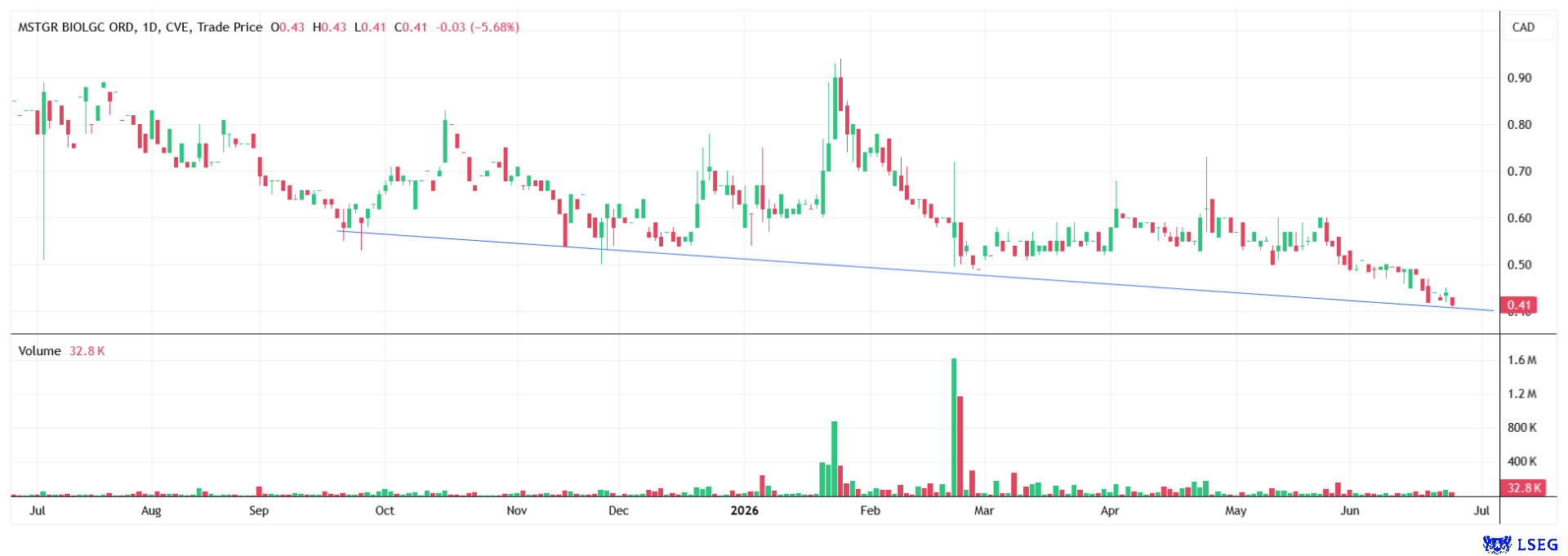
From a technical analysis perspective, the setup at MustGrow Biologics appears increasingly attractive. The stock has reached the lower boundary of its trend channel at approximately CAD 0.40 to 0.41 (see chart below), an area that represents significant support. This could provide the foundation for renewed upward momentum. Following the successful financing and with fresh capital behind it, the shares may well be positioned for a rebound. Initial upside targets of CAD 0.50, or even CAD 0.60, are therefore back in focus. Should the stock successfully break through these levels, a move toward the CAD 0.75 to 0.80 range cannot be ruled out from a technical perspective, as this corresponds to the most recent significant high. At current levels, the risk-reward profile appears favourable for investors considering an entry position.
In summary, the market currently shows little, if any, tolerance for major missteps. SAP must prove with its operating figures at the end of July that margins are holding steady and the cloud narrative remains intact. Until then, anything is possible. On the downside, investors who believe in the long-term prospects of the software giant may consider building a position gradually during periods of weakness.
At BYD, global expansion plans face fierce domestic price competition and regulatory hurdles in Europe. The company is growing, but the market demands significantly higher profitability. At EUR 8–8.50, bold investors could buy the stock for a rebound trade, targeting EUR 10.
The current situation at MustGrow Biologics appears increasingly attractive following the recent share price weakness. The company operates in a promising long-term growth market, continues to secure key regulatory approvals, and has successfully strengthened its financial position. With Bayer as a strong strategic partner and the stock trading near the lower end of its long-term trend channel, MustGrow has established a compelling starting position. For informed investors with a higher risk tolerance, the stock may warrant a closer look at current levels.
Conflict of interest
Pursuant to §85 of the German Securities Trading Act (WpHG), we point out that Apaton Finance GmbH as well as partners, authors or employees of Apaton Finance GmbH (hereinafter referred to as "Relevant Persons") may hold shares or other financial instruments of the aforementioned companies in the future or may bet on rising or falling prices and thus a conflict of interest may arise in the future. The Relevant Persons reserve the right to buy or sell shares or other financial instruments of the Company at any time (hereinafter each a "Transaction"). Transactions may, under certain circumstances, influence the respective price of the shares or other financial instruments of the Company.
In addition, Apaton Finance GmbH is active in the context of the preparation and publication of the reporting in paid contractual relationships.
For this reason, there is a concrete conflict of interest.
The above information on existing conflicts of interest applies to all types and forms of publication used by Apaton Finance GmbH for publications on companies.
Risk notice
Apaton Finance GmbH offers editors, agencies and companies the opportunity to publish commentaries, interviews, summaries, news and the like on news.financial. These contents are exclusively for the information of the readers and do not represent any call to action or recommendations, neither explicitly nor implicitly they are to be understood as an assurance of possible price developments. The contents do not replace individual expert investment advice and do not constitute an offer to sell the discussed share(s) or other financial instruments, nor an invitation to buy or sell such.
The content is expressly not a financial analysis, but a journalistic or advertising text. Readers or users who make investment decisions or carry out transactions on the basis of the information provided here do so entirely at their own risk. No contractual relationship is established between Apaton Finance GmbH and its readers or the users of its offers, as our information only refers to the company and not to the investment decision of the reader or user.
The acquisition of financial instruments involves high risks, which can lead to the total loss of the invested capital. The information published by Apaton Finance GmbH and its authors is based on careful research. Nevertheless, no liability is assumed for financial losses or a content-related guarantee for the topicality, correctness, appropriateness and completeness of the content provided here. Please also note our Terms of use.