November 3rd, 2026 | 05:22 CET
Rock Tech Lithium, Vulcan Energy and Rheinmetall: Lithium meets defence
Security policy and the energy transition are becoming increasingly intertwined. At the centre is lithium, which is crucial for both civilian electric mobility and new weapons systems. Reports of a potential investment by Rheinmetall in the German-Canadian lithium developer Rock Tech Lithium have cast a spotlight on this possible new collaboration. Meanwhile, in south-western Germany, Vulcan Energy is demonstrating how far the company has already progressed towards European production. We put the background into context.
time to read: 3 minutes | Author: Nico Popp
ISIN: Rock Tech Lithium Inc | CA77273P2017 , RHEINMETALL AG | DE0007030009 , VULCAN ENERGY RESOURCES | AU0000066086
Table of contents:
Author

Nico Popp
At home in Southern Germany, the passionate stock exchange expert has been accompanying the capital markets for about twenty years. With a soft spot for smaller companies, he is constantly on the lookout for exciting investment stories.
Tag cloud
Shares cloud
Rheinmetall and the electrification of the battlefield
Electrifying military platforms is becoming mission-critical. Hybrid powertrains with high-performance battery storage enable, for example, noiseless "Silent Watch" phases, during which sensors and communications operate without the diesel engine running. For defence groups such as Rheinmetall, this also brings the supply of battery raw materials into focus. An uninterrupted supply chain for these critical raw materials is strategically essential. According to Bloomberg, Rheinmetall is said to have already taken a stake in Rock Tech and its planned converter in Guben. Neither Rheinmetall nor Rock Tech has confirmed this so far.
Vulcan Energy: Progress on Schedule, but Facing Market Headwinds
Unlike Rock Tech, which is still struggling to secure financing, Vulcan Energy provides an operationally mature benchmark with its Lionheart project in the Upper Rhine region. Although Vulcan is on schedule, project developers are suffering from poor sector sentiment due to falling lithium carbonate futures in China. Vulcan Energy secured a financing package of EUR 2.2 billion, held EUR 209.4 million in cash and cash equivalents at the end of September and recorded operational progress in a drilling and injection test.
Lithium market: Falling prices slow new projects
The lithium market is currently in a fragile phase. After record levels of around 600,000 yuan (just over USD 80,000) per tonne at the end of 2022, lithium carbonate prices imploded; at the end of October, it was trading at only around 96,000 yuan (equivalent to around USD 14,400) per tonne on the spot market in China. This price collapse has sharply reduced the pipeline of new mining projects worldwide. As it often takes five to seven years from the investment decision to commercial production at a new mine, essential upfront investment is now lacking. In an ambitious climate scenario, Wood Mackenzie's analysts therefore consider a structural supply deficit possible as early as 2028 unless significantly more is invested. While the expansion of e-mobility progresses, lithium supply risks falling behind. For independent project developers, this volatile price environment poses an enormous risk, which is why financially strong industrial partners are currently gaining in importance.
Rock Tech Lithium: Between Guben and North America
For Rock Tech Lithium, financing the planned lithium hydroxide converter in Guben, Brandenburg, remains the absolute priority. Should Rheinmetall officially confirm the reported equity investment at project level, industrial capital could prevent the European project from coming to a standstill and also mobilise public funding. The plant in Guben is targeting an annual production capacity of 24,000 tonnes, with Rock Tech estimating investment costs at around EUR 680 million. In light of frustrating experiences in Europe, management has shifted its priorities in recent years towards an integrated North American model in the province of Ontario. At its heart is the planned "Red Rock Converter", for which Siemens Canada is currently developing a digital twin. In addition, the first field programme at the large Victory project began at the end of October to collect geological data there.
Fresh funds: Corporate action for the next stage of development
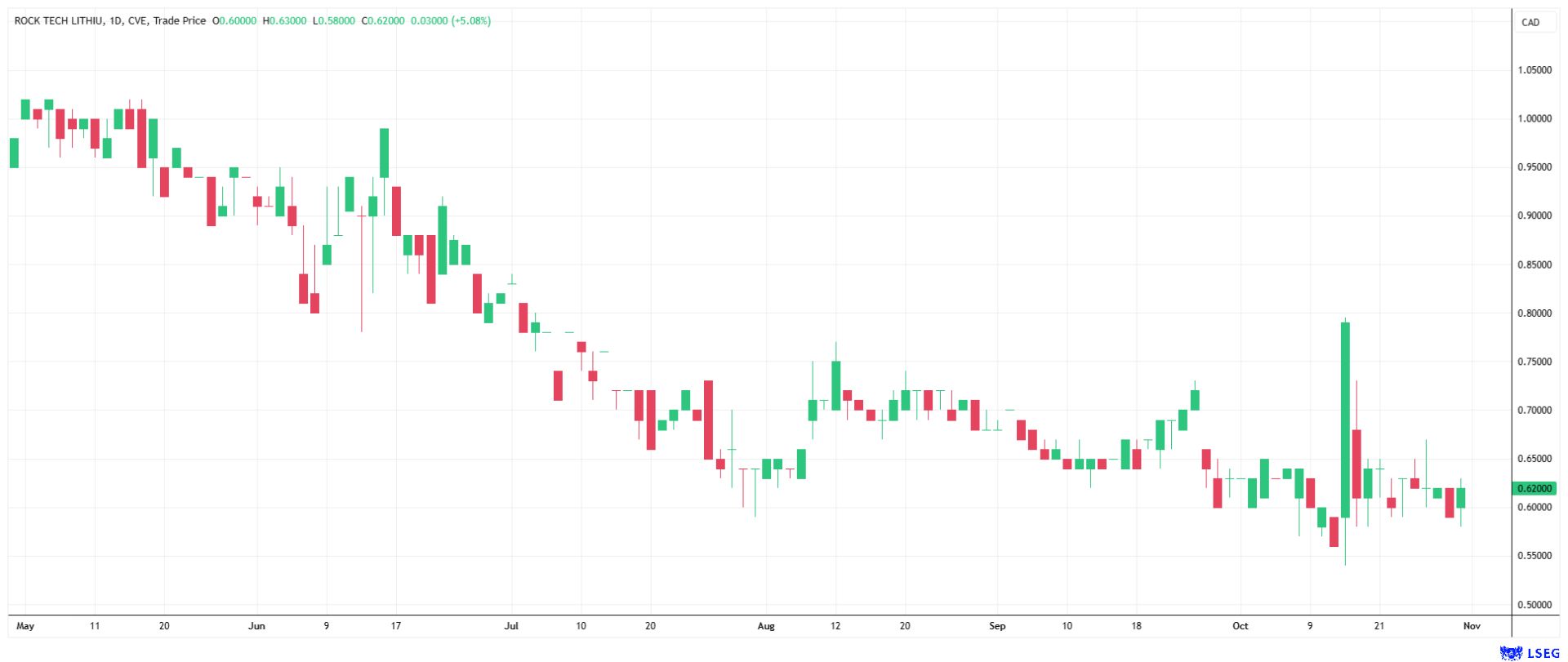
To raise new funds for the next steps, Rock Tech completed a private placement in three tranches in October. The issuance of new shares brought in gross proceeds of just under CAD 6 million, of which an unnamed strategic investor alone subscribed for CAD 3.25 million. Bloomberg linked this strategic investor directly to Rheinmetall.
Conclusion: Security of supply trumps market price
Given the historic collapse in lithium prices, financial commitments from strategic industrial investors are becoming necessary to make projects financeable over the long term and ensure supply security. If new investment fails to materialise, the lithium market could tighten as early as 2028, according to Wood Mackenzie. Automakers or defence groups could then become the decisive risk buffer. Investors need to read between the lines with Rock Tech Lithium and consider the overall situation. Although market scepticism remains considerable, there are signs the company could be a sought-after industry partner. In my view, another factor is that a Bloomberg report carries more weight than a report in an arbitrary media outlet: reputable news agencies generally check their sources carefully, which is why I consider the current situation more than a mere market rumour. However, official confirmation from Rheinmetall or Rock Tech is still pending. As construction financing for Guben also remains unresolved, the shares remain speculative for now.
Conflict of interest
Pursuant to §85 of the German Securities Trading Act (WpHG), we point out that Apaton Finance GmbH as well as partners, authors or employees of Apaton Finance GmbH (hereinafter referred to as "Relevant Persons") may hold shares or other financial instruments of the aforementioned companies in the future or may bet on rising or falling prices and thus a conflict of interest may arise in the future. The Relevant Persons reserve the right to buy or sell shares or other financial instruments of the Company at any time (hereinafter each a "Transaction"). Transactions may, under certain circumstances, influence the respective price of the shares or other financial instruments of the Company.
In addition, Apaton Finance GmbH is active in the context of the preparation and publication of the reporting in paid contractual relationships.
For this reason, there is a concrete conflict of interest.
The above information on existing conflicts of interest applies to all types and forms of publication used by Apaton Finance GmbH for publications on companies.
Risk notice
Apaton Finance GmbH offers editors, agencies and companies the opportunity to publish commentaries, interviews, summaries, news and the like on news.financial. These contents are exclusively for the information of the readers and do not represent any call to action or recommendations, neither explicitly nor implicitly they are to be understood as an assurance of possible price developments. The contents do not replace individual expert investment advice and do not constitute an offer to sell the discussed share(s) or other financial instruments, nor an invitation to buy or sell such.
The content is expressly not a financial analysis, but a journalistic or advertising text. Readers or users who make investment decisions or carry out transactions on the basis of the information provided here do so entirely at their own risk. No contractual relationship is established between Apaton Finance GmbH and its readers or the users of its offers, as our information only refers to the company and not to the investment decision of the reader or user.
The acquisition of financial instruments involves high risks, which can lead to the total loss of the invested capital. The information published by Apaton Finance GmbH and its authors is based on careful research. Nevertheless, no liability is assumed for financial losses or a content-related guarantee for the topicality, correctness, appropriateness and completeness of the content provided here. Please also note our Terms of use.