March 31st, 2026 | 07:05 CEST
Resilience in Logistics: Daimler Truck and Nel Explore a Hydrogen Future – dynaCERT Bridges the Gap
The logistics sector faces major challenges that highlight just how dependent it is on fossil fuels. An escalating conflict in the Middle East and the blockade of the Strait of Hormuz have shaken energy markets and led to rising prices for petroleum products and their derivatives. Particularly alarming is the price surge for diesel, the primary fuel for global heavy-duty transport. According to current market data, diesel prices on the London Stock Exchange have jumped by about 27 cents per liter since the end of February 2026. The economic consequences are enormous: simulations by the German Economic Institute show that a sustained oil price of USD 100 per barrel could result in real economic damage of about EUR 40 billion over two years. In this context, hydrogen is no longer seen merely as a tool for greater sustainability but as a prerequisite for resilience in energy matters. In this transformation process, the business models of Daimler Truck, Nel ASA, and dynaCERT complement one another. We analyze the solutions, which range from far-reaching visions for the future of mobility to immediate efficiency gains in heavy-duty engines.
time to read: 3 minutes
|
Author:
Nico Popp
ISIN:
DYNACERT INC | CA26780A1084 | TSX: DYA , OTCQB: DYFSF , Daimler Truck Holding AG | DE000DTR0013 , NEL ASA NK-_20 | NO0010081235
Table of contents:
Author

Nico Popp
At home in Southern Germany, the passionate stock exchange expert has been accompanying the capital markets for about twenty years. With a soft spot for smaller companies, he is constantly on the lookout for exciting investment stories.
Tag cloud
Shares cloud
Daimler Truck is Pushing for Liquid Hydrogen
As an industry leader, Daimler Truck is pursuing a consistent dual-track strategy in which battery-electric drives are used for local transport and hydrogen-based fuel cells are used for heavy-duty long-haul transport. CEO Karin Rådström emphasized that hydrogen plays an indispensable role, as the European power grid cannot bear the load of six million trucks on its own. The company favors liquid hydrogen because it enables a higher energy density, making ranges of over 1,000 km feasible at full capacity. Starting in late 2026, Daimler Truck plans to deploy a small series of 100 GenH2 fuel cell vehicles with selected customers such as the Rhenus Group. The fuel cell stacks are being developed in the cellcentric joint venture with the Volvo Group, with a new pilot production facility in Esslingen preparing for mass production. Despite geopolitical challenges such as US import tariffs, Daimler Truck achieved an adjusted EBIT of EUR 3.8 billion on revenue of EUR 49.4 billion in fiscal year 2025.
Nel ASA Scales Up Its Production Infrastructure
While Daimler Truck develops the commercial vehicles of tomorrow, Nel focuses on providing the necessary production capacities for green hydrogen. As a pioneer in electrolysis technology, the company faces the challenge of making the transition to a profitable mass producer. In the fourth quarter of 2025, Nel recorded a net loss of NOK 870 million due to write-downs, but at the same time, order intake rose by 364% to NOK 686 million. A decisive turning point for global scaling was the partnership with Samsung E&A concluded in March 2025, which enables the company to offer integrated electrolyser solutions for major international projects. According to the company, the market launch of a new alkaline platform is planned for May of this year; this is considered a technological milestone and is expected to reduce investment costs for hydrogen projects by 40 to 60%. Forecasts by the consulting firm McKinsey suggest that green hydrogen could become competitive on a large scale through such economies of scale.
dynaCERT Provides the Bridging Technology for Existing Fleets
In the critical transition phase toward a comprehensive hydrogen economy, dynaCERT plays a special role, as the fleet conversion in the logistics industry will take decades. With its HydraGEN technology, the Canadian company offers a mobile electrolysis unit that splits distilled water into hydrogen and oxygen, which are then introduced into the air intake of existing diesel engines. This process significantly improves combustion efficiency and enables fuel savings of up to 19% as well as a reduction in greenhouse gases of up to 40%. **In times of the current oil price shock, this technology pays for itself for logistics companies almost solely through direct fuel savings—so dynaCERT customers benefit directly.
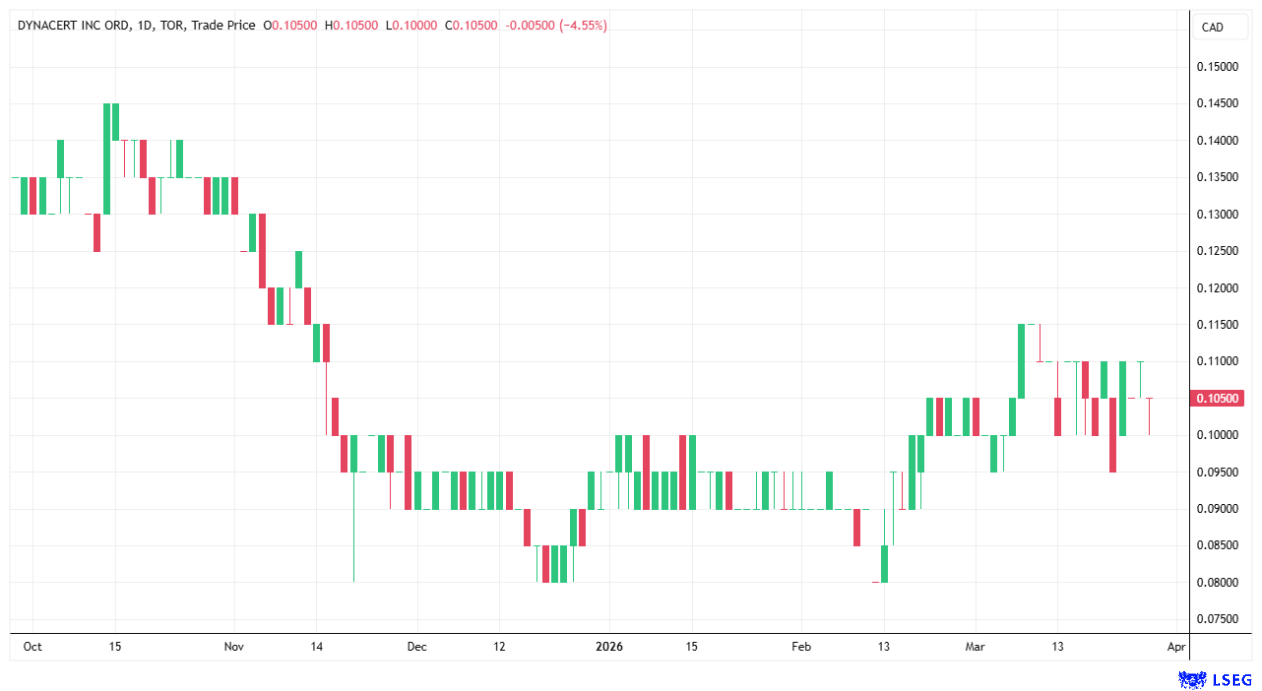
dynaCERT has also expanded its business model to include the monetization of CO2 credits through its HydraLytica telematics platform, which tracks emissions reductions in real time according to stringent standards of the Verra organization. Following a recent leadership change appointing Kevin Unrath as CEO, the company is now focusing on global commercial scaling, as evidenced by an initial order of 100 units for the Mexican market. Analysts on platforms such as Investing.com assign an average price target of CAD 0.75 for the stock, underscoring the high return potential of this readily deployable bridge technology.
dynaCERT: Is This the Calm Before the Storm?
After years of courting customers, dynaCERT has achieved notable successes time and again in recent quarters. The technology particularly shines when applied to heavy machinery in mining or port facilities. A truck in the Paris-Dakar Rally was also equipped with dynaCERT's technology and reached the finish line without any issues. The stock is currently trading near historic lows, presenting a potential opportunity for speculative investors. If dynaCERT regains momentum, it could emerge as the most promising of the three companies discussed.
Conflict of interest
Pursuant to §85 of the German Securities Trading Act (WpHG), we point out that Apaton Finance GmbH as well as partners, authors or employees of Apaton Finance GmbH (hereinafter referred to as "Relevant Persons") may hold shares or other financial instruments of the aforementioned companies in the future or may bet on rising or falling prices and thus a conflict of interest may arise in the future. The Relevant Persons reserve the right to buy or sell shares or other financial instruments of the Company at any time (hereinafter each a "Transaction"). Transactions may, under certain circumstances, influence the respective price of the shares or other financial instruments of the Company.
In addition, Apaton Finance GmbH is active in the context of the preparation and publication of the reporting in paid contractual relationships.
For this reason, there is a concrete conflict of interest.
The above information on existing conflicts of interest applies to all types and forms of publication used by Apaton Finance GmbH for publications on companies.
Risk notice
Apaton Finance GmbH offers editors, agencies and companies the opportunity to publish commentaries, interviews, summaries, news and the like on news.financial. These contents are exclusively for the information of the readers and do not represent any call to action or recommendations, neither explicitly nor implicitly they are to be understood as an assurance of possible price developments. The contents do not replace individual expert investment advice and do not constitute an offer to sell the discussed share(s) or other financial instruments, nor an invitation to buy or sell such.
The content is expressly not a financial analysis, but a journalistic or advertising text. Readers or users who make investment decisions or carry out transactions on the basis of the information provided here do so entirely at their own risk. No contractual relationship is established between Apaton Finance GmbH and its readers or the users of its offers, as our information only refers to the company and not to the investment decision of the reader or user.
The acquisition of financial instruments involves high risks, which can lead to the total loss of the invested capital. The information published by Apaton Finance GmbH and its authors is based on careful research. Nevertheless, no liability is assumed for financial losses or a content-related guarantee for the topicality, correctness, appropriateness and completeness of the content provided here. Please also note our Terms of use.