January 21st, 2026 | 07:10 CET
Nuclear fusion fantasy at Almonty, Chevron, Cenovus Energy: Why tungsten is the key to infinite energy
Until now, when investors thought of tungsten, they usually pictured hardened steel for armor-piercing ammunition or high-performance drill bits for industrial use. But this perception is on the verge of changing fundamentally. The latest physical breakthroughs in nuclear fusion, particularly at the Chinese experimental reactor EAST, often referred to as the "artificial sun", are placing the high-melting metal at the center of an energy revolution. While oil multinationals such as Chevron and Cenovus Energy are managing the present with record profits, a new market is emerging in the background for materials that must withstand the most extreme conditions. In this scenario, Almonty Industries is evolving from a traditional mining company into a strategic technology enabler – after all, there can be no fusion energy without tungsten. For investors willing to look beyond the fossil fuel world, this opens up an opportunity that goes far beyond cyclical commodity trading.
time to read: 3 minutes | Author: Nico Popp
ISIN: ALMONTY INDUSTRIES INC. | CA0203987072 , CHEVRON CORP. DL-_75 | US1667641005 , CENOVUS ENERGY INC. | CA15135U1093
Table of contents:
Author

Nico Popp
At home in Southern Germany, the passionate stock exchange expert has been accompanying the capital markets for about twenty years. With a soft spot for smaller companies, he is constantly on the lookout for exciting investment stories.
Tag cloud
Shares cloud
Nuclear fusion: The physical necessity of tungsten
The news that China's "artificial sun" has broken through a crucial barrier in plasma stability is more than just a major scientific event. It is also an industrial wake-up call. In a tokamak reactor, currently the most promising design for fusion power plants, hydrogen plasma is heated to temperatures of over 100 million degrees Celsius – hotter than the core of our sun. To withstand this unimaginable heat, the reactor walls, especially the divertor, require a material that does not melt, hardly erodes, and does not release impurities into the plasma. Tungsten is unrivaled in this regard.
With the highest melting point of any metal at 3,422 degrees Celsius, tungsten is the only element that can permanently withstand the brutal thermal stresses and neutron bombardment inside a fusion reactor. Experts agree: the path to commercial fusion leads almost exclusively through tungsten-based components. When international projects such as ITER or private startups scale up their pilot plants, the demand for high-purity tungsten is likely to increase exponentially. After all, it is the indispensable "heat shield" of the energy transition.
Almonty Industries: Geopolitical life insurance
But this is precisely where the problem for the West begins: China controls over 80% of global tungsten production and is increasingly using this dominance as geopolitical leverage. In a world where energy independence is also relevant to security, neither NATO nor the emerging fusion industry can rely on supplies from Beijing. With its Sangdong mine in South Korea, Almonty Industries is positioning itself as the only significant and scalable alternative outside China's sphere of influence in the coming years. Sangdong is not just any mine; it is one of the largest and richest tungsten deposits in the world and is considered the largest Western tungsten project since the 1970s.
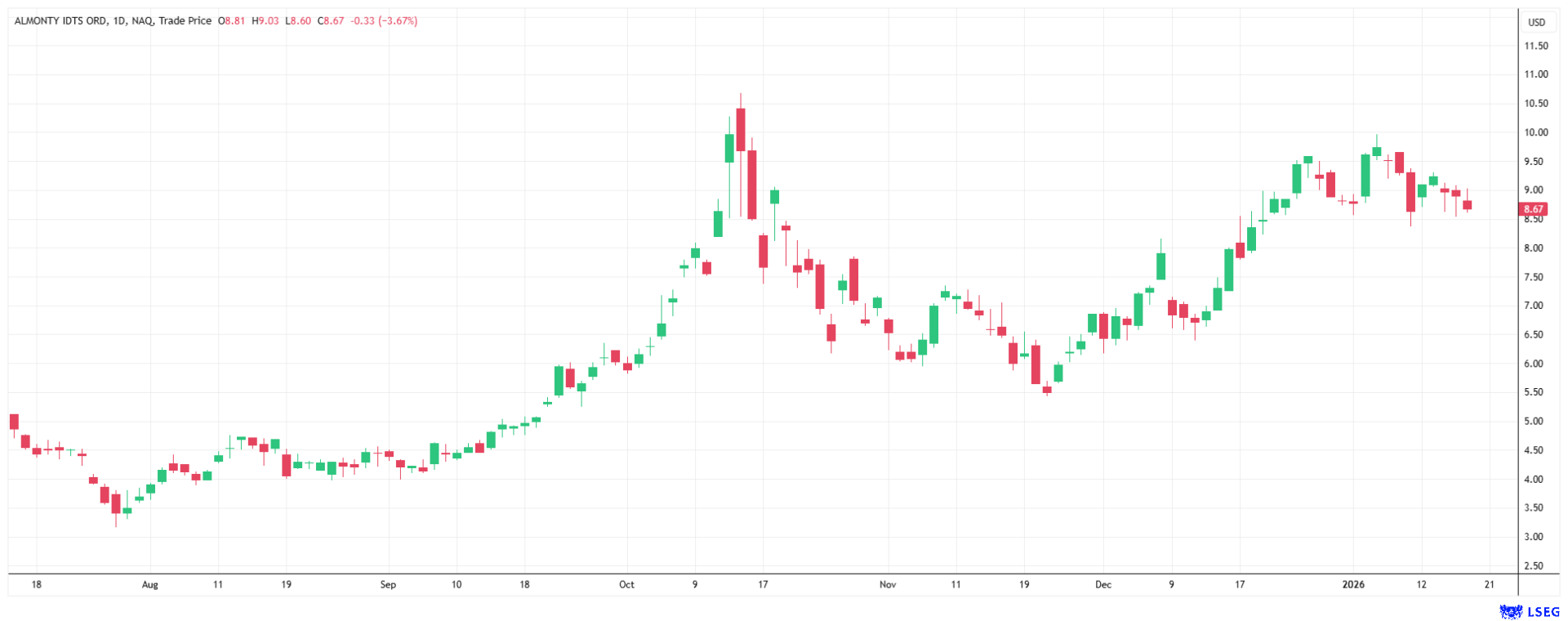
Almonty's strategic importance is underscored by the investment landscape. While the broader market is still asleep, investors such as the Plansee Group have already secured the material. For the fusion industry, Almonty is a decisive factor in ensuring that its reactors can be built even as geopolitical tensions increase, thanks to its activities in stable jurisdictions and the potential for capacity expansion at its mines. Almonty's stock thus offers a fantasy that goes far beyond the current tungsten market price of over USD 1,000: it is an option on the availability of a material that is essential for the energy supply of the 22nd century.
Chevron and Cenovus: The bridge to the future
The fact that fusion is no longer a distant science fiction fantasy is also demonstrated by the moves made by the major energy companies. Chevron, one of the most profitable oil companies in the world, is investing specifically in fusion startups through its venture capital division. The Company is using its massive cash flows from its core fossil fuel business to prepare for the future in terms of technology, among other things. Cenovus Energy is taking a similar approach: the Canadian oil producer is also investing in fusion startups and aims to commercialize the technology by mid-2030. The involvement of the oil industry validates the investment thesis surrounding the fusion-driven narrative for tungsten: when the oil industry invests in nuclear fusion startups, it is a clear indication of the likely increase in future demand for tungsten.
Conclusion: Almonty – also a bet on nuclear fusion
In summary, tungsten is facing a revaluation. It is transforming from an industrial metal to a technology metal. For Almonty Industries, the breakthrough in fusion research means that the addressable market volume could multiply in the long term. Investors who get in today are not just buying a mine, but an indispensable building block of the future energy architecture. While Chevron and Cenovus are building the bridge, Almonty is supplying the steel – or rather, the tungsten. At the end of this process, in one to two decades, there could be unlimited, clean energy – and substantial price gains for Almonty Industries shareholders. The stock has recently fallen back a little. For long-term investors, this could represent an opportunity.
Watch YouTube videoConflict of interest
Pursuant to §85 of the German Securities Trading Act (WpHG), we point out that Apaton Finance GmbH as well as partners, authors or employees of Apaton Finance GmbH (hereinafter referred to as "Relevant Persons") currently hold or hold shares or other financial instruments of the aforementioned companies and speculate on their price developments. In this respect, they intend to sell or acquire shares or other financial instruments of the companies (hereinafter each referred to as a "Transaction"). Transactions may thereby influence the respective price of the shares or other financial instruments of the Company.
In this respect, there is a concrete conflict of interest in the reporting on the companies.
In addition, Apaton Finance GmbH is active in the context of the preparation and publication of the reporting in paid contractual relationships.
For this reason, there is also a concrete conflict of interest.
The above information on existing conflicts of interest applies to all types and forms of publication used by Apaton Finance GmbH for publications on companies.
Risk notice
Apaton Finance GmbH offers editors, agencies and companies the opportunity to publish commentaries, interviews, summaries, news and the like on news.financial. These contents are exclusively for the information of the readers and do not represent any call to action or recommendations, neither explicitly nor implicitly they are to be understood as an assurance of possible price developments. The contents do not replace individual expert investment advice and do not constitute an offer to sell the discussed share(s) or other financial instruments, nor an invitation to buy or sell such.
The content is expressly not a financial analysis, but a journalistic or advertising text. Readers or users who make investment decisions or carry out transactions on the basis of the information provided here do so entirely at their own risk. No contractual relationship is established between Apaton Finance GmbH and its readers or the users of its offers, as our information only refers to the company and not to the investment decision of the reader or user.
The acquisition of financial instruments involves high risks, which can lead to the total loss of the invested capital. The information published by Apaton Finance GmbH and its authors is based on careful research. Nevertheless, no liability is assumed for financial losses or a content-related guarantee for the topicality, correctness, appropriateness and completeness of the content provided here. Please also note our Terms of use.