April 27th, 2026 | 07:45 CEST
No Security Without Drones: Volatus Aerospace, Helsing, and Rheinmetall Under Review
No drones, no security — that bluntly summarizes the strategic doctrine in today's geopolitical environment. Success in modern defense increasingly hinges on resilient supply chains and software sovereignty. Dependence on Chinese components is now widely seen as a critical vulnerability. As a result, new value chains are emerging. Software pioneers like Helsing are delivering the AI backbone for autonomous swarm technologies and securing billion-dollar contracts, while defense heavyweight Rheinmetall is rapidly scaling production for large-scale orders, including the FV-014 Kamikaze Drones. Meanwhile, Canadian drone veteran Volatus Aerospace is positioning itself as an indispensable partner that bridges the gap between civilian logistics and military readiness through its consistent "dual-use model." It is precisely this versatility that is considered crucial for scaling up even in peacetime.
time to read: 3 minutes | Author: Nico Popp
ISIN: VOLATUS AEROSPACE INC | CA92865M1023 | TSXV: FLT , OTCQB: TAKOF , RHEINMETALL AG | DE0007030009
Table of contents:
Author

Nico Popp
At home in Southern Germany, the passionate stock exchange expert has been accompanying the capital markets for about twenty years. With a soft spot for smaller companies, he is constantly on the lookout for exciting investment stories.
Tag cloud
Shares cloud
Canada Drives a Special Economic Boom
Since the new Canadian defense strategy is already allocating around 70% of procurement contracts to domestic suppliers this year, Volatus is securing the necessary industrial base and operational expertise for NATO allies. This should provide a favorable starting point for international collaborations in the future. A clear opportunity is opening up for investors. Volatus Aerospace not only supplies the systems but also the critical infrastructure and training related to drones, making these technologies deployable on an industrial scale worldwide. We examine the market and potential partners from Germany.
Helsing: Artificial Intelligence as the Brain of Autonomous Swarms
The technology company Helsing has rapidly established itself as a leading provider of software-defined defense. In modern warfare, it is not enough to simply offer superior hardware. Rather, unmanned systems must be capable of processing vast amounts of data in milliseconds during operations and making autonomous decisions. Helsing provides precisely the artificial intelligence that is essential, for example, for controlling autonomous drone swarms. By deeply integrating AI into existing platforms, the company gives Western armed forces an advantage that can circumvent enemy jamming measures. This technological edge is reflected in Helsing's order book—as evidenced by recently won billion-dollar contracts to upgrade European fighter jets and accompanying unmanned systems with AI. For the European defense architecture, Helsing has risen from a pure software supplier to an indispensable problem-solver.
Rheinmetall: Scaling Now Also for Drones
While Helsing excels with AI, the Düsseldorf-based defense conglomerate Rheinmetall delivers tangible solutions for the battlefield. The company is benefiting from the defense industry trend and the paradigm shift toward unmanned, responsive weapon systems. A key growth driver is so-called loitering munitions—intelligent kamikaze drones that circle over the target area, collect data, and can strike with precision when needed. According to recent media reports, Rheinmetall is currently ramping up production capacity for large orders of systems such as the FV-014 to meet the growing demand from NATO partners. To secure supply chains and achieve the necessary economies of scale, the company is investing billions in the expansion of new manufacturing facilities and recently reported a record order backlog of over EUR 38 billion. For conservative investors, Rheinmetall is a kind of core investment—the defense sector will continue to benefit from government demand for years to come. However, the stock is already expensive, and fragile supply chains remain a bottleneck for Rheinmetall.
Volatus Aerospace: The Bridge Builder in the Dual-Use Segment
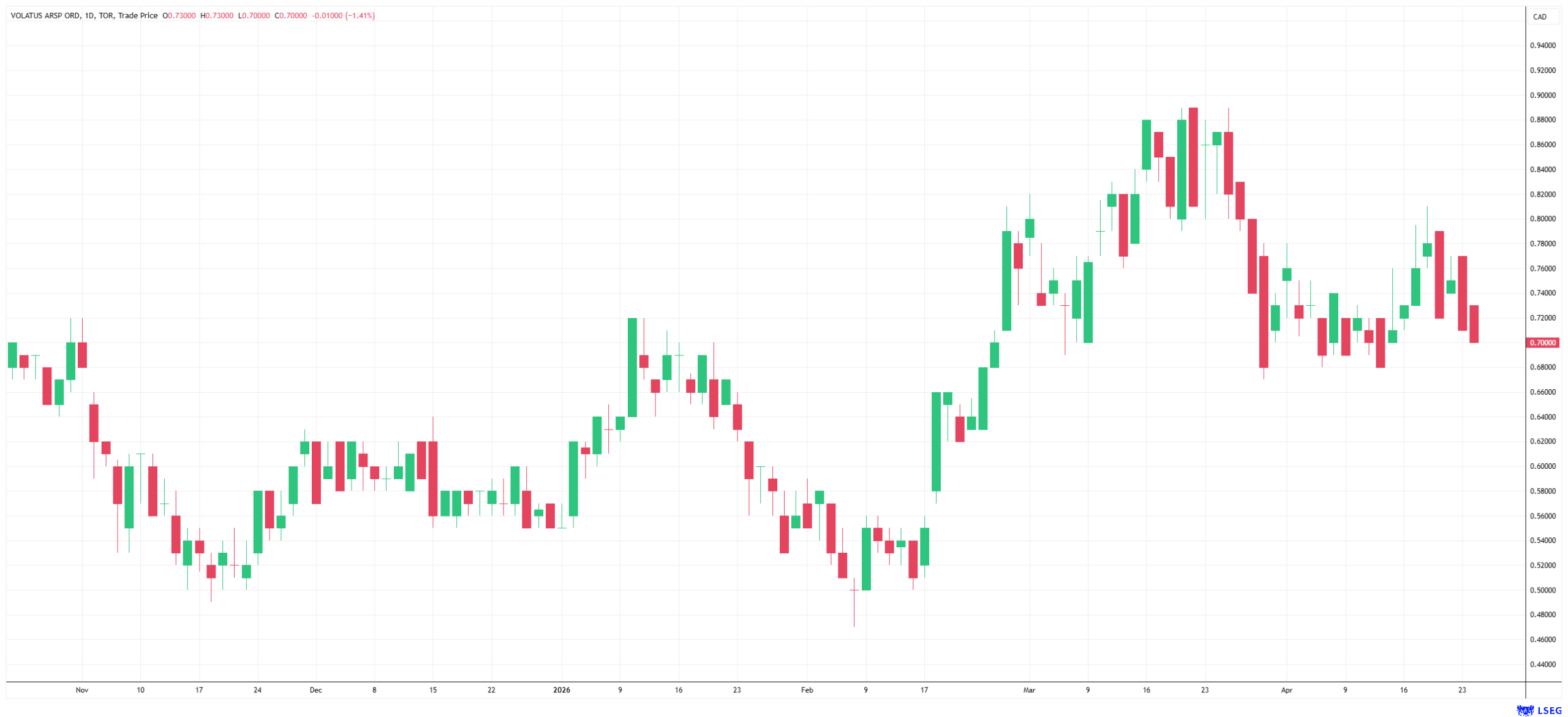
Volatus Aerospace operates right at the intersection of civilian innovation and military solutions. The Canadian company leverages its deep expertise in commercial drone logistics and adapts it to the defense sector—a classic dual-use approach. The broader political landscape plays into Volatus's hands: Canada's new defense strategy mandates that approximately 70% of procurement contracts must be awarded to domestic suppliers to strengthen North America's strategic autonomy. Volatus benefits directly from this government-mandated protectionism. The company not only supplies hardware free of Chinese components but also ensures operational readiness for NATO allies by establishing critical infrastructure and offering extensive training programs. Most recently, Volatus announced a training contract with a NATO country worth CAD 9.0 million. Thanks to the combination of in-house manufacturing and the management of complex drone missions, Volatus has secured an excellent position for future international defense cooperation.
Investment Opportunities in the Drone Supercycle
The market for unmanned systems has definitively evolved from a niche into one of the most important growth drivers in 2026. While investors remain sidelined from private tech unicorns like Helsing and established players such as Rheinmetall represent a more defensive investment with solid dividend characteristics, Volatus Aerospace offers a different profile. The company combines the dynamic growth of an emerging specialist with the relative stability of government-backed demand. This positioning is somewhat comparable to DroneShield a few years ago. For more speculative retail investors, Volatus Aerospace provides a form of leveraged exposure, as it covers the entire value chain, from production and integration of security systems to pilot training, positioning itself as a system integrator in a rapidly expanding market. Investors looking to gain early exposure to the drone megatrend may find this dual-use pioneer an intriguing opportunity.
Watch YouTube videoConflict of interest
Pursuant to §85 of the German Securities Trading Act (WpHG), we point out that Apaton Finance GmbH as well as partners, authors or employees of Apaton Finance GmbH (hereinafter referred to as "Relevant Persons") may hold shares or other financial instruments of the aforementioned companies in the future or may bet on rising or falling prices and thus a conflict of interest may arise in the future. The Relevant Persons reserve the right to buy or sell shares or other financial instruments of the Company at any time (hereinafter each a "Transaction"). Transactions may, under certain circumstances, influence the respective price of the shares or other financial instruments of the Company.
In addition, Apaton Finance GmbH is active in the context of the preparation and publication of the reporting in paid contractual relationships.
For this reason, there is a concrete conflict of interest.
The above information on existing conflicts of interest applies to all types and forms of publication used by Apaton Finance GmbH for publications on companies.
Risk notice
Apaton Finance GmbH offers editors, agencies and companies the opportunity to publish commentaries, interviews, summaries, news and the like on news.financial. These contents are exclusively for the information of the readers and do not represent any call to action or recommendations, neither explicitly nor implicitly they are to be understood as an assurance of possible price developments. The contents do not replace individual expert investment advice and do not constitute an offer to sell the discussed share(s) or other financial instruments, nor an invitation to buy or sell such.
The content is expressly not a financial analysis, but a journalistic or advertising text. Readers or users who make investment decisions or carry out transactions on the basis of the information provided here do so entirely at their own risk. No contractual relationship is established between Apaton Finance GmbH and its readers or the users of its offers, as our information only refers to the company and not to the investment decision of the reader or user.
The acquisition of financial instruments involves high risks, which can lead to the total loss of the invested capital. The information published by Apaton Finance GmbH and its authors is based on careful research. Nevertheless, no liability is assumed for financial losses or a content-related guarantee for the topicality, correctness, appropriateness and completeness of the content provided here. Please also note our Terms of use.