March 30th, 2026 | 08:25 CEST
NEO Battery Materials Charging Ahead – The New Performance Standard for the Energy of the Future
While the Iran conflict in the Middle East is unsettling the global economy, a much deeper shift in the balance of power is taking place on the global commodities market. The rivalry between the US and China, long marked by trade and technology wars, is now extending to energy supply and battery production. Beijing is restricting not only the export of rare earths but also the export of high-performance battery cells, forcing Western industries to reorganize their supply chains. The situation is particularly critical for batteries used in defense and drone technology, which are considered security-critical infrastructure. The general public's thinking is simple: with the constant rise in the cost of fossil fuels, the world faces a choice - accept expensive mobility or pursue self-sufficient development of renewable solutions! In this context, the Canadian-South Korean company NEO Battery Materials is making a strategic statement of technological independence.
time to read: 5 minutes | Author: André Will-Laudien
ISIN: NEO BATTERY MATERIALS LTD | CA62908A1003 | TSXV: NBM , OTC: NBMFF
Table of contents:
Author

André Will-Laudien
Born in Munich, he first studied economics and graduated in business administration at the Ludwig-Maximilians-University in 1995. As he was involved with the stock market at a very early stage, he now has more than 30 years of experience in the capital markets.
Tag cloud
Shares cloud
The Three Major Drivers of the Battery Revolution
In recent months, scientists and engineers have not hesitated to discuss publicly, and even debate, the future of energy storage systems. However, there is broad consensus on the technological approaches needed to improve current standards. In the trade press and relevant industry communications, three main technological approaches dominate the discussion on significantly increasing the performance of modern batteries. First, the use of silicon in the anode is considered one of the most promising avenues, as silicon can store many times more lithium than graphite, thereby enabling higher energy densities and faster charging cycles. Second, intensive research is being conducted on solid-state batteries, in which a solid electrolyte replaces the traditional liquid, aiming to achieve greater safety, longer ranges, and potentially longer service life. Third, manufacturers are focusing on improved cell architectures and software management, such as optimized cooling, more precise charging algorithms, and new production processes, to utilize existing chemistry more efficiently.
Silicon as a Lever for Efficiency and Range
Taken together, these three approaches demonstrate that the future of battery performance does not depend on a single innovation, but rather on the combination of materials science, engineering, and digital control technology. NEO Battery Materials' business model is based on the development and production of silicon-enhanced anode materials for lithium-ion batteries, which enable higher energy densities and faster charging cycles. This technology addresses a key bottleneck in modern energy systems, as range, charging time, and lifespan are increasingly determining the competitiveness of electric vehicles, drones, and robotic systems. Unlike traditional material suppliers, the company pursues a collaborative development approach in which products are designed to closely meet the requirements of industrial customers. This approach resembles the so-called "foundry principle" from the semiconductor industry, where customized solutions lead to long-term customer loyalty. At the same time, the patented silicon processing enables cost-effective integration into existing production lines, facilitating scaling and industrial implementation. Strategically, the company thus positions itself not as a niche provider, but as a technology platform for high-performance battery systems in high-growth industries.
Danny Huh, SVP of Strategy & Operations, explains the details of his strategic positioning and the company's medium-term growth strategy in an interview with IIF host Lyndsay Malchuk.
Current Projects: Industrial Production in South Korea as the Foundation for Global Expansion
The operational hub of NEO Battery Materials Ltd. is located in South Korea, one of the world's most important locations for battery production and industrial manufacturing. There, the company operates a production line that is already operating at an industrial scale and can be expanded to a capacity of approximately 500 megawatt-hours per year in the future. This facility forms the foundation for supplying growing markets such as drones, robotics, energy storage, and electric mobility. Particularly relevant is the ability to supply existing battery factories with new anode materials without major retrofits, which significantly accelerates market entry. In addition, the company has acquired a new industrial site to secure production capacity and supply capabilities in the long term. This creates an industrial infrastructure designed for growth not only technologically but also logistically. Within the universe of American growth stocks, NBM's approach can be described as "unique"!
Recent Developments: Military Partnership and OEM Accreditation as Operational Milestones
Recent developments show a clear shift in the company's profile from research toward industrial implementation and market penetration. Of particular significance is the strategic collaboration with the Association of the Republic of Korea Army (AROKA), which aims to jointly develop high-performance batteries for drones and robotic systems. The highlight of this deal: this partnership grants the company direct access to military procurement channels and increases the likelihood of long-term programs in the defense sector. Several weeks ago, the company was accredited as an official supplier to a global Fortune 500 automotive manufacturer after successfully meeting all technical and regulatory requirements. This status enables direct orders without intermediaries while simultaneously strengthening credibility with other industrial customers. From an operational perspective, these steps mark the transition from technology provider to recognized series supplier in demanding industries. The company benefits from a completely China-free supply chain, which is increasingly becoming a decisive selection criterion for government and industrial customers. From an analytical perspective, this creates new, structural demand driven not by market cycles but by geopolitical and security factors.
Outlook: Scaling Production and Entering Security-Critical Markets
NEO Battery Materials Ltd.'s medium-term growth path is largely determined by the scaling of production capacities and integration into security-relevant applications. New clusters of demand are currently emerging, particularly in the defense and drone sectors, as modern systems rely on high-performance energy storage solutions. Initial field tests have already demonstrated a significant increase in flight time compared to conventional battery solutions, confirming the technology's practical performance under real-world conditions. At the same time, the civilian market for robotics, industrial electronics, and autonomous systems is growing at double-digit rates, creating additional sales channels. The combination of industrial production readiness and growing demand creates a solid foundation for revenue growth in the coming years. Should additional major customers follow, the company could quickly become a key component of the global battery value chain.
Conclusion: A strategic technology provider at the heart of the new energy and security architecture
NEO Battery Materials combines technological innovation, industrial manufacturing, and geopolitical relevance in a single business model. The ability to upgrade existing battery systems with higher-performance materials creates immediate economic benefits for customers while simultaneously reducing barriers to market entry. At the same time, the growing importance of drones, robotics, and electromobility ensures long-term growth in demand for high-performance energy storage solutions. The company is in a phase where operational progress can be translated into scalable business models for the first time. As in any technology-driven industry, competitive pressures and technological risks remain and must be closely monitored. Nevertheless, from a strategic perspective, an attractive growth profile emerges, driven by structural trends in energy, mobility, and security.
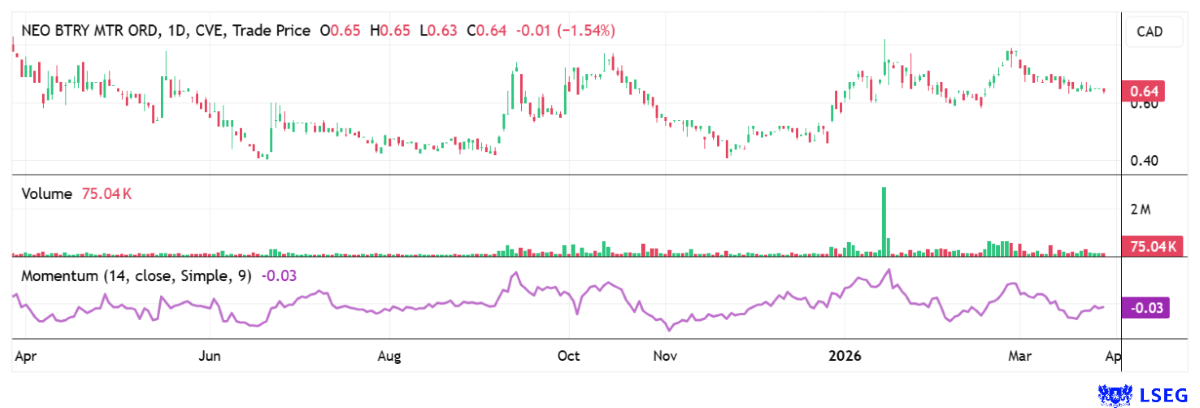
Combined with a still-moderate valuation, this creates an investment case that could still deliver major surprises in 2026. With ongoing uncertainty surrounding fossil fuels, high-performance batteries are becoming strategic infrastructure, and NEO, with a current market capitalization of just over EUR 60 million, is part of a multi-billion-euro market. The company is now captivating investors with a medium-term focus who can think beyond the current crisis and build positions with foresight. A small spark could therefore set off a massive fireworks display for NEO at any time!
Conflict of interest
Pursuant to §85 of the German Securities Trading Act (WpHG), we point out that Apaton Finance GmbH as well as partners, authors or employees of Apaton Finance GmbH (hereinafter referred to as "Relevant Persons") currently hold or hold shares or other financial instruments of the aforementioned companies and speculate on their price developments. In this respect, they intend to sell or acquire shares or other financial instruments of the companies (hereinafter each referred to as a "Transaction"). Transactions may thereby influence the respective price of the shares or other financial instruments of the Company.
In this respect, there is a concrete conflict of interest in the reporting on the companies.
In addition, Apaton Finance GmbH is active in the context of the preparation and publication of the reporting in paid contractual relationships.
For this reason, there is also a concrete conflict of interest.
The above information on existing conflicts of interest applies to all types and forms of publication used by Apaton Finance GmbH for publications on companies.
Risk notice
Apaton Finance GmbH offers editors, agencies and companies the opportunity to publish commentaries, interviews, summaries, news and the like on news.financial. These contents are exclusively for the information of the readers and do not represent any call to action or recommendations, neither explicitly nor implicitly they are to be understood as an assurance of possible price developments. The contents do not replace individual expert investment advice and do not constitute an offer to sell the discussed share(s) or other financial instruments, nor an invitation to buy or sell such.
The content is expressly not a financial analysis, but a journalistic or advertising text. Readers or users who make investment decisions or carry out transactions on the basis of the information provided here do so entirely at their own risk. No contractual relationship is established between Apaton Finance GmbH and its readers or the users of its offers, as our information only refers to the company and not to the investment decision of the reader or user.
The acquisition of financial instruments involves high risks, which can lead to the total loss of the invested capital. The information published by Apaton Finance GmbH and its authors is based on careful research. Nevertheless, no liability is assumed for financial losses or a content-related guarantee for the topicality, correctness, appropriateness and completeness of the content provided here. Please also note our Terms of use.